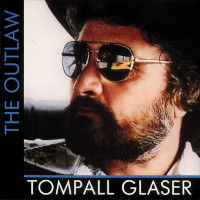
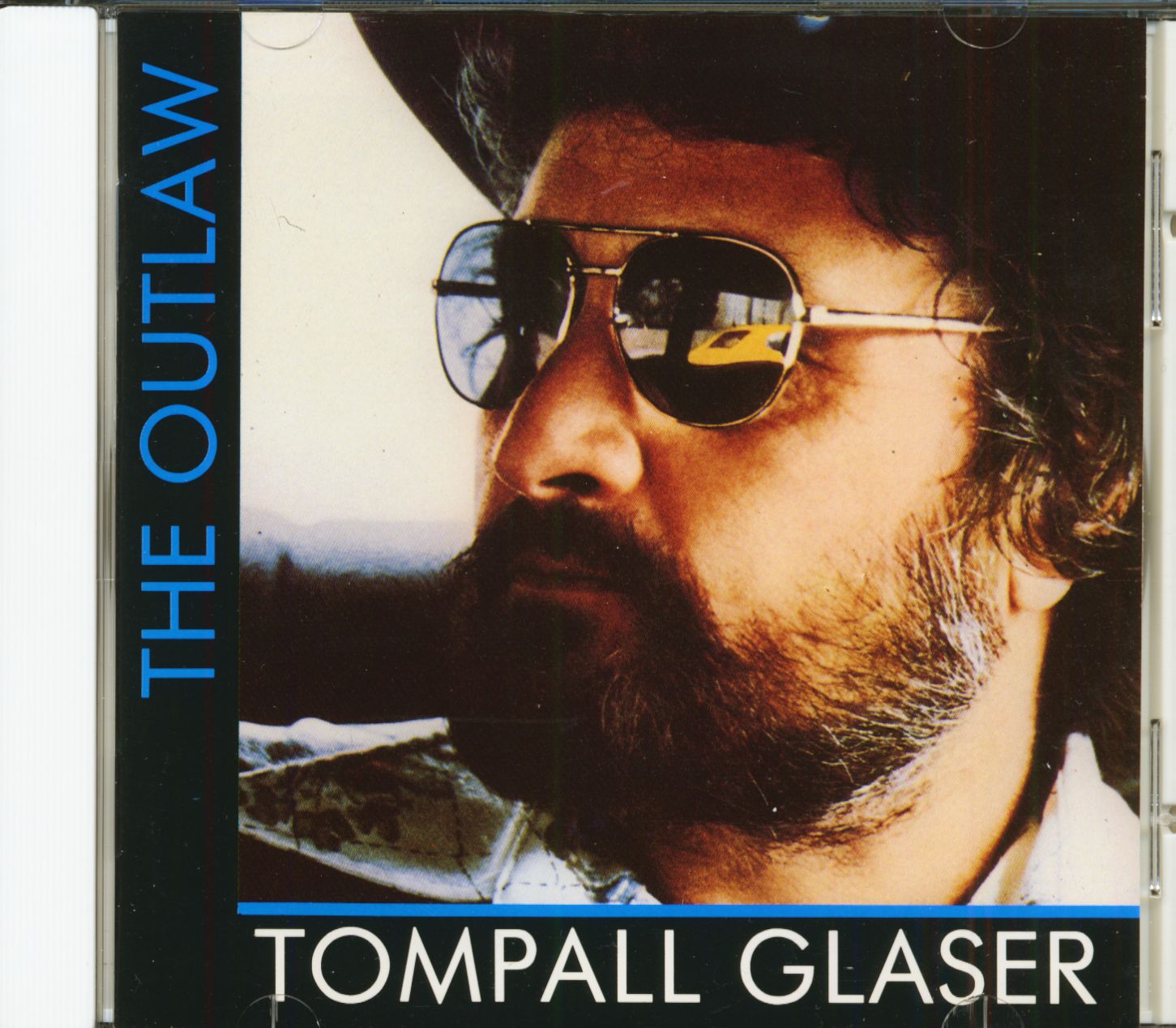
Tompall Glaser The Outlaw (CD)


* incl. VAT / plus shipping costsDepending on the country of delivery, the VAT at checkout may vary.
Ready to ship today,
delivery time** appr. 1-3 workdays
- catalog number:BCD15605
- weight in Kg 0.115
Tompall Glaser: The Outlaw (CD)
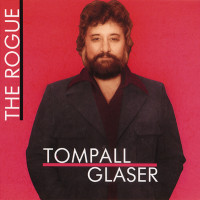
Of all the Outlaws who envigorated mainstream country music in the Seventies, Tompall Glaser was the most dangerous as far as the Nashville status quo was concerned. Thanks to his success as the senior member of the trio the Glaser Brothers, the Glasers ran Hillbilly Central, a recording studio on Nineteenth Avenue South in Nashville. He was a self-contained performer and producer, someone who could thrive in Nashville without Nashville's usual constraints, and that's what made him most worrisome to the city music establishment's perennial powers.
Glaser was born in Spalding, Nebraska, on September 3, 1933. Glaser remembers that the first songs he learned on guitar were Ernest Tubb tunes, and he soon was able to replicate Jimmy Short's legendary terse, slangy six-string figures. A budding lead guitarist needs a band, and Tompall turned to his siblings. By his late teens, along with his brothers Chuck and Jim (he has two other brothers, Bob and Jack, and a sister, Eleanor), Tompall was performing regularly around the area, playing a mixture of folk and country music, but with a definite country leaning. By this time, the family home had finally been electrified, and Carter Family, Vernon Dalhart, Riley Puckett and Jimmie Rodgers were regulars on the house Victrola. "The Carter Family recordings inspired our group," Tompall told Dixie Deen in 1967. "
That was later on. In the beginning, I didn't know we were going to have a group and I was going to be a soloist. I started out admiring people like Eddy Arnold, Ernest Tubb, and Gene Autry."
Tompall did some time for Uncle Sam in Germany. By the time he returned and re-energized the group in 1957, the trio was popular enough to land themselves a regular gig on KHAS-TV in Hastings, Nebraska. In August 1957, they won an audition for the Arthur Godfrey Show and were soon noticed by Marty Robbins, who heard them cover his A White Sport Coat (And a Pink Carnation), then sitting comfortably atop 'Billboard's' country chart. Robbins was impressed by how close their harmonies mirrored those on his record (this was no accident - the trio had meticulously prepared for what was presented as an impromptu audition) and promptly hired them to back him up on stage.
The star signed the Glaser Brothers to his own label, Robbins Records, and within a year sold the contract to Decca. Now billed as Tompall and the Glaser Brothers, they moved to Nashville in early 1959 and worked with producer Owen Bradley. Around the same time they outgrew Marty Robbins's stage band, when it was Chuck's turn to give the U.S. Army two years of his life. During this time, their friend Joe Babcock, who had also replaced Tompall during his military stint, completed the trio. The Glasers, both with and without Joe Babcock, can also be heard in support of Hank Snow on his better recordings from the early '60s. Their work with Snow clearly eclipses the more saccharine backings of the Anita Kerr Singers.
It was hard to pigeonhole the reunited Glaser Brothers in the early Sixties. Their live shows concentrated on country, though their Decca album, `This Land,' was clearly geared (at Owen Bradley's direction) toward the folk audience. It's no accident that during that period they toured with Johnny Cash, a towering perfomer also straddling folk and country. In a 1967 interview, Glaser emphasized the importance of Cash to his career. He said that although the Brothers had long since left Robbins's tutelage, "we had the reputation of being just a backing group, and we were dependent on what work we could get on recording sessions.
We had all borrowed all we could from the band and we were at our lowest ebb. Then, one day, Johnny Cash called the Jordanaires, asking them to tour with him. Gordon Stoker told him that they didn't work out of the town and recommended us. Well, Johnny called us and we went to work for him. He kept telling us that we should be an individual act and he kept pushing us out in front until we were doing more by ourselves than we were backing. He took us to Carnegie Hall and to Las Vegas. Thanks to Johnny Cash, the rest of Nashville grew to recognize us as an act."
The Decca years brought little chart success to Tompall, Chuck, and Jim, the low point was probably a promotional tour in which the Brothers were embarrassed to be pantomiming their records before what Tompall called "a bunch of nine-year-olds who were looking at us knowing we weren't singing and thinking what a bunch of idiots we were." Their luck changed when they moved to MGM in 1965. Under the stewardship of an assertive producer, the boisterous Sun Records alumnus Jack Clement, they chalked up some country chart success, as well as one minor pop hit, California Girl (And The Tennessee Square).
Article properties:Tompall Glaser: The Outlaw (CD)
Interpret: Tompall Glaser
Album titlle: The Outlaw (CD)
Genre Country
Label Bear Family Records
- Preiscode AH
Artikelart CD
EAN: 4000127156051
- weight in Kg 0.115
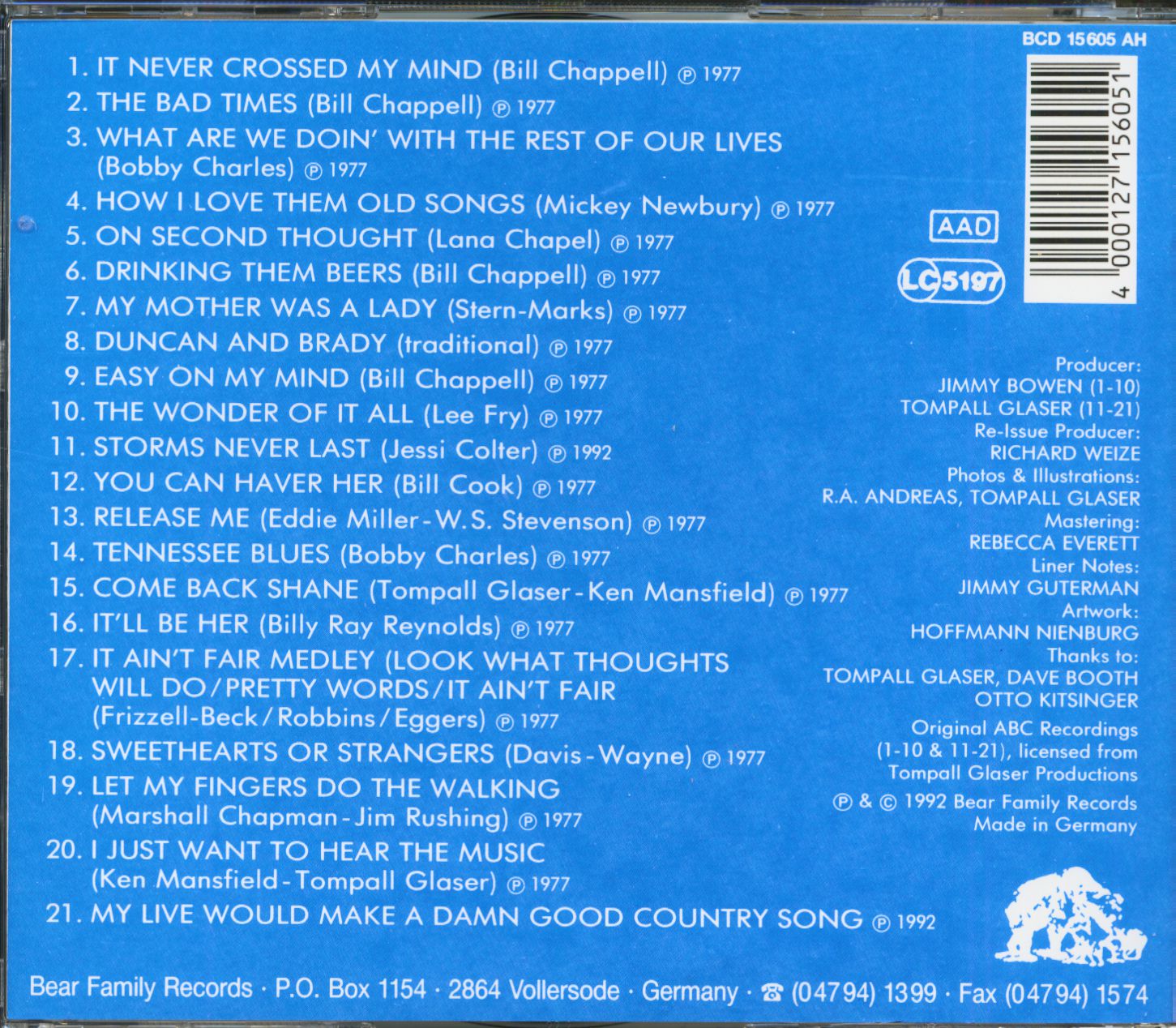
| Glaser, Tompall - The Outlaw (CD) CD 1 | ||||
|---|---|---|---|---|
| 01 | It Never Crossed My Mind | Tompall Glaser | ||
| 02 | The Bad Times | Tompall Glaser | ||
| 03 | What Are We Doin' With The Rest Of Our Lives | Tompall Glaser | ||
| 04 | How I Love Them Old Songs | Tompall Glaser | ||
| 05 | On Second Thought | Tompall Glaser | ||
| 06 | Drinking Them Beers | Tompall Glaser | ||
| 07 | My Mother Was A Lady | Tompall Glaser | ||
| 08 | Duncan And Brady | Tompall Glaser | ||
| 09 | Easy On My Mind | Tompall Glaser | ||
| 10 | The Wonder Of It All | Tompall Glaser | ||
| 11 | Storms Never Last/You Can Have Her | Tompall Glaser | ||
| 12 | Release Me | Tompall Glaser | ||
| 13 | Tennessee Blues | Tompall Glaser | ||
| 14 | Come Back Shane | Tompall Glaser | ||
| 15 | It'll Be Her | Tompall Glaser | ||
| 16 | [It Ain't Fair Medley: | Tompall Glaser | ||
| 17 | Look What Thoughts Will Do | Tompall Glaser | ||
| 18 | Pretty Words | Tompall Glaser | ||
| 19 | It Ain't Fair] | Tompall Glaser | ||
| 20 | Sweethearts Or Strangers | Tompall Glaser | ||
| 21 | Let My Fingers Do The Walking | Tompall Glaser | ||
| 22 | I Just Want To Hear The Music | Tompall Glaser | ||
| 23 | My Live Would Make A Damn Good Country Song | Tompall Glaser | ||
Tompall and the Glaser Brothers
Gone Girl
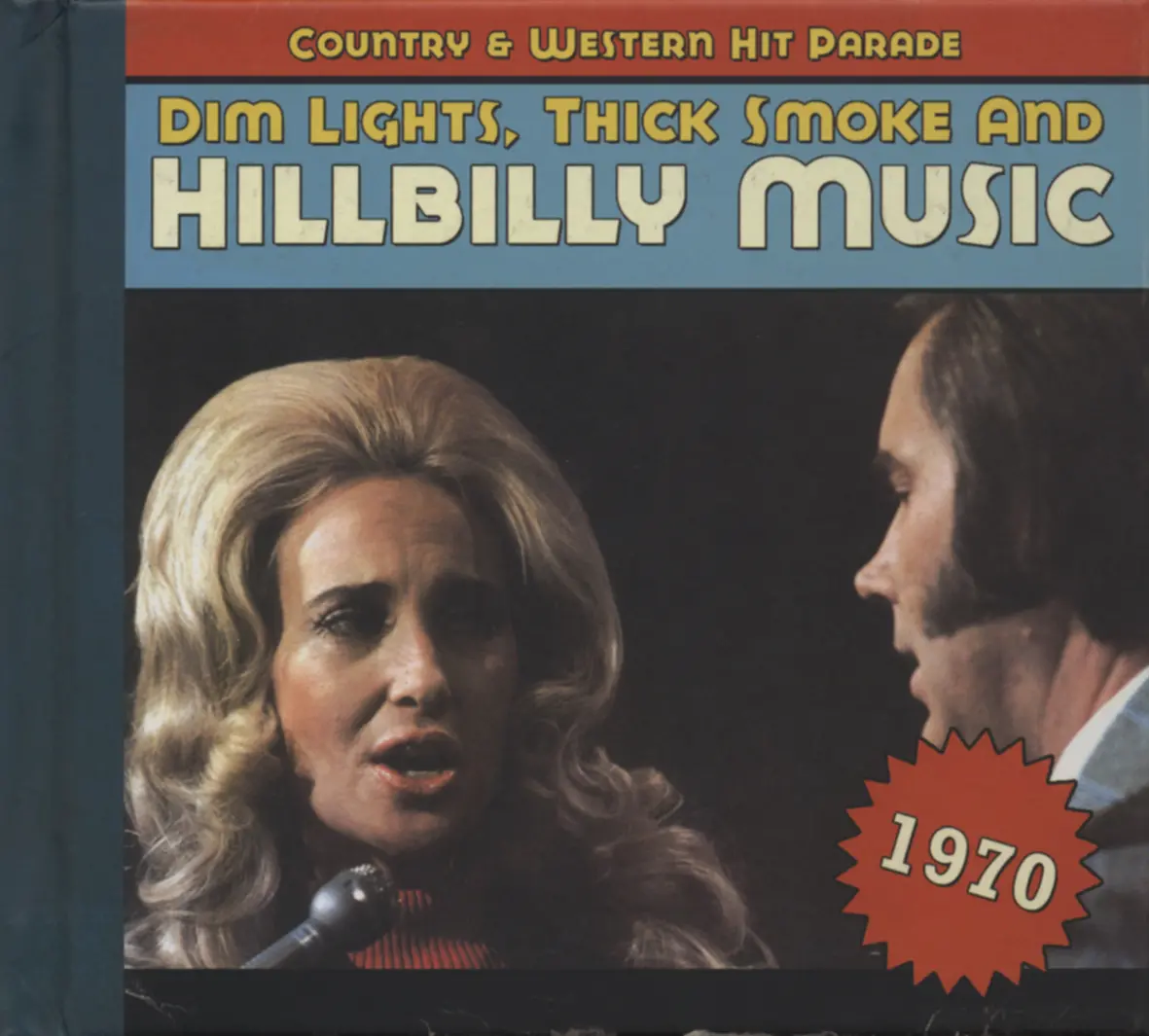
Tompall and the Glaser Brothers
Gone Girl
(Jack Clement)
recorded May 21, 1970; Nashville, Tennessee
with Thomas Paul (Tompall) Glaser, Charles 'Chuck' Glaser, Jim Glaser: vocal; other details unknown
MGM K 14169 - master 70N 51 142
Marty Robbins hatte die Glaser-Brüder in Nebraska gefunden und sie nach Nashville gebracht, weil er den Gesang der engen Harmonie liebte. Tompall, Chuck und Jim Glaser hatten seit 1957 mit sehr wenig Erfolg aufgenommen. Ihr erster Vertrag war bei Robbins Records, bevor Owen Bradley sie als Deccas Antwort auf das Kingston Trio aufnahm. Die Glasers haben sich nicht selbst geholfen, indem sie Streets Of Baltimore, Gentle On My Mind, Sittin' In An All-Night Café und Woman, Woman geschrieben oder veröffentlicht haben, ohne auch nur einen dieser Hits für sich zu behalten.
Jack Clement unterzeichnete sie bei MGM, für die er bereits die Stonemans produzierte. Auf ihren Aufnahmen konnte Clement alle Elemente hinzufügen, die bei seinen Charley Pride-Produktionen tabu waren: Marimbas, Latin Percussion und Mock-Mariachi-Hörner. Beim Schreiben Gone Girl, Clement setzte sich die fast unmögliche Aufgabe der Suche nach sieben Zeilen zu reimen mit gegangen Mädchen. Die Tatsache, dass die Reime nur Assonanz (d.h. reimende Vokale) teilen, scheint nicht sehr wichtig zu sein, weil das Lied so einnehmend ist. Wirbelnd und romantisch, deutet es auf Clements Hintergrund im Gesellschaftstanz hin. Der Erfolg der Glaser mit Clement an der Spitze brachte ihnen einige verspätete Anerkennung ein, darunter die Auszeichnung der CMA Vocal Group of the Year 1970. Richtig, es war eine niedrige Wettbewerbskategorie (1969 haben sich Johnny Cash und June Carter irgendwie qualifiziert und gewonnen). Clement hat Gone Girl auf seinem 1978er Elektra-Album'All I Want To Do In Life' wiederverwendet und es wurde der Titelsong einer 1982er Cash-LP.
- Colin Escott -
Various Country & Western Hit Parade 1970
Read more at: https://www.bear-family.de/various-country-und-western-hit-parade-1970.html
Copyright © Bear Family Records
Ready to ship today, delivery time** appr. 1-3 workdays

Ready to ship today, delivery time** appr. 1-3 workdays

Ready to ship today, delivery time** appr. 1-3 workdays
Ready to ship today, delivery time** appr. 1-3 workdays

Item has to be restocked

Ready to ship today, delivery time** appr. 1-3 workdays

Ready to ship today, delivery time** appr. 1-3 workdays

This article is deleted and can no longer be ordered!
Ready to ship today, delivery time** appr. 1-3 workdays
Ready to ship today, delivery time** appr. 1-3 workdays

Ready to ship today, delivery time** appr. 1-3 workdays
Ready to ship today, delivery time** appr. 1-3 workdays

Ready to ship today, delivery time** appr. 1-3 workdays

Item has to be restocked

Ready to ship today, delivery time** appr. 1-3 workdays

only 2x still available
Ready to ship today, delivery time** appr. 1-3 workdays