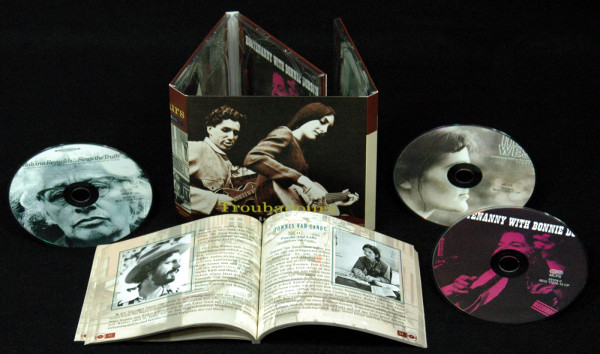
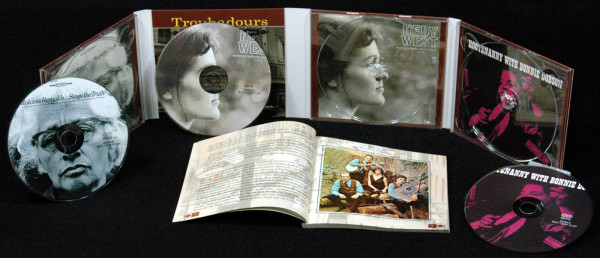
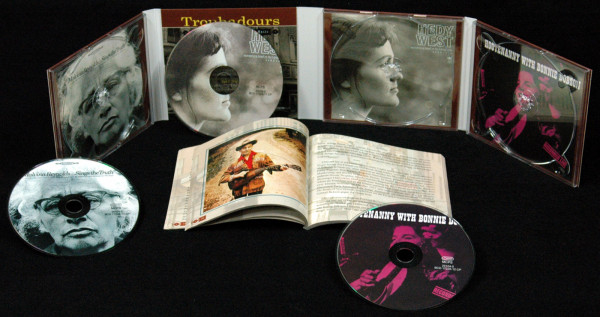
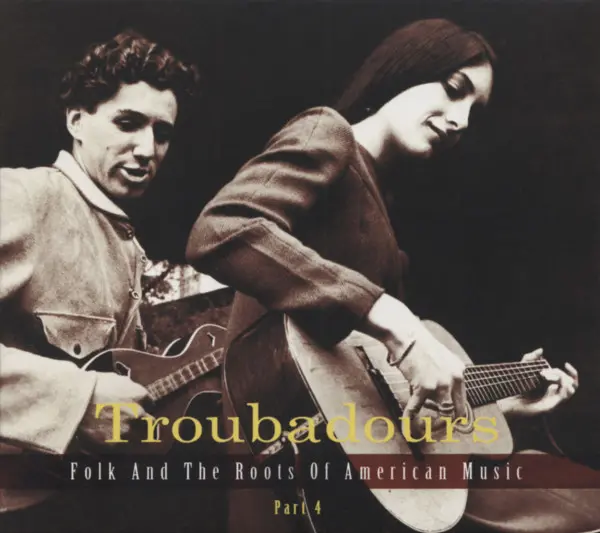
Various - Troubadours Teil 4, Folk und die Wurzeln amerikanischer Musik (3-CD)
* incl. VAT / plus shipping costsDepending on the country of delivery, the VAT at checkout may vary.
Ready to ship today,
delivery time** appr. 1-3 workdays
Various - Troubadours: Teil 4, Folk und die Wurzeln amerikanischer Musik (3-CD)
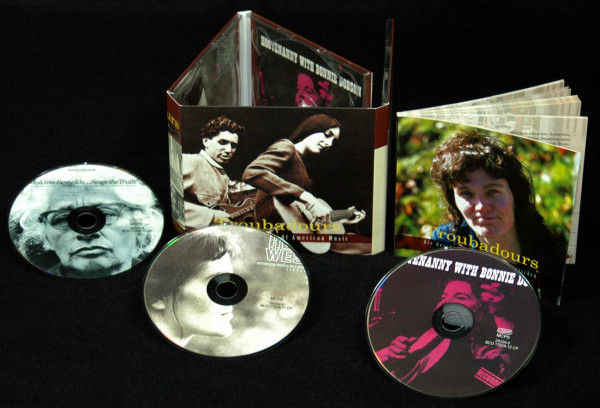
3-CD Digipak mit 140-seitigem Booklet, 80 tracks. Gesamtspieldauer ca. 257 Minuten
Die Westküste
Das Folk-Musik-Revival und die Singer-Songwriter-Bewegung an der Westküste konzentrierten sich auf Los Angeles und San Francisco. Sie bekamen den ersten wichtigen Schub mit der Gründung des People's Songs-Büros in Los Angeles 1945. Pete Seegers Vision wurde dort durch den Folksänger Earl Robinson realisiert. Schnell schlossen sich Kreative aus allen Bereichen an (Songs von Earl Robinson und ein detaillierter Abriss von People's Songs finden sich in der ersten Troubadours-Box, BCD 17225). In Los Angeles waren auch die Independent-Plattenlabel Charter Records und Capitol beheimatet. Charter versorgte die People's Songs Anhänger mit Veröffentlichungen von Pete Seeger, Morry Goodson, Sonny Vale und dem Calypso-Veteranen Sir Lancelot. Capitol hingegen hatte Merle Travis, Jack Guthrie, Tennessee Ernie Ford, und später dann das Kingston Trio. In San Francisco begann die lange Reihe von Folkies mit Malvina Reynolds.
Auch Reynolds hatte ihren Start dem überall vernetzten und vertretenen Pete Seeger zu verdanken. Seeger ermutigte sie, eigene Lieder zu schreiben, die sie im Umfeld von People's Songs aufführte. Ihre pointierten satirischen Lieder wurden zu Klassikern des Folk-Revivals. People's Songs wurde zwar 1949 schon wieder dicht gemacht, aber die Basis für eine vielfältige und dauerhafte Folk-Szene war geschaffen. Der Erfolg bei einem breiteren Publikum ließ auch nicht lange auf sich warten: Terry Gilkyson hatte mit dem folkigen The Cry Of The Wild Goose 1947 einen großen Hit. Gilkyson war kurz zuvor aus dem fernen Pennsylvania nach Los Angeles gekommen. Sein Song wurde vielfach gecovert und war einer der ersten 'Cross-Over-Songs'. Frankie Laines Pop-Version für Mercury war 1951 ein Chart-Topper. Gilkyson hatte aber auch selber Pop-Erfolg: Zusammen mit den Weavers nahm er On Top Of Old Smokey auf und kam bis auf Platz zwei der Pop-Charts.
1955 wurde er Mitglied der Folk-Gruppe the Easy Riders (BCD 17225). Er war Co-Autor des Riders-Klassikers Memories Are Made Of This. Als Dean Martin den Song coverte, holte er sich die Easy Riders als Hintergrundsänger ins Studio. Die Single kam auf Platz eins der Pop-Charts. Für sein American Recordings-Album 'Unchained', nahm Johnny Cash den Song mit Tom Petty & The Heartbreakers auf und holte ihn somit in den Kanon der Americana-Bewegung und ins 21. Jahrhundert.
Der Folk der Westküste war also massentauglich und pop-kompatibel. Dasselbe galt auch für den modernen Jazz. Verglichen mit dem Folk der New Yorker Boheme-Kultur und Beatnik-Szene, die sich gerne existentialistisch schwarz kleidete und düster gab, kam der West Coast-Sound sonnig und fröhlich daher. Das lag natürlich nicht nur am Wetter: Viele der Musiker und Komponisten waren eng mit der Unterhaltungsindustrie in Hollywood verbunden oder arbeiteten gar als Schauspieler, Autoren oder Komponisten. Verwertbarkeit und Erfolg wurden in Los Angeles nicht verteufelt – sie waren Alltag. Künstler wie Rod McKuen, Mason Williams, Mike Settle, Travis Edmonson, Van Dyke Parks und John Stewart waren herausragende Komponisten und Texter. Als Bob Dylan 1962 an der Ostküste Fuß fasste, hatten jene Künstler schon lange etablierte Karrieren.
Video von Various - Troubadours - Teil 4, Folk und die Wurzeln amerikanischer Musik (3-CD)
Article properties:Various - Troubadours: Teil 4, Folk und die Wurzeln amerikanischer Musik (3-CD)
Artist: Various - Troubadours
Album titlle: Teil 4, Folk und die Wurzeln amerikanischer Musik (3-CD)
Genre Country
Label Bear Family Records
- Preiscode CP
- Edition 2 Deluxe Edition
Artikelart CD
EAN: 5397102172281
- weight in Kg 0.25
| Various - Troubadours - Teil 4, Folk und die Wurzeln amerikanischer Musik (3-CD) CD 1 | ||||
|---|---|---|---|---|
| 01 | Love's Been Good To Me | Rod Mckuen | ||
| 02 | Seasons In The Sun | Rod Mckuen | ||
| 03 | Long Time Gone | Mason Williams | ||
| 04 | The Times I've Had | Mark Spoelstra | ||
| 05 | She's Gone | Mark Spoelstra | ||
| 06 | Five And Twenty Questions | Mark Spoelstra | ||
| 07 | If I Were Free | Dian James | ||
| 08 | He Was A Friend Of Mine | Dian James | ||
| 09 | Little Boxes | Malvina Reynolds | ||
| 10 | Pack Up Your Sorrows (Acoustic Version) | Richard Fariña & Mimi | ||
| 11 | The Falcon | Richard Fariña & Mimi | ||
| 12 | Birmingham Sunday | Richard Fariña & Mimi | ||
| 13 | Bold Marauder | Richard Fariña & Mimi | ||
| 14 | A Swallow Song | Richard Fariña & Mimi | ||
| 15 | Hickory Wind | Byrds | ||
| 16 | Tried So Hard | Gene Clark | ||
| 17 | Train Leaves Here This Morning | Dillard And Clark Expedition | ||
| 18 | Once I Was | Tim Buckley | ||
| 19 | July, You're A Woman | John Stewart | ||
| 20 | California Bloodlines | John Stewart | ||
| 21 | One (Is A Lonely Number) | Harry Nilsson | ||
| 22 | Rainmaker | Harry Nilsson | ||
| 23 | Joanne | Michael Nesmith | ||
| 24 | Calico Girl Friend | Michael Nesmith | ||
| 25 | Take Me Home, Country Roads | John Denver | ||
| 26 | Rocky Mountain High | John Denver | ||
| 27 | Back Home Again | John Denver | ||
| Various - Troubadours - Teil 4, Folk und die Wurzeln amerikanischer Musik (3-CD) CD 2 | ||||
|---|---|---|---|---|
| 01 | The Battle Of New Orleans | Jimmie Driftwood | ||
| 02 | Tennessee Stud | Jimmie Driftwood | ||
| 03 | What Color Is The Soul Of A Man | Jimmie Driftwood | ||
| 04 | Rain And Snow | Obray Ramsey | ||
| 05 | 500 Miles | Hedy West | ||
| 06 | Cotton Mill Girls | Hedy West | ||
| 07 | The L&N Don't Stop Here Anymore | Jean Ritchie | ||
| 08 | Blue Diamond Mines | Jean Ritchie | ||
| 09 | Black Waters | Jean Ritchie | ||
| 10 | Coal Tattoo | Billy Edd Wheeler | ||
| 11 | Blistered | Billy Edd Wheeler | ||
| 12 | Jackson | Billy Edd Wheeler | ||
| 13 | High Flying Bird | Billy Edd Wheeler | ||
| 14 | Gentle On My Mind | John Hartford | ||
| 15 | Natural To Be Gone | John Hartford | ||
| 16 | California Earthquake | John Hartford | ||
| 17 | Steamboat Whistle Blues | John Hartford | ||
| 18 | How I Love Them Old Songs | Mickey Newbury | ||
| 19 | Sweet Memories | Mickey Newbury | ||
| 20 | Mr Bojangles | Jerry Jeff Walker | ||
| 21 | Pancho And Lefty | Townes Van Zandt | ||
| 22 | Seven Bridges Road | Steve Young | ||
| 23 | Brand New Tennessee Waltz | Jesse Winchester | ||
| 24 | Yankee Lady | Jesse Winchester | ||
| 25 | Me And Bobby Mcgee | Kris Kristofferson | ||
| 26 | Help Me Make It Through The Night | Kris Kristofferson | ||
| 27 | Casey's Last Ride | Kris Kristofferson | ||
| Various - Troubadours - Teil 4, Folk und die Wurzeln amerikanischer Musik (3-CD) CD 3 | ||||
|---|---|---|---|---|
| 01 | Settle Down | Mike Settle | ||
| 02 | Sing Hallelujah | Mike Settle | ||
| 03 | Greenback Dollar | Hoyt Axton | ||
| 04 | Thunder 'n' Lightnin' | Hoyt Axton | ||
| 05 | Blues Around My Head | Bob Gibson | ||
| 06 | Where I'm Bound | Bob Gibson | ||
| 07 | Daddy Roll 'em | Gibson, Bob & Camp, Hamilton (Bob) | ||
| 08 | Good Time Charlie | Spider John Koerner | ||
| 09 | The Unicorn | Shel Silverstein | ||
| 10 | Bury Me In My Shades | Shel Silverstein | ||
| 11 | Sam Stone | John Prine | ||
| 12 | Angel From Montgomery | John Prine | ||
| 13 | Paradise | John Prine | ||
| 14 | Souvenirs | John Prine | ||
| 15 | City Of New Orleans | Steve Goodman | ||
| 16 | Four Strong Winds | Ian & Sylvia | ||
| 17 | You Were On My Mind | Ian & Sylvia | ||
| 18 | Some Day Soon | Ian & Sylvia | ||
| 19 | Summer Wages | Ian & Sylvia | ||
| 20 | For Loving Me | Gordon Lightfoot | ||
| 21 | Early Morning Rain | Gordon Lightfoot | ||
| 22 | Did She Mention My Name? | Gordon Lightfoot | ||
| 23 | Morning Dew | Bonnie Dobson | ||
| 24 | Snowbird | Maclellan, Gene & Doucette, Blair | ||
| 25 | Put Your Hand In The Hand | Gene Maclellan | ||
| 26 | Both Sides Now | Joni Mitchell | ||
Troubadours
The history of the American singer-songwriters
Jackson Browne, Bob Dylan, Carole King, Joni Mitchell and James Taylor are usually cited as the founders of the contemporary singer-songwriter movement in America. The American songwriting tradition, however, goes back to the middle of the 19th century. It is deeply rooted in Anglo-Celtic ballads, Protestant revival hymns, African-American spirituals and work songs, and the minstrel and medicine shows. In addition, the English and American Romantics of the 18th and 19th centuries supplied ideas and role models for many of today's songwriters.
The experiences and energy of a young, motley nation in search of an identity provided the cultural backdrop for a rich folklore. Until the end of the First World War, the USA was essentially an agricultural nation, in places very sparsely populated. Folk songs were an ever-present part of daily life. They not only eased loneliness and monotonous work and offered relaxation during what were rather short evenings off, but also carried news as well as social and religious norms into remote areas. The close link between folklore and everyday life also helped to form a distinct American voice, as a new variant of the English language. In the later 19th century, individual pioneers began to draw on the folk pool for commercial and political purposes. Truly pioneering work was done, for example, by the Hutchinson Family from Milford, New Hampshire. They toured the United States with sacred and secular songs and often provided the musical backdrop for populist rallies. In the years before the First World War, the left-wing activists Joe Hill and Ralph Chaplin fashioned sardonic anthems for the Industrial Workers of the World out of traditional songs and hymns.
In the early twenties, Virginia-born Bentley Ball gave song recitals of Appalachian ballads, cowboy songs and even musical examples from some Native American tribes to fascinated urban audiences. From 1918 to 1920 he was the first to record folk standards such as Jesse James and The Dying Cowboy. Marion Try Slaughter, a Texas-born operetta singer who performed under the name Vernon Dalhart, recorded versions of The Wreck Of The Southern 97 and The Prisoner's Song four years later, heralding a new way of handling old material. Though by no means authentic, they caught the public's ear and sold several hundred thousand copies.
The minstrel tradition arose in the American South in the 1830s and had a lasting influence on various roots music styles. In the minstrel shows, white musicians imitated and caricatured black music, culture and speech. To conform to the racist norms of the time, they had to black up their faces. Ironically, the music being imitated was itself an imitation of the Irish-Scottish fiddle dance music of the day. Over time, the Celtic melodies and rhythms blended with African rhythms and styles of interpretation, and an increasingly distinctive American music emerged. After the Civil War, African Americans also appeared in the shows. Because of the prevailing racial segregation, however, they too had to black up their faces!
This kind of music was also used in the so-called medicine shows: travelling sales and entertainment events with music, acrobatics and every kind of sideshow. The climax was the appearance of a supposed doctor touting a miracle cure. These elixirs, usually high-proof home-distilled liquor rounded off with a few local herbs, could cure everything: warts, impotence, flu, bile complaints and, above all, headaches! Here, however, musicians of different cultures and races came together and inevitably exchanged ideas. The music met American frontier humour and developed wisdoms, lyrics and entertainment patterns that still hold true to this day. Today's folk canon and its dissemination, as well as generations of musicians and singers, would not have been possible without these travelling shows. The ideal – or cliché – of the truth-seeking, often suffering artist who wants to share his insights with the world certainly goes back to English Romanticism. From American counterparts such as Thoreau and Emerson come the sober, pragmatic virtues meant to help avoid repeating the mistakes of the Old World in the New. The parallels in political as well as philosophical and ethical awareness between the Romantic poets and their equally romantic colleagues of the 20th and 21st centuries are undeniable.
For the sake of clarity, we refer here only to performers who also toured with programmes and thus enriched the tradition of oral transmission in this way. From the middle of the 19th century there were also a few professional songwriters, such as the world-famous Stephen Foster (1826-1864). His 'Oh! Susanna' is perhaps America's best-known 'folk song'.
Speaking of singer-songwriters in the folk traditions of that era is, however, problematic. Apart from Carson Robison and other exceptions, most singers were referred to as songsters: the term describes musicians who drew on the large pool of minstrel, medicine-show, folk and pop songs and performed them at all kinds of public and private events. Their creative achievement lay in adapting the songs to the prevailing cultural conditions and to their own artistic ideas. Current events and world-shaking happenings, such as the sinking of the Titanic, were skilfully worked into old material. This quality makes the songsters the direct forerunners of today's singer-songwriters. 'Lead Belly', for example, judging by his repertoire and his way of working, would strictly speaking be more of a songster.
The I.W.W., or 'Wobblies', was an internationally organised trade union whose aims included the abolition of wages, which was meant to result in all workers being placed on an equal footing.
Copyright © Bear Family Records

Ready to ship today, delivery time** appr. 1-3 workdays

Ready to ship today, delivery time** appr. 1-3 workdays
Ready to ship today, delivery time** appr. 1-3 workdays

Ready to ship today, delivery time** appr. 1-3 workdays
Ready to ship today, delivery time** appr. 1-3 workdays

Item has to be restocked

Ready to ship today, delivery time** appr. 1-3 workdays

This article is deleted and can no longer be ordered!

Ready to ship today, delivery time** appr. 1-3 workdays

Item has to be restocked

Ready to ship today, delivery time** appr. 1-3 workdays

Ready to ship today, delivery time** appr. 1-3 workdays

Ready to ship today, delivery time** appr. 1-3 workdays

Ready to ship today, delivery time** appr. 1-3 workdays

Ready to ship today, delivery time** appr. 1-3 workdays

only 1x still available
Ready to ship today, delivery time** appr. 1-3 workdays

Item has to be restocked

only 1x still available
Ready to ship today, delivery time** appr. 1-3 workdays

Ready to ship today, delivery time** appr. 1-3 workdays