Article successfully added.

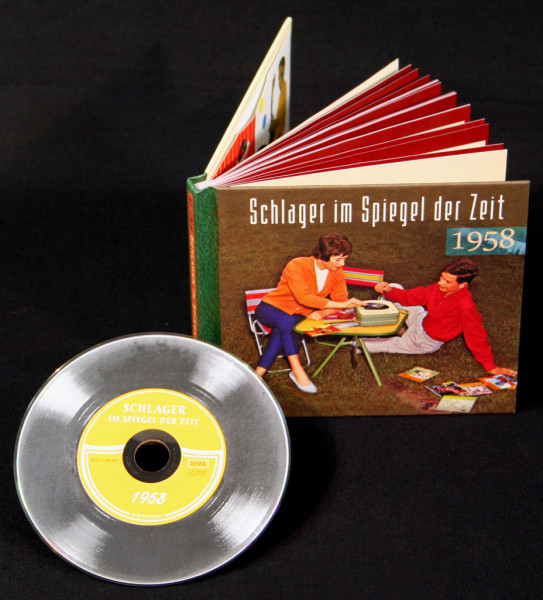
Various - Schlager im Spiegel der Zeit 1958 Schlager im Spiegel der Zeit (CD)

This article is deleted and can no longer be ordered!
Please inform me as soon as the product is available again.
Please enter the digits and letters in the following text field.

  • BCD17188
  • 0.14
  • Download
1-CD with 84-page, german language booklet. 34 tracks, playing time: 85:45. 'Schlager in the... more

Various - Schlager im Spiegel der Zeit: 1958 Schlager im Spiegel der Zeit (CD)

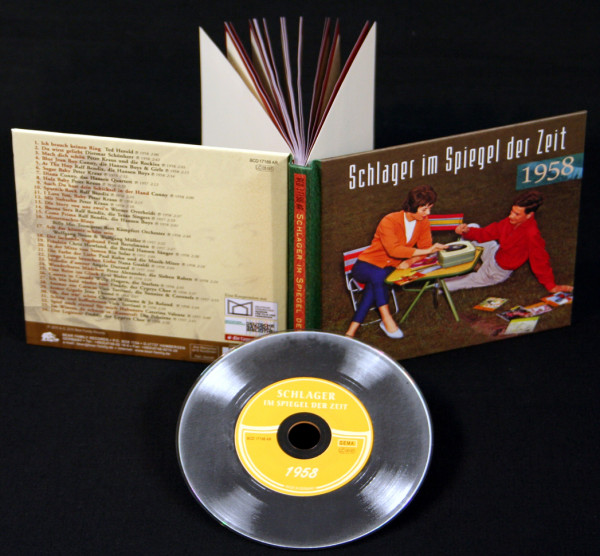
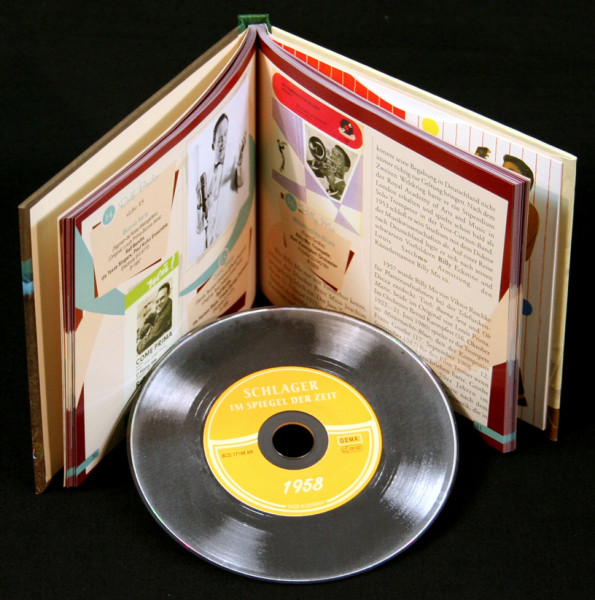
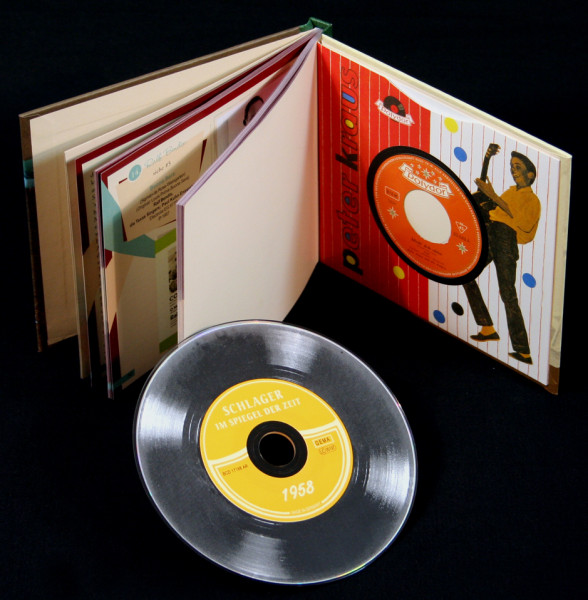
1-CD with 84-page, german language booklet. 34 tracks, playing time: 85:45.

'Schlager in the Mirror of Time - 1958'

Boredom from the radio
Bravo', the central organ of the 50s youth, brought a picture of the German actor Joachim Hansen on the title at Easter 1958. The back showed a colored photo of the American pop singer Pat Boone with the headline "Who's going to be the king of the music? The accompanying article addressed a problem that moved both the magazine's readers and the music industry: the broadcasting landscape at the time. Radio Luxembourg had just started broadcasting for West Germany and, as 'Bravo' put it, brought "a cocktail of notes. The Luxembourgers mix soft hits of the Torriani type with the popular local music production, decorate the whole thing with a little Lehár and Mozart and pepper with a pinch of "Pat Boone". As a contrast, the magazine named the AFN stations in Germany and their effects: "New vocal groups are appearing all the time - and their hot songs make the juke boxes glow white." German stations, on the other hand, were yawning boredom. To the great frustration of the 'Bravo' community, the "programme makers were almost as unworldly as the ancient Romans". The BRAVO music box in the same issue reflects this situation - with a clear focus on German hits.

The dilemma in which the music industry was stuck at the time: taste shifted more and more towards pop music for young people, but trade and radio lagged behind. In addition, the American influence, which had already begun at the end of the 1940s, now came increasingly to the fore. The popular magazine 'Film und Frau' therefore pleaded: "You shouldn't put today's young people at a disadvantage if they love the hard beat more than the sweet tearjerker. If your son doesn't give a damn about heath, foresters or Hawaii today - that's fine! Anyone who wants to make it up in the Schlager business today will be able to enjoy the big foreign successes, either in the original version or with German text. The US hit parade is now having an effect all the way to the last record dealer in Posemuckel. For months there have only been one or two German pop compositions among the ten German bestsellers." And also the 'vending machine market' did not want to miss the trend. Under the headline 'Teenager - an important factor in the record business' he took up the lance for imported music: "The new rock 'n' roll music has almost exclusively teenagers as followers... The greater the number of music-loving, record-buying youth - the more interesting for the record industry and jukebox."

Soundtracks for the record market
The American and English soldier broadcasters and the record jockey Chris Howland had done a great job for years and prepared the ground for the taste revolution. The result could be heard. And even though the German radio broadcasts slept through the development, the new times were still noticeable in the jukeboxes. There has not been a single month without an American title among the top hits. And if the original was not listed, the operators had at least written a German cover version on their postcards to the 'Automaten-Markt'. One of the most played plays was 1958 The River Kwai March from the movie 'Die Brücke am Kwai'. In the 'vending machine market' the great importance of film music for the operators has now been discussed. The editorial staff created a new section 'Film hits for your box' to support it. Because films with their soundtracks still had a positive impact on the record market. For example, the Nick Nack song from the 6th Bliss Hostel. The midnight blues was the musical highlight of the student drama 'Immer wenn der Tag beginnt'. And also Caterina Valente contributed film music again: Play for me again, Habanero. Title of the strip: '.... and in the evening to the Scala'. Chansonnier Eddie Constantine distinguished himself as an actor in 'Hoppla, now comes Eddie', and Freddy Quinn appeared in 'Heimatlos'.

The film 'Nasser Asphalt' with Horst Buchholz and Maria Perschy, a film about the role of the press and the treatment of the war years, was more time-critical. Dealing with the past also came to West German cinemas with 'Wir Wunderkinder': As a journalist, Hansjörg Felmy took a look at careerists who had secured their place in the sun both during the Nazi era and during the economic miracle period. The present was the subject of Rolf Thiele's 'Das Mädchen Rosemarie' - about the Nitribitt murder case - and Wolfgang Staudte's film 'Madeleine und der Legionär' (Madeleine and the Legionnaire), which took up the horror of the Battle of Algiers: German legionnaires - among them Joachim Hansen in the leading role - flee the Algerian war and meet the French Madeleine (Hildegard Knef) in the desert. Freddy Quinn's The Legionnaire was a perfect fit for time. The successful boy from St. Pauli has now been consistently built up as a star for better marketing in a number of music films.

Youth speaks out
That had already worked out excellently in the USA with Elvis Presley. But his 'Loving You' ('gold from a hot throat') was rejected by the local film critics. Klaus Hebecker from the magazine 'Star Revue' tore the leading actor apart and found himself unexpectedly in the middle of a hot controversy. The paper was flooded with letters from Elvis fans and turned into a discussion topic: Who's the best - Elvis Presley, Pat Boone or Vico Torriani? Headline: 'Loved by youth, acclaimed, booed, reviled, idolized. Three singers stand in the crossfire of opinions. Each of them has his own audience.' The reaction wasn't long in coming. The theme polarized so much that a well-balanced transcription already had a rare character: "We love racy songs like those of Elvis, but we also enjoy listening to Vico Torriani's hits." The editors got a foretaste of the irreconcilable character of the conflict between Peter Kraus and Ted Herold fans that broke out next year.

Obviously, the media provoked each other and the young people reacted. However, there were signs of social change. The sociologist Helmut Schelsky, who noted the emergence of a 'skeptical generation', became a pioneer. So far, the adult world has had the sovereignty of opinion in the country. Now the young generation articulated itself, which did not want to think and act simply further in the given paths of their parents. For the first time after the war, their views received a - albeit not always benevolent - public. Their topics also increasingly moved from the periphery to the centre of interest. The magazine series and reports about James Dean had only been the beginning. Elvis Presley's arrival in Bremerhaven did not only fascinate 'Bravo' and the 'Star Revue'. Already in 1956 'Der Spiegel' had dedicated a cover story to 'Rock 'n' Roll-Singer'. The press generally got into the 'Hipwackler' and the 'Heulboje'. After all, the spontaneous gangs of people in the streets of the big cities after the Bill Haley film 'Außer Rand und Band' must also be regarded as rallies of opinion. And the different nature of the 'Teenager' and 'Twens' train really broke when Haley toured the Federal Republic of Germany in October. That smelled like rebellion. There was no uniform opinion in the youth of the country at that time, but it made itself heard.

Bluejeans and Hula Hoop
The entertainment industry hoped the cup would pass soon. The end of the shellac record did not mean that the obsolete format also meant that old sounds were abandoned at the same time. The new stereo technology was initially used in proven applications such as Mitch-Miller music. The Polydor recorded once again Malaguena and The Breeze And I in stereo with Caterina Valente. The singer herself was open to the new sound: Bill Haley and the Comets were quickly recruited for the local hit market and integrated into the Valente film 'Hier bin ich - hier bleib ich'. Bill intoned Vive le Rock 'n' Roll in it. A year later Louis Armstrong, who appeared in front of the camera with Marika Rökk for 'Die Nacht vor der Premiere' and sang in duet with little Gabriele in 'La Paloma', was treated similarly. His portrait was even used to advertise the Rolleiflex camera. You couldn't win Elvis for such escapades. At the Teldec they even left him out on the 'Klingende Post' advertising boards, with one exception, and instead of Billy Vaughn (with the giant hit Sail Along Silvery Moon) and Vera Lynn (with the giant flop Bon Giorno) they added him to the program. The harmless was booming.

Video von Various - Schlager im Spiegel der Zeit - 1958 Schlager im Spiegel der Zeit (CD)

Article properties: Various - Schlager im Spiegel der Zeit: 1958 Schlager im Spiegel der Zeit (CD)

Various - Schlager im Spiegel der Zeit - 1958 Schlager im Spiegel der Zeit (CD) CD 1
01 Ich brauch keinen Ring Herold, Ted
02 Du wirst geliebt Schönherr, Dietmar
03 Mach dich schön Kraus, Peter und die Rockies
04 Blue Jean Boy Conny & die Hansen Boys & Girl
05 At The Hop Bendix, Ralf & die Hansen Boys
06 Sugar Baby Kraus, Peter
07 Diana Conny & das Hansen Quartett,
08 Hula Baby Kraus, Peter
09 Auch Du hast dein Schicksal in der Hand Conny & die Hansen Boys & Girl
10 Sputnik-Rock Bendix, Ralf
11 I Love You, Baby Kraus, Peter
12 Mit Siebzehn Kraus, Peter
13 Die Story von uns zwei'n Overheidt, Werner
14 Buona Sera Bendix, Ralf & die Texas Singe
15 Come Prima Bendix, Ralf & die Hansen Boys
16 Mitternachts-Blues Mo, Billy: Trompete & Bert Käm
17 Ach das könnte schön sein Neuss, Wolfgang & Wolfgang Mül
18 Der lachende Vagabund Bertelmann, Fred
19 Fräulein Howland, Chris & die Bernd Han
20 In der Mitte von Samoa Solar, Ria
21 Die Farbe der Liebe Kuhn, Paul und die Musik-Mixer
22 Junge Leute brauchen Liebe Gualdi, Nana
23 Melodie d'amour Durand, AngÞle
24 Wunderbares Mädchen Alexander, Peter & die Sieben
25 Eine Reise ins Glück Bieler, Erni
26 Casetta in Canada Hagara, Willy & die Starlets
27 Ich bin bald wieder hier Freddy & der Cyprys Chor
28 Ananas aus Caracas Torriani, Vico & die Sunnies &
29 Armer Gigolo Thomé, Jean
30 Oh, das wär' schön Williams, Christa & Jo Roland
31 Schön und kaffeebraun Torriani, Vico & die Sunnies &
32 Spiel noch einmal für mich Habanero Valente, Caterina
33 Im Winter, da schneit es (Karneval) Peheiros, Die
34 Der Legionär Freddy & der Cyprys Chor
Schlager im Spiegel der Zeit Few genres polarise opinion quite like Schlager. But anyone who... more
"Various - Schlager im Spiegel der Zeit"

Schlager im Spiegel der Zeit

Few genres polarise opinion quite like Schlager. But anyone who thinks only of its current excesses when they hear the word does it an injustice. Before Ballermann, Schlagermove and Mutantenstadl there were times when Schlager not only won people over with charm, wit and esprit, but actually provided the soundtrack to what was going on: in its boom phases during the Golden Twenties and the years of the economic miracle, Schlager was a mass phenomenon ("mainstream" by today's standards). Like it or not, it is an integral part of the country's (musical) culture, and in the 20th century it reflects the national state of mind and the history of everyday life in Germany as vividly as hardly any other genre.

With the chronological CD documentation "Schlager im Spiegel der Zeit 1926 bis 1970", Bear Family now presents comprehensive background, astonishing developments, rousing melodies and high-flying artists. The first batch of releases covers, in two parts, the periods 1929-33 and 1954-59, with one CD and an extensive booklet for each year. It stands to reason that the series thrives on stars and hits: Schlager are by their very nature popular tunes loved by a mass audience. But it is precisely in this entertaining combination that the link between the genre and the spirit of the age becomes apparent.

Schlager im Spiegel der Zeit 1929-33

The Golden Twenties take shape between Bauhaus, bobbed hair and ballroom. Right in the middle of it all, at the peak of its popularity: the Schlager. With Marlene Dietrich, the Comedian Harmonists, Max Hansen, Hans Albers, Willy Fritsch and Lilian Harvey, the Schlager reaches an audience of millions. Not least thanks to the arrival of the talkies, earworms such as "Ich bin die fesche Lola" or "Flieger, grüß mir die Sonne", alongside evergreens such as "Surabaya-Johnny" or "Veronika, der Lenz ist da", make up the musical outfit of the Weimar Republic.

Schlager im Spiegel der Zeit 1954-59

After dictatorship, war and deprivation, the Schlager comes into full bloom again in the years of the economic miracle. It voices themes that are in the air and satisfies the longing for carefree harmony. With its messages, the Schlager channels dreams of faraway lands, the sea, unknown beauties and an unspoiled world. Peter Alexander's love ballads, Freddy's sailor songs, an ever cheerful Vico Torriani or the sparkling Caterina Valente – they spin on the turntables of the jukeboxes. The triumphant advance of rock 'n' roll, beat & co. at first shakes up listening habits and shifts the boundaries of taste, but teen idols such as Peter Kraus and Ted Herold underline the adaptability of "their" genre with rocking sounds. In the 1960s an internationally emerging pop culture displaces the Schlager and its performers as the vehicle of a way of life: while at the beginning of the Sixties almost every top title is sung in German, barely ten years later this is the exception. "Schlager im Spiegel der Zeit 1926 bis 1970" looks back at top stars and one-hit wonders from five decades who, with their melodies, turned entertainment products into cultural assets – beyond all boundaries of taste.

Some remarks on sound quality

Ever since the launch of our CD series, we at Bear Family have reaffirmed time and again our commitment to delivering the best possible quality. This edition contains transfers from matrices and shellac records. The background noise level of these recordings is audible. Short clicks and crackles as well as a certain amount of hiss can be reduced to a minimum with systems such as Cedar and No-Noise.

However, such processing often comes at the expense of the sound of the original recordings. We use such techniques with the utmost care. Please note: when historical recordings are played through headphones, background noise and other analogue shortcomings are amplified!
You can always buy a BEAR FAMILY product with confidence.

Copyright © Bear Family Records

Review 0
Read, write and discuss reviews... more
Customer evaluation for "1958 Schlager im Spiegel der Zeit (CD)"
Write an evaluation
Evaluations will be activated after verification.

The fields marked with * are required.

More products by Various - Schlager im Spiegel der Zeit
Schlager im Spiegel der Zeit 1929 - 1933 (5-CD)
Various - Schlager im Spiegel der Zeit: Schlager im Spiegel der Zeit 1929 - 1933 (5-CD) Item no.: BCD17159_bu

Ready to ship today, delivery time** appr. 1-3 workdays

$99.16 * $40.89 *
1959 Schlager im Spiegel der Zeit (CD)
Various - Schlager im Spiegel der Zeit: 1959 Schlager im Spiegel der Zeit (CD) Item no.: BCD17189
Ready to ship today, delivery time** appr. 1-3 workdays

$19.83 * $17.49 *
Schlager im Spiegel der Zeit - 1957
Various - Schlager im Spiegel der Zeit: Schlager im Spiegel der Zeit - 1957 Item no.: BCD17187

Ready to ship today, delivery time** appr. 1-3 workdays

$29.19 *
Schlager im Spiegel der Zeit - 1956
Various - Schlager im Spiegel der Zeit: Schlager im Spiegel der Zeit - 1956 Item no.: BCD17186

Ready to ship today, delivery time** appr. 1-3 workdays

$19.83 * $17.49 *
Schlager im Spiegel der Zeit - 1954
Various - Schlager im Spiegel der Zeit: Schlager im Spiegel der Zeit - 1954 Item no.: BCD17184

Ready to ship today, delivery time** appr. 1-3 workdays

$19.83 * $17.49 *
Elvis Hits in Deutsch Folge 4 (CD)
Various - Elvis Hits in deutsch: Elvis Hits in Deutsch Folge 4 (CD) Item no.: ACD25028

Item has to be restocked

$16.32 $18.66
American Originals
James Talley: American Originals Item no.: BCD15244

Ready to ship today, delivery time** appr. 1-3 workdays

$16.32 $18.66
Die Singles 1958-60
Ted Herold: Die Singles 1958-60 Item no.: BCD15404

This article is deleted and can no longer be ordered!

$23.34
The RCA Sessions (CD)
Roy Orbison & Sonny James: The RCA Sessions (CD) Item no.: BCD15407

Ready to ship today, delivery time** appr. 1-3 workdays

$15.15 $18.66
Tiptoe Through The Tulips - Resurrection (CD)
Tiny Tim: Tiptoe Through The Tulips - Resurrection (CD) Item no.: BCD15409

Item has to be restocked

$16.32 $18.66
Schlager im Spiegel der Zeit - 1957
Various - Schlager im Spiegel der Zeit: Schlager im Spiegel der Zeit - 1957 Item no.: BCD17187

Ready to ship today, delivery time** appr. 1-3 workdays

$29.19
Schlager im Spiegel der Zeit - 1956
Various - Schlager im Spiegel der Zeit: Schlager im Spiegel der Zeit - 1956 Item no.: BCD17186

Ready to ship today, delivery time** appr. 1-3 workdays

$17.49 $19.83
1959 Schlager im Spiegel der Zeit (CD)
Various - Schlager im Spiegel der Zeit: 1959 Schlager im Spiegel der Zeit (CD) Item no.: BCD17189
Ready to ship today, delivery time** appr. 1-3 workdays

$17.49 $19.83
Schlager im Spiegel der Zeit - 1954
Various - Schlager im Spiegel der Zeit: Schlager im Spiegel der Zeit - 1954 Item no.: BCD17184

Ready to ship today, delivery time** appr. 1-3 workdays

$17.49 $19.83
Schlager im Spiegel der Zeit - 1955
Various - Schlager im Spiegel der Zeit: Schlager im Spiegel der Zeit - 1955 Item no.: BCD17185

Ready to ship today, delivery time** appr. 1-3 workdays

$17.49 $19.83