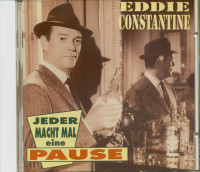
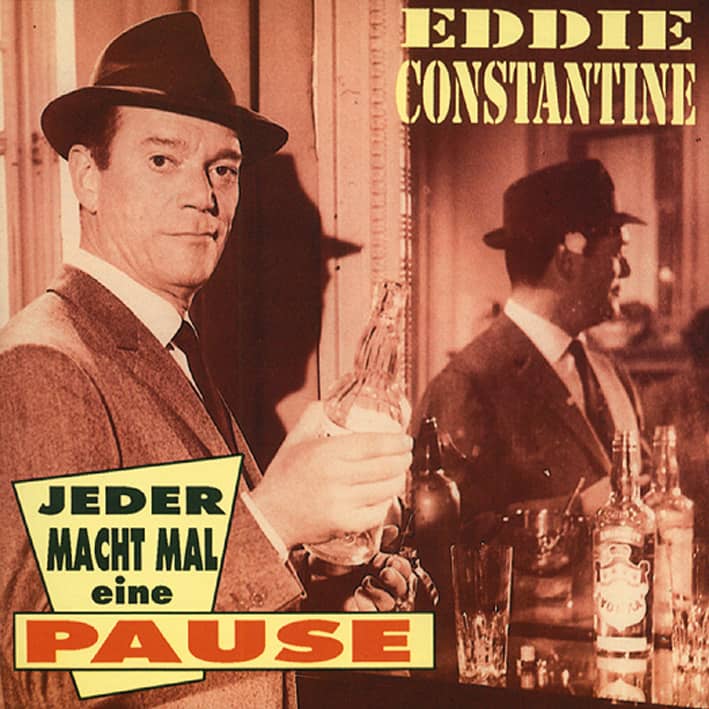
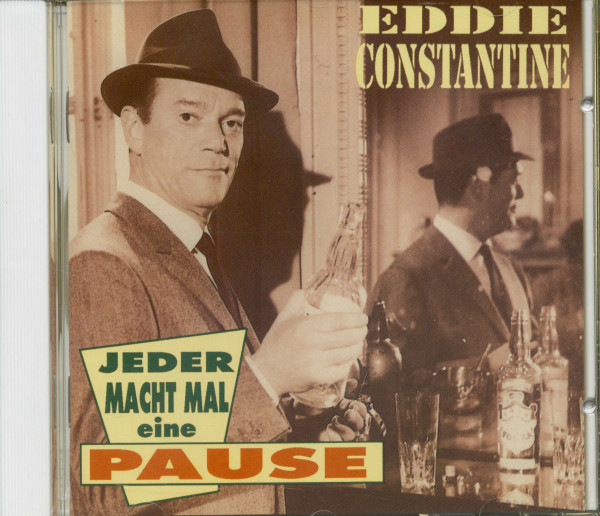
Eddie Constantine Jeder macht mal eine Pause (CD)



* incl. VAT / plus shipping costsDepending on the country of delivery, the VAT at checkout may vary.
Ready to ship today,
delivery time** appr. 1-3 workdays
- catalog number: BCD15679
- weight in Kg 0.115
Eddie Constantine: Jeder macht mal eine Pause (CD)
He was the film star of the fifties, who could also sing: Eddie Constantine! He became known as the popular screen character Lemmy Caution; but his heart beat for the hits and chansons.
He recorded 1953 with Electrola Platten in German language, among them the very successful titles Schenk deiner Frau doch einmal einmal einmal rote Rosen, I wish you a sleepless evening and
Over a small cup of tea.
Just like in a comic strip: The face like a woodcut, the touch of a smile around the narrow mouth, always with a saying ready, a Pepita hat on the head, and - bang - a fist under the opponent's chin, then a whisky and a beautiful woman in each arm. Lemmy Caution, for example, is an FBI agent and popular screen figure of the 1950s. Played by Eddie Constantine. He was so close to the role that the fans thought one was the other, and vice versa.
After all, the native American of Russian descent, who lived in Paris, came along just as the cinema audience in post-war Europe imagined an American: victory-sure, without fear and with a lot of charm, a whole guy. One who is always on the move, feels at home in every bar and forces his opponents to their knees. People wanted to see one of these in the cinema, whether in Italy, France or Germany.
Eddie Constantine diligently used the cliché and shot one film after another,'Im Banne des blon-den Satans' was the first of eighteen films produced in the 50's alone in 1953. A movie star, a movie myth, and nobody really liked to imagine that this man could still sing. "Actually, I never wanted to become an actor, my preference was always music - pop and chanson," he once confessed to a journalist, and referred to his beginnings. Born on October 29, 1917 in Los Angeles as Edward Constantine, his father, a descendant of the Moscow opera singer Constantinewski, sent him to the Vienna Conservatory as a young man in 1933. There he studied singing with the professional aim of becoming an opera singer.
After two years Constantine stopped his education and went to New York, where he continued his singing studies, this time with a focus on light music.
And then Eddie Constantine started small, first in third-class bands, then in the choir of the film company MGM ih Los Angeles. But it didn't last long on the west coast, shortly afterwards he joined the vocal quintet'The Five Musketeers' in New York, which accompanied well-known musicians like Louis Armstrong, Harry James or Frank Sinatra on extensive tours through the USA. In 1941 he was engaged for the choir of the New York Radio Music City Hall. Here he also met his future wife, the Czech dancer Helene Mussle, who belonged to the ballet of the house.
Then he should join the military. But Eddie Constantine was released from military service for weakness. But to be there, he went to the Canadian troop support and sang for the soldiers. Back in civilian life he appeared on the radio as a singer for commercials in front of the microphone.
Article properties: Eddie Constantine: Jeder macht mal eine Pause (CD)
-
Interpret: Eddie Constantine
-
Album titlle: Jeder macht mal eine Pause (CD)
-
Genre Schlager und Volksmusik
-
Label Bear Family Records
- Preiscode AH
-
Artikelart CD
-
EAN: 4000127156792
- weight in Kg 0.115
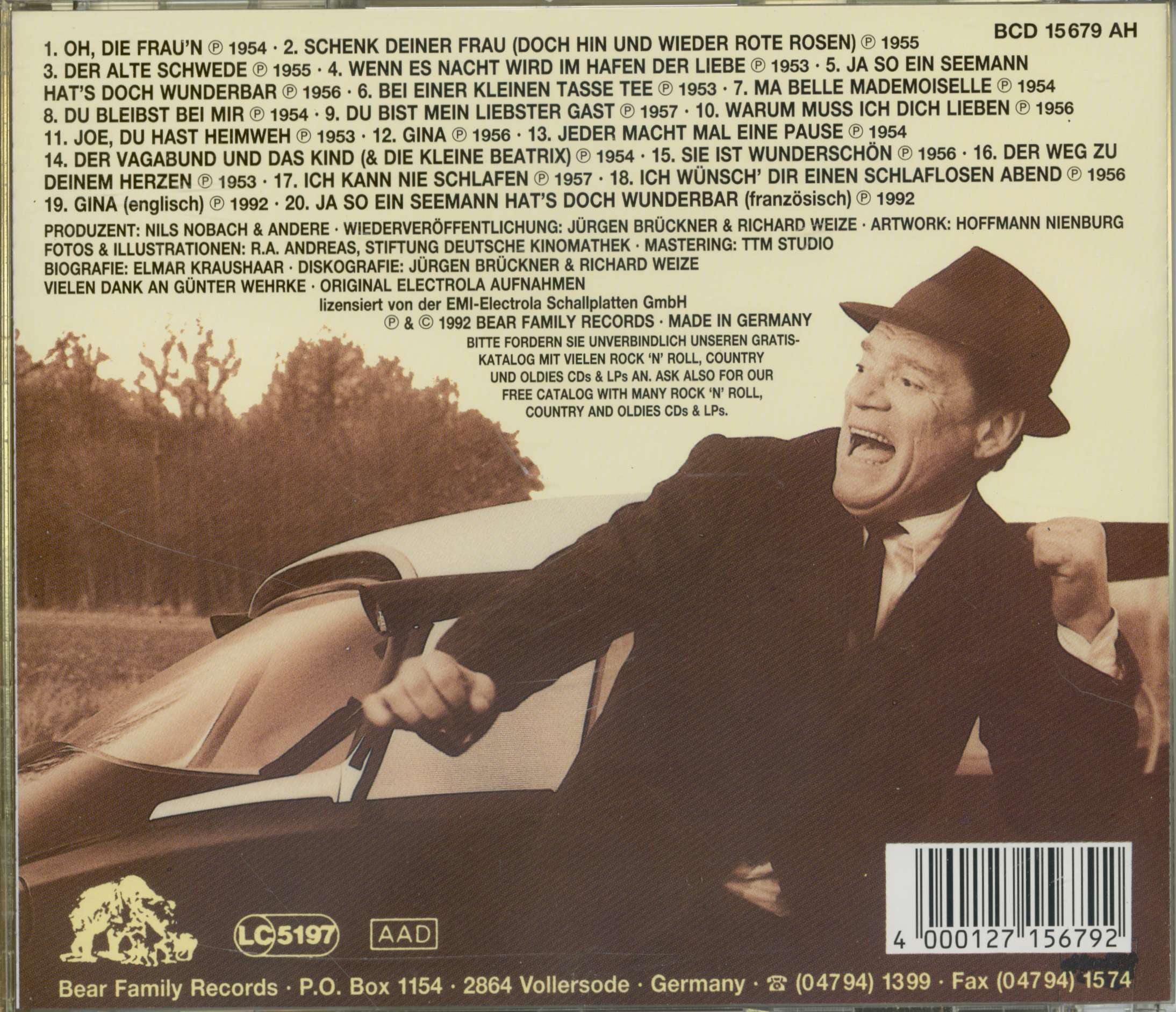
| Constantine, Eddie - Jeder macht mal eine Pause (CD) CD 1 | ||||
|---|---|---|---|---|
| 01 | Oh, die Frau'n | Eddie Constantine | ||
| 02 | Schenk deiner Frau (doch hin und wieder ...) | Eddie Constantine | ||
| 03 | Der alte Schwede | Eddie Constantine | ||
| 04 | Wenn es Nacht wird im Hafen der Liebe | Eddie Constantine | ||
| 05 | Ja, so ein Seemann hat's doch wunderbar | Eddie Constantine | ||
| 06 | Bei einer kleinen Tasse Tee | Eddie Constantine | ||
| 07 | Ma Belle Mademoiselle | Eddie Constantine | ||
| 08 | Du bleibst bei mir | Eddie Constantine | ||
| 09 | Du bist mein liebster Gast | Eddie Constantine | ||
| 10 | Warum muss ich dich lieben | Eddie Constantine | ||
| 11 | Joe, du hast Heimweh | Eddie Constantine | ||
| 12 | Gina | Eddie Constantine | ||
| 13 | Jeder macht mal eine Pause | Eddie Constantine | ||
| 14 | Der Vagabund und das Kind (& KLEINE BEATRIX) | Eddie Constantine | ||
| 15 | Sie ist wunderschön | Eddie Constantine | ||
| 16 | Der Weg zu deinem Herzen | Eddie Constantine | ||
| 17 | Ich kann nie schlafen | Eddie Constantine | ||
| 18 | Ich wünsch' dir einen schlaflosen Abend | Eddie Constantine | ||
| 19 | Gina (englisch) | Eddie Constantine | ||
| 20 | Ja, so ein Seemann hat's doch wunderbar(frz.) | Eddie Constantine | ||
Eddie Constantine

Geboren am 29. 10. 1917 in Los Angeles. Spielte in Club-Combos, sang im MGM-Filmchor, gehörte in New York zum Vokal-Ensemble The Five Musketeers. 1947 begleitete er seine damalige Frau, die tschechische Tänzerin Helinka Musilova, nach Europa und blieb in Frankreich (Staatsbürgerschaft seit den 60er Jahren). Erste Filmangebote ab 1952 - 53, unter anderem für die inzwischen kultigen Lemmy-Caution-Krimis. Zugleich Plattenaufnahmen in Paris mit dem belgischen Produzenten Jack Kluger. Constantine wurde durch seine Filme in Deutschland sehr populär, was auch seine Karriere als Sänger ankurbelte: Allein 19 Singles in deutscher Sprache von 1953 bis 1963 (Electrola, Ariola, Philips) machten ihn zum eingemeindeten Schlager-Star. 1979 Heirat mit seiner dritten Frau, der TV-Redakteurin Maja Faber-Janssen. Wohnort: Wiesbaden, wo Constantine am 25. 2. 1993 verstarb. Größte Hits: Ich wünsch dir einen schlaflosen Abend (12 - 56, Platz 6), Jeder macht mal eine Pause (1 - 57, Platz 9), Der Vagabund und das Kind (12 - 56, Platz 10). Aus dem Bear Family Buch - 1000 Nadelstiche von Bernd Matheja - BFB10025 -
Es gehört schon eine Riesenportion Ironie dazu, wenn ein Mann vom amerikanischen Kriegsdienst als untauglich befreit wird, um dann nach dem Krieg in Europa auf der Leinwand den knallharten Agenten und Super-Rambo zu geben. Eddie Constantine, am 29. Oktober 1917 als Edward Constantinowsky in Los Angeles geboren, hatte eigentlich eher an eine Karriere als Sänger gedacht. Der Nachfahre eines Moskauer Opernsängers wurde schon 1933 von seinem Vater nach Wien aufs Konservatorium geschickt. Nach zwei Jahren zog es ihn nach New York, wo er sich der Unterhaltungsmusik verschrieb. Als Chorsänger begleitete er die Tourneen von Stars wie Louis Armstrong oder Frank Sinatra und wurde 1941 für den Chor der New Yorker 'Radio Music City Hall' engagiert. Es ist kaum vorstellbar, daß der Typ mit der Hau-drauf-Mimik im pockennarbigen Gesicht wegen 'Schwächlichkeit' vom Militär abgelehnt wurde.
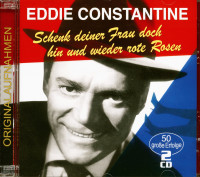
Aber er hat ja dann in seinen französischen Lemmy-Caution-Filmen alles getan, um sein Image aufzupolieren. Nach Europa kam er durch das Engagement seiner Frau Helene Mussle, einer tschechischen Tänzerin, die mit dem 'Ballet Russe' in London auftrat. Das war 1947. Im Anschluß an die Londoner Auftritte tanzte Helene als Primaballerina bei dem französischen Choreographen Roland Petit, und die Constantines blieben in Paris. Im deutschen Schlager zählt er zu den Zugereisten, wie auch Kenneth Spencer oder Bill Ramsey. Die ersten deutschen Aufnahmen absolvierte er 1953 in Köln, wo er auch 1955 Schenk deiner Frau (doch hin und wieder rote Rosen) im Electrola-Studio sang. Produzent war Nils Nobach, der schon den Schwedenexport Bibi Johns entdeckt hatte und damals bei der Electrola das Sagen hatte. Beim Rote-Rosen-Schlager spielte Eddie Constantine mal nicht den harten Kerl, sondern gab sich als Frauenversteher. Das gelang ihm besonders gut, weil er den Text mit leicht französischem Akzent vortrug.
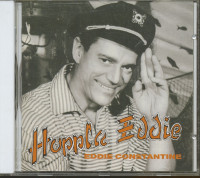
 Für viele galt er deshalb damals in Deutschland auch als französischer Chansonnier. Der Tenor seines Liedchens unterstützte das nur: "Denn jede Frau weiß ganz genau, daß Blumen ihr nur schenkt, wer gerne an sie denkt!" Es müssen gar nicht immer Rosen sein, genauso gut gehen "Anemonen, Nelken und Mimosen". Und Eddie weiß: "Mit den Blumen bringst du dir das Glück ins Haus." Mit deutschen Titeln wie Ich wünsch dir einen schlaflosen Abend, Der Vagabund und das Kind und Jeder macht mal eine Pause kam er in den nächsten Jahren wiederholt in die Schlagerparade. Unterstützt wurde sein Erfolg durch deutsche Filme wie 'Hoppla, jetzt kommt Eddie' (1958) und 'Bomben auf Monte Carlo' (1959). In letzterem gab er einen zweiten Aufguß des Hamburgers Hans Albers, dessen Lieder wie Das ist die Liebe der Matrosen er auch im Film anstimmte. 'Der Spiegel' schrieb über ihn: "Sein Gesicht war seinem Alter immer um Jahre voraus, schon mit 35 sah er aus wie einer, der sein ganzes Leben hinter sich hat".
Von 1969 an konnte er seine Filmkarriere wieder auffrischen, als ihm Peter Lilienthal ('Malatesta') und Rainer Werner Fassbinder ('Warnung vor einer heiligen Nutte') Rollen anboten. Im Theater und Fernsehen tauchte er anschließend immer wieder bei uns auf, und inzwischen hatte er sich auch mit seiner dritten Ehefrau in Wiesbaden niedergelassen. Dort starb er am 25. Februar 1993.

Item has to be restocked

Ready to ship today, delivery time** appr. 1-3 workdays

Item has to be restocked

Ready to ship today, delivery time** appr. 1-3 workdays

Ready to ship today, delivery time** appr. 1-3 workdays

This article is deleted and can no longer be ordered!

Ready to ship today, delivery time** appr. 1-3 workdays

Ready to ship today, delivery time** appr. 1-3 workdays

Ready to ship today, delivery time** appr. 1-3 workdays
Item has to be restocked

Item has to be restocked

only 2x still available
Ready to ship today, delivery time** appr. 1-3 workdays


only 1x still available
Ready to ship today, delivery time** appr. 1-3 workdays