* incl. VAT / plus shipping costsDepending on the country of delivery, the VAT at checkout may vary.
Ready to ship today,
delivery time** appr. 1-3 workdays
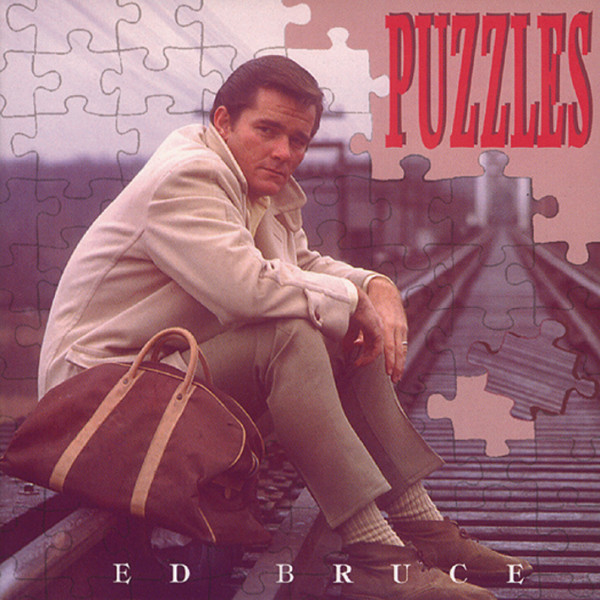
Ed Bruce: See The Big Man Cry - The complete SUN and Wand recordings 1957 – 65, plus… (CD)
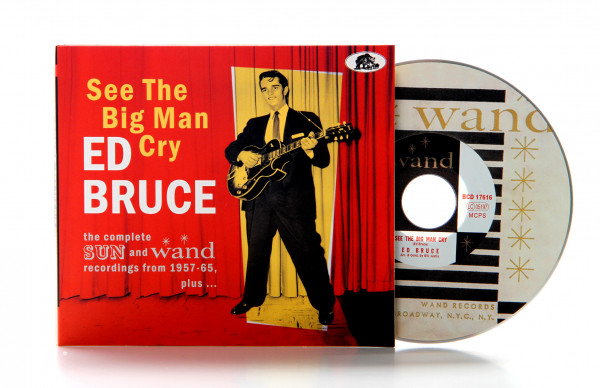
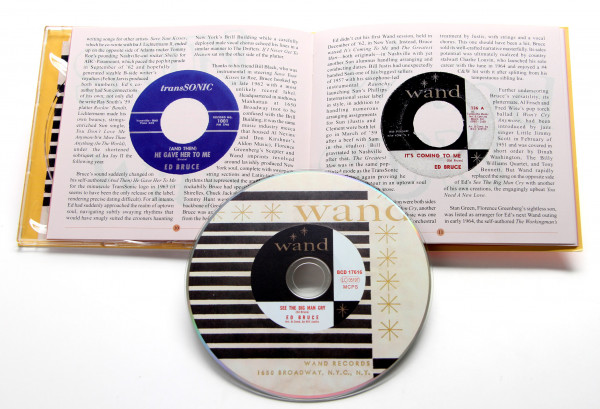
- Bear Family presents ‘See The Big Man Cry – The complete SUN and Wand recordings from 1957 – 65, plus…', the first complete CD collection of Ed Bruce's outstanding early recordings from 1956 to 1965.
- During that time he recorded for Sun Records, RCA Victor, TransSonic, Wand and Apt Records, among others.
- All titles have not been re-released on CD - until now!
- Including several recordings initially left forgotten in the Sun archives.
- In the U.S. Ed Bruce was best known for TV shows and movies and as a country singer in later years - in Europe he is recognized for his great mix of rockabilly, country and country soul.
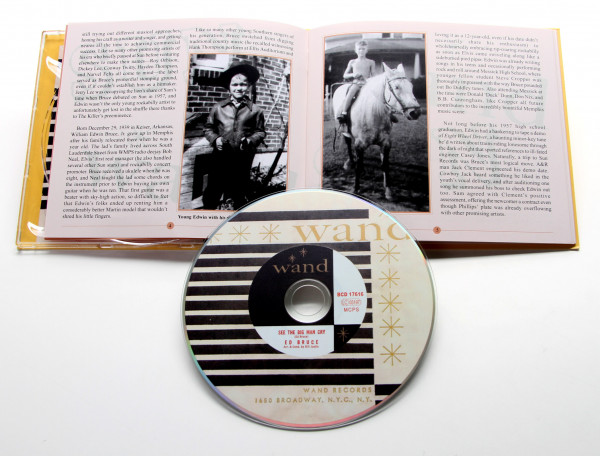
- Extensive liner notes in the richly illustrated booklet.
- Wherever possible, like in the case of RCA and Wand, we have dubbed from digital copies of the original masters!
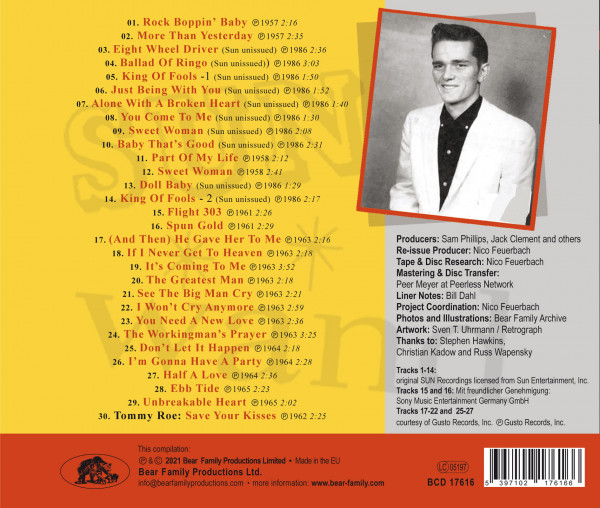
'See The Big Man Cry' contains everything Edwin released during his first burst of studio activity, including obscure one-off singles for TransSonic and Apt. There are also 10 sides that Sun didn't see fit to release at the time, including Eight Wheel Driver, Baby That's Good and Doll Baby. Bruce died January 6, 2021, and 'See The Big Man Cry' stands as a fitting 30-song tribute to the late singer/actor's fascinating early years on record.
Video von Ed Bruce - See The Big Man Cry - The complete SUN and Wand recordings 1957 – 65, plus… (CD)
Article properties: Ed Bruce: See The Big Man Cry - The complete SUN and Wand recordings 1957 – 65, plus… (CD)
-
Interpret: Ed Bruce
-
Album titlle: See The Big Man Cry - The complete SUN and Wand recordings 1957 – 65, plus… (CD)
-
Genre Country
-
Label Bear Family Records
- Preiscode AH
-
Artikelart CD
-
EAN: 5397102176166
- weight in Kg 0.115
| Bruce, Ed - See The Big Man Cry - The complete SUN and Wand recordings 1957 – 65, plus… (CD) CD 1 | ||||
|---|---|---|---|---|
| 01 | Rock Boppin' Baby | Ed Bruce |
|
|
| 02 | More Than Yesterday | Ed Bruce |
|
|
| 03 | Eight Wheel Driver | Ed Bruce |
|
|
| 04 | Ballad Of Ringo (Sun unissued) | Ed Bruce |
|
|
| 05 | King Of Fools -1 (Sun unissued) | Ed Bruce |
|
|
| 06 | Just Being With You (Sun unissued) | Ed Bruce |
|
|
| 07 | Alone With A Broken Heart (Sun unissued) | Ed Bruce |
|
|
| 08 | You Come To me (Sun unissued) | Ed Bruce |
|
|
| 09 | Sweet Woman (Sun unissued) | Ed Bruce |
|
|
| 10 | Baby That's Good (Sun unissued) | Ed Bruce |
|
|
| 11 | Part Of My Life | Ed Bruce |
|
|
| 12 | Sweet Woman | Ed Bruce |
|
|
| 13 | Doll Baby (Sun unissued) | Ed Bruce |
|
|
| 14 | King Of Fools -2 (Sun unissued) | Ed Bruce |
|
|
| 15 | Flight 303 | Ed Bruce |
|
|
| 16 | Spun Gold | Ed Bruce |
|
|
| 17 | (And Then) He Gave Her To Me | Ed Bruce |
|
|
| 18 | If I Never Get To Heaven | Ed Bruce |
|
|
| 19 | It's Coimg To Me | Ed Bruce |
|
|
| 20 | The Greatest Man | Ed Bruce |
|
|
| 21 | See The Big Man Cry | Ed Bruce |
|
|
| 22 | I Won't Cry Anymore | Ed Bruce |
|
|
| 23 | You Need A New Love | Ed Bruce |
|
|
| 24 | The Workingman's Prayer | Ed Bruce |
|
|
| 25 | Don't Let It Happen | Ed Bruce |
|
|
| 26 | I'm Gonna Have A Party | Ed Bruce |
|
|
| 27 | Half A Love | Ed Bruce |
|
|
| 28 | Ebb Tide | Ed Bruce |
|
|
| 29 | Unbreakable Heart | Ed Bruce |
|
|
| 30 | Save Your Kisses | Tommy Roe |
|
|
Ed Bruce
EDWIN BRUCE
Born 29 December 1939 in Keiser, Arkansas. Record labels: Sun, Philips, RCA, Monument, United Artists, Epic, MCA, Bear Family. First hit: Walker’s Woods (1967). First No. 1 hit: You’re The Best Break This Old Heart Ever Had (1982). Ed Bruce was a former rock ’n’ roll singer who came to Nashville in the mid-1960s to try his hand at country music. Even so, until his first No. 1 hit in 1982 his records met with only moderate success. He was far more successful as a songwriter: his songs Mammas Don’t Let Your Babies Grow Up To Be Cowboys, Texas (When I Die), The Man That Turned My Mama On and Working Man’s Prayer became big hits for other singers. Even after his great successes as a singer, Ed Bruce has remained active in advertising. He voices commercials and keeps turning up in TV series. In Germany, Ed Bruce became known above all for his role as the sheriff in the TV series ‘Maverick’.
In the late 1970s it was almost impossible to avoid Ed Bruce. His composition Mammas Don’t Let Your Babies Grow Up To Be Cowboys was not only a No. 1 hit for Waylon ’n’ Willie but an era-defining song, and his own records for MCA were getting played. Switch off the stereo and his voice was on radio and television, selling everything and everybody from Hungry Jack biscuits to Tennessee tourism. He even had a brief run as James Garner’s sidekick in the 1982 revival of Maverick. On his MCA albums and in his TV and film appearances Ed had the grizzled look of a Marlboro Man nearing retirement, but he didn’t always look that way. In 1957 Ed Bruce was Edwin Bruce, a seventeen-year-old rockabilly on Sun Records.
William Edwin Bruce, Jr. was born on 29 December 1939 in Keiser, Arkansas. His family moved to Memphis when Ed was about a year old, and his father became a car salesman. The Bruces lived on South Lauderdale across from Elvis’s first manager, Bob Neal. Besides managing Elvis and Johnny Cash, Neal was a DJ who hosted a children’s show as Uncle Piggly. He showed Ed how to make a few chords on the ukulele. “I got one when I was eight years old,” Ed told Dave Booth in 1986. “Then I started playing guitar when I was ten. I saved the money from my paper route and put it in a change jar. A kid in the neighbourhood had a guitar for sale and I wanted it so bad I could hardly stand it. I bought the thing, and it took almost a machine press to squeeze the strings down to the fingerboard. My poor little old hand was like raw hamburger. I worked so hard at it, and my parents saw I was so serious that they rented a Martin guitar.” Ed’s first love was country music, and he was at pains to stress this later on. In the eighth grade he won third prize in a high school talent contest singing High Noon. Around the same time, as he told Booth: “I remember a show at Ellis Auditorium when I was twelve. I took my first true love, who was also twelve. Bob Neal was presenting the show and the headliner was Hank Thompson. After a while my date turned to me: ‘Do you really like this?’ It just broke my heart, because of course I did.”
Ed attended Messick High School in Memphis along with Steve Cropper, Duck Dunn, B.B. Cunningham and Don Nix. Talking to Premier Guitar, Cropper remembered that Bruce was two years ahead of him and would sing Bo Diddley songs unaccompanied. “I went up to him after a show,” said Cropper, “and said to him, ‘Man, how do you do that?’ He said, ‘Well, you gotta get yourself a git-tar and learn how to play it.’” Elvis was inescapable. “I remember seeing him on a package show at the Overton Park Shell in Memphis,” Bruce said later. “He didn’t seem to play guitar all that well, but he had a great show. I met him at his house when he was still living on Audubon Drive. I was out there with Sonny Neal. Elvis was very warm. Back then he didn’t even have a gate at his house. Even then a lot of people were starting to take advantage of him.” Ed graduated in June 1957. A little earlier he had gone to Sun to make a demo of the first song he had written, Eight Wheel Driver, and Jack Clement heard some promise in the kid. “We had run through a song and Jack said, ‘Y’all just hold on a minute,’ and he stopped, went back and got Sam out of his office. He said, ‘Do that song again.’ We did, and Sam came out onto the studio floor and started talking to my parents about what he wanted to do with me.” The first session was probably in April or May 1957. There was a session on 8 May, and a Hi-Lo publishing contract for Eight Wheel Driver and Doll Baby was issued ten days later, which suggests that Phillips saw those two songs as the first single. At some point the plan changed and Rock Boppin’ Baby was issued with More Than Yesterday. Bruce remembers writing More Than Yesterday, but it bears more than a passing resemblance to the Dream Kings’ More Than Yesterday, Less Than Tomorrow on Checker Records.
Rock Boppin’ Baby could have made it; the Collins Kids certainly thought enough of it to cover it. It is a wonderfully hypnotic record, with Roland Janes’ muted bass guitar and rocking drums by J.M. Van Eaton. As it slid from the minor-key verses into a major key on the bridge, Bruce’s tightly controlled vocal style built to great effect. It sold well in Memphis on the strength of local appearances and a spot on Memphis’s own clone of Bandstand, Wink Martindale’s Top Ten Dance Party. The fall of 1957 found Edwin Bruce at Memphis State University, majoring in speech and drama. During the Christmas break he went back to Sun and recorded a batch of titles. Those sessions yielded Sweet Woman/Part Of My Life, released in April 1958.
In April and May 1958 Johnny Cash was working out his contract with Sun in preparation for his move to Columbia Records. He was holding back all his new songs because he would get a better rate from Columbia, and that gave Sun Records’ little army of songwriters a golden opportunity. “I was in the studio when Cash recorded ‘Guess Things Happen That Way’,” said Bruce. “I was sitting in the control room and Jack Clement said, ‘We need a bridge or a last verse,’ so I wrote one on the spot. I never thought to say, ‘Hey, what about giving me a share.’ A manifestation of the innocence of youth.” Ed Bruce demoed his song King Of Fools in a Cash-like style, playing his own Luther Perkins guitar part. This song and a few others may have been intended for Johnny Cash’s ears. The log books suggest that Bruce played guitar or sang backup on one of Cash’s last sessions, although Bruce doesn’t remember it. A lot of tape was spent on King Of Fools, suggesting it was seen as a potential third Sun single. If the cryptic notes on the Sun tape boxes are to be believed, Bruce returned to Sun one last time in April 1959 to have another go at King Of Fools. If so, it was his swansong at Sun.
During his last year with Sun, Bruce took over Elvis Presley’s original backing duo, Scotty Moore and Bill Black. “I had a gig at the Rebel Club in Osceola, Arkansas. It was one of those places where you took somebody along to count the door so you’d get a fair shake. Play for $10 a night and all the pride you could swallow. Elvis had fired Scotty and Bill, and I called Bill when I was putting a group together for the Rebel Club. Bill said, ‘Who else have you got?’ I said, ‘Johnny Cannon,’ who later became Ace Cannon and played saxophone, and he said, ‘Well, why don’t you call Scotty. He needs the work.’”
Talking to Dave Booth in 1986, Ed Bruce felt charitable towards Sun Records and Sam Phillips: “Genius is an overused word, but Sam Phillips was probably a genius. He certainly had an extraordinary ear for talent. In my case he was 25 years too early. Sun Records has a significant place in the heritage of the music industry, but as a 16- or 17-year-old I had no notion of being part of history in the making. It was the only game in town. Sam Phillips had a two-track board and two microphones in the studio. You got a balance by raising the volume on the singer’s mike and moving the group farther from or closer to the band mike. There was no baffling, although the studio doubled as a warehouse, so there were boxes of records everywhere. As it happened those boxes served as baffles, but there was a lot of leakage. I didn’t know much about the finer points of the business. My parents were managing my career back then without knowing much about it. I had no idea I was part of something people would be talking about three decades later.”
After college Ed sold used cars and worked a few lounges as a solo act with his guitar. Until 1960 he got no further chance to record. By then Jack Clement had left Sun and was working with Chet Atkins at RCA in Nashville. He brought Ed to Nashville to cut a single for RCA. One side was a morbid song, Flight 303, written by Sun producer Charles Underwood; the other was one of Ed’s originals, the lovely Spun Gold. In 1962 Bill Black got him a record deal with Scepter-Wand Records. One of the songs, See The Big Man Cry, was arranged by another Sun alumnus, Bill Justis. Ed moved to Nashville and tried to sell songs, but his biggest success came when Bill Black put one of his songs, Save Your Kisses, on the other side of Tommy Roe’s Sheila. By the time Ed recorded for Sonic and Apt Records in 1964 and 1965, it was clear that his career in pop music was over before it had begun. The Beatles had changed everything, and Ed was thinking of getting out of the business when Charlie Louvin scored a top five country hit with See The Big Man Cry. Its success earned him another shot at RCA.
Ed married for the first time in Memphis. His son, Trey Bruce, became a successful country songwriter and producer. Ed met his second wife, Patsy, during his first year in Nashville, when they both lived in the same apartment building. They married in October 1964, and when they returned to Nashville they had a one-year-old daughter, Ginny. Later Patsy took over Ed’s management. Back on RCA, Ed cut the Southern Gothic Walker’s Woods and at last had a hit under his own name. He paid the bills with the Marijohn Wilkin Singers on WSM-TV and on the Bobby Lord Show. He sang backgrounds on commercials, and from July 1969 he was with Pete Sayers on WSM-TV’s ‘Morning Show’. A year or two later Ed and Patsy bought a restaurant in the Biltmore Hotel on Nashville’s Eighth Avenue. Commercials were Ed’s mainstay for years. He sang and narrated spots for more than a hundred sponsors. “People in Nashville laughed at us,” he said, “but they stopped laughing when they found out how much money there was in it.”
The RCA deal was followed by a stint with Monument and then a four-year layoff from recording. When Ed came back, it was with United Artists, Epic and then MCA. Waylon ’n’ Willie hit No. 1 with his Urban Cowboy anthem Mammas Don’t Let Your Babies Grow Up To Be Cowboys, and in 1981 he finally had his own first No. 1 hit as a singer with You’re The Best Break This Old Heart Ever Had. In 1984 Ed left MCA and returned to RCA for the second time – or the third, if you count the one-off single from 1961.
Ed and Patsy are divorced. The hits tailed off. But Ed kept working. Most recently he was seen in the 2009 Johnny Depp/Christian Bale film Public Enemies and in the 2010 Gwyneth Paltrow film Country Strong. His seasoned baritone still sells whatever it is asked to sell, most recently Tuborg beer. His website says: “Ed and [third wife] Judith recently sold their ranch and moved into a log home with a wraparound porch. There, on the back porch, overlooking a river and the mountain beyond, Ed loves to sit with friends and talk about sports, horses and dogs, and he loves to talk about the change Jesus has made in his life.”
(Colin Escott)
Copyright © Bear Family Records
His complete early recordings!
This compilation is a must for those who appreciate Bruce’s work, as well as those who enjoy the Sun Records sound. See The Big Man Cry represents both of these things in abundance, and is well worth checking out.
A nice surprise!
I'm very pleased with the Ed Bruce cd.
I have the LP for about 30 tears but I prefer cd's. The additional tracks compared to the LP are very good which was a nice surprise.
Bear Family is my favourite label!
Der "Rare" Ed Bruce
Obwohl ich eine umfangreiche Ed Bruce Sammlung habe, hat es Bear Family Records wieder einmal geschaft eine Lücke zu schließen. Fehlten mir doch noch einige Aufnahmen, die Ed auf WAND-Records veröffentlicht hat. Hier ist er der "Rare" Ed Bruce. Rockabilly, Pop Songs und Teenager Balladen. Alles ist vorhanden. Und natürlich in gewohnter Bear Family Qualität. Ein informatives, 22 Seiten zählendes Booklet runden das Ganze ab. Mit ca. 70 Minuten Spieldauer bekommt man viel Musik für sein Geld. Ich als Ed Bruce Fan vergebe 20 von 10 Punkten. Ich wünsche mir mehr von diesem Ausnahmekünstler. Wie wäre es mit einer Wiederveröffentlichung von Shades Of Ed Bruce oder die unveröffentlichte LP von United Artists oder die diversen Promosingles, z.B. Follow Me To Tennessee oder eine CD Box. The Complete Ed Bruce. Ein Anfang ist gemacht.
Ready to ship today, delivery time** appr. 1-3 workdays
the very last 1 available
Ready to ship today, delivery time** appr. 1-3 workdays