Christa Williams Himmelblaue Serenade - 49 große Erfolge (2-CD)
* incl. VAT / plus shipping costsDepending on the country of delivery, the VAT at checkout may vary.
Item is temporarily out of stock.
Approx. delivery time: up to 3 weeks. (as far as available at the supplier - can be faster, but sometimes unfortunately not)
- catalog number: CD2087660
- weight in Kg 0.11
Christa Williams: Himmelblaue Serenade - 49 große Erfolge (2-CD)
Article properties: Christa Williams: Himmelblaue Serenade - 49 große Erfolge (2-CD)
-
Artist: Christa Williams
-
Album titlle: Himmelblaue Serenade - 49 große Erfolge (2-CD)
-
Genre Schlager und Volksmusik
-
Label SPECTRE MEDIA
-
Artikelart CD
-
EAN: 4260320876600
- weight in Kg 0.11
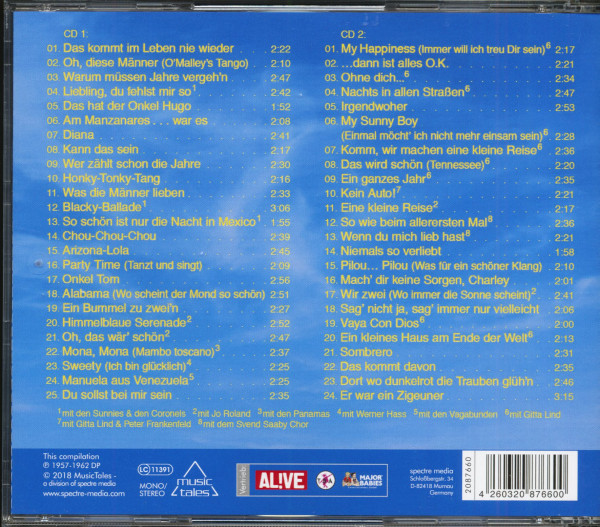
| Williams, Christa - Himmelblaue Serenade - 49 große Erfolge (2-CD) CD 1 | ||||
|---|---|---|---|---|
| 01 | Das kommt im Leben nie wieder (Das ist die Geschichte von Charly) | Christa Williams |
|
|
| 02 | Oh, diese Männer (O’Malley’s Tango) | Christa Williams |
|
|
| 03 | Warum müssen Jahre vergeh’n | Christa Williams |
|
|
| 04 | Liebling, du fehlst mir so (mit den Sunnies & den Coronels) | Christa Williams |
|
|
| 05 | Das hat der Onkel Hugo | Christa Williams |
|
|
| 06 | Am Manzanares war es (Komm, Isabella, komm ) | Christa Williams |
|
|
| 07 | Diana | Christa Williams |
|
|
| 08 | Kann das sein | Christa Williams |
|
|
| 09 | Wer zählt schon die Jahre | Christa Williams |
|
|
| 10 | Honky-Tonky-Tang | Christa Williams |
|
|
| 11 | Was die Männer lieben | Christa Williams |
|
|
| 12 | Blacky-Ballade (mit den Sunnies & den Coronels) | Christa Williams |
|
|
| 13 | So schön ist nur die Nacht in Mexico (mit den Sunnies & den Coronels) | Christa Williams |
|
|
| 14 | Chou-Chou-Chou | Christa Williams |
|
|
| 15 | Arizona-Lola | Christa Williams |
|
|
| 16 | Party Time (Tanzt und singt) | Christa Williams |
|
|
| 17 | Onkel Tom | Christa Williams |
|
|
| 18 | Alabama (Wo scheint der Mond so schön) | Christa Williams |
|
|
| 19 | Ein Bummel zu zwei’n | Christa Williams |
|
|
| 20 | Himmelblaue Serenade (mit Jo Roland) | Christa Williams |
|
|
| 21 | Oh, das wär’ schön (mit Jo Roland) | Christa Williams |
|
|
| 22 | Mona, Mona (mit den Panamas) | Christa Williams |
|
|
| 23 | Sweety (Ich bin glücklich) (mit Werner Hass) | Christa Williams |
|
|
| 24 | Manuela aus Venezuela (mit den Vagabunden) | Christa Williams |
|
|
| 25 | Du sollst bei mir sein | Christa Williams |
|
|
| Williams, Christa - Himmelblaue Serenade - 49 große Erfolge (2-CD) CD 2 | ||||
|---|---|---|---|---|
| 01 | My Happiness (Immer will ich treu Dir sein) (mit Gitta Lind) | Christa Williams |
|
|
| 02 | …dann ist alles OK | Christa Williams |
|
|
| 03 | Ohne dich… (mit Gitta Lind) | Christa Williams |
|
|
| 04 | Nachts in allen Straßen (mit Gitta Lind) | Christa Williams |
|
|
| 05 | Irgendwoher | Christa Williams |
|
|
| 06 | My Sunny Boy (Einmal möcht’ ich nicht mehr einsam sein) (mit Gitta Lind) | Christa Williams |
|
|
| 07 | Komm, wir machen eine kleine Reise (Sentimental Journey) (mit Gitta Lind) | Christa Williams |
|
|
| 08 | Das wird schön (Tennessee) (mit Gitta Lind) | Christa Williams |
|
|
| 09 | Ein ganzes Jahr (mit Gitta Lind) | Christa Williams |
|
|
| 10 | Kein Auto! (mit Gitta Lind & Peter Frankenfeld) | Christa Williams |
|
|
| 11 | Eine kleine Reise (mit Jo Roland) | Christa Williams |
|
|
| 12 | So wie beim allerersten Mal (mit dem Svend Saaby Chor) | Christa Williams |
|
|
| 13 | Wenn du mich lieb hast (mit dem Svend Saaby Chor) | Christa Williams |
|
|
| 14 | Niemals so verliebt | Christa Williams |
|
|
| 15 | Pilou… Pilou (Was für ein schöner Klang) | Christa Williams |
|
|
| 16 | Mach’ dir keine Sorgen, Charley | Christa Williams |
|
|
| 17 | Wir zwei (Wo immer die Sonne scheint) (mit Jo Roland) | Christa Williams |
|
|
| 18 | Sag’ nicht ja, sag’ immer nur vielleicht | Christa Williams |
|
|
| 19 | Vaya Con Dios (mit Gitta Lind) | Christa Williams |
|
|
| 20 | Ein kleines Haus am Ende der Welt (mit Gitta Lind) | Christa Williams |
|
|
| 21 | Sombrero (Loose Ends) | Christa Williams |
|
|
| 22 | Das kommt davon | Christa Williams |
|
|
| 23 | Dort wo dunkelrot die Trauben glüh’n | Christa Williams |
|
|
| 24 | Er war ein Zigeuner (Oh Gipsy, Oh Gipsy) | Christa Williams |
|
|
Christa Williams
Gitta Lind and Christa Williams
The American Connie Francis perfected a recipe for success that helped many US performers get by in the Fifties: popular songs from the first half of the century were warmed up again with new instrumentation, a modern arrangement and a contemporary interpretation. After Who’s Sorry Now from 1923, she pulled it off with My Happiness from 1948. Here, too, her emotional singing went down very well. A special feature: Connie sang a duet with herself. As My Happiness sold better and better in German record shops, two producers hit on the same idea at the same time: recording the song with German verses. The title line, already pre-sold internationally, was kept – people were not nearly as averse to the English language as was claimed.
Because producers Sigrid Volkmann and Werner Müller could not agree on which of their two artists should sing My Happiness, in 1959 they simply brought Gitta Lind and Christa Williams into the studio in Berlin together. Unusual as it seemed to team up two female singers, it was just as obvious to divide Connie Francis’s two voices between Lind and Williams. The lyric is a promise to stay by the loved one’s side and never leave him alone, rounded off with the English title line. To fans of Gitta Lind’s Weißer Holunder, the words, with their whiff of the cosy family-magazine idyll, will hardly have seemed kitschy: a wonderful fairy tale has finally come true now that the singer knows who it is that so often kisses her in her dreams. So that nothing would disturb this dream world, the saxophone that dominated the American recording was discreetly toned down.
‘Gitta Lind’ was not the name on her birth certificate: Rita Gracher, born in Trier on 17 April 1925, had put together her stage name from those of her role models Gitta Alpar and Jenny Lind. The names of the two singers still meant something to the public when Rita Gracher auditioned for the forces’ station Soldatensender Luxemburg in 1944. On a Wehrmacht tour in Norway she fell in love with a man from Hamburg, and she was taken prisoner of war when she visited him there again shortly before the capitulation. Radio remained her forum, and by way of the NWDR she came to Bavarian Radio, where she was appearing regularly by 1950. There, by now divorced, she met and fell in love with the announcer Joachim Fuchsberger. Her career as a pop star began with a contract with Telefunken. Joachim Fuchsberger, later known as ‘Blacky’ and one of the country’s best-known actors, wrote the song Blumen für die Dame (1953) for her, with music by Heinz Gietz. Flowers played no small part in Gitta Lind’s life.
Gitta Lind’s floral dreams came true when she was offered Weißer Holunder in 1956. Success stayed with her: the record went gold with more than 650,000 copies sold. By rights things should only have gone uphill for Gitta Lind from there, but when Margot Hielscher was preferred to her in the 1958 national heat for the Grand Prix Eurovision, her career suffered a setback – until in 1959, together with Christa Williams, she turned up in the hit parade again with My Happiness. Her marriage to ‘Blacky’ Fuchsberger did not last long, but Gitta Lind stayed in Munich, where she ran a chain of express dry cleaners and, with Fred Bertelmann, opened the first German show school. In 1963 she once more offered pop fans flowers: Rosen und Flieder, however, could not repeat the success of Weißer Holunder, which she had recorded for the international market, botanically incorrectly, as White Were The Lilacs. Gitta Lind died on 9 November 1974.
Christa Bojarzin, born in Königsberg on 5 February 1926, had ended up in Munich with her family in 1942. There she studied at the Hochschule für Musik and soon discovered her love of jazz. Producer Wolf Kabitzky made her first pop recordings with her in 1957. A year later, after her appearance in the film ‘Die Beine von Dolores’, producer Heinz Woezel took over Christa Williams – the name Kabitzky had given her in a nod to the American Esther Williams. As usual, Woezel relied on international hits and wrote the German lyric to Don Gibson’s Oh Lonesome Me himself. The other side of the single, Himmelblaue Serenade, was based on a song Kurt Feltz had adapted from the Italian. For both numbers she was paired at the microphone with the Swiss singer Jo Roland (born 13 June 1932). So she was already known as a duet singer when she sang My Happiness with Gitta Lind. Encouraged by the success, the two followed up with Vaya Con Dios and Blueberry Hill (Ein kleines Haus). A song produced by Mal Sondock, Pilou-Pilou (Was für ein schöner Klang), written and sung by Gilbert Bécaud, earned Christa Williams one more place in the hit parade in 1960. She then signed a contract with Ariola, but it did not allow her to build on her earlier successes. In 1968 she and her husband founded a music school in Munich.
Copyright © Bear Family Records
Ready to ship today, delivery time** appr. 1-3 workdays
Item has to be restocked
Ready to ship today, delivery time** appr. 1-3 workdays


the very last 2 available
Ready to ship today, delivery time** appr. 1-3 workdays