
Who was/is Troubadours ? - CDs, Vinyl LPs, DVD and more
Troubadours
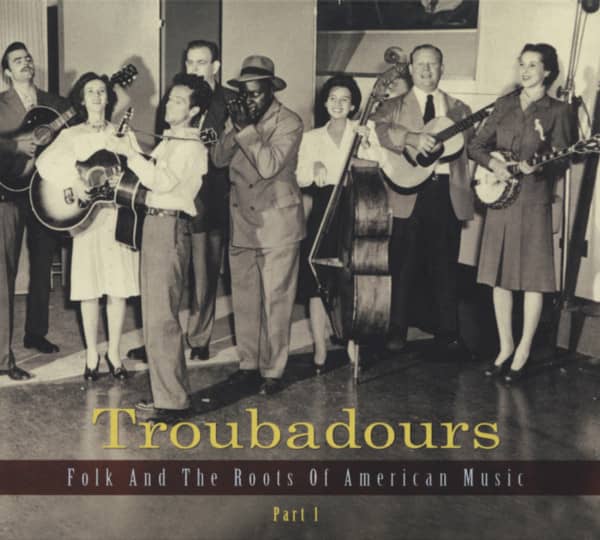
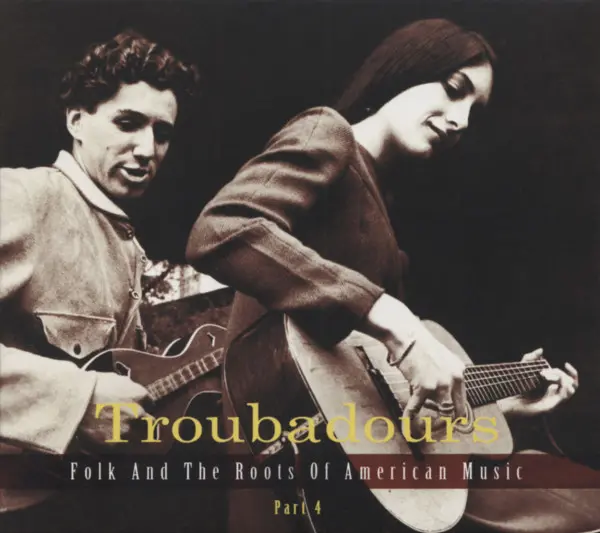
The history of the American singer-songwriters
Jackson Browne, Bob Dylan, Carole King, Joni Mitchell and James Taylor are usually cited as the founders of the contemporary singer-songwriter movement in America. The American songwriting tradition, however, goes back to the middle of the 19th century. It is deeply rooted in Anglo-Celtic ballads, Protestant revival hymns, African-American spirituals and work songs, and the minstrel and medicine shows. In addition, the English and American Romantics of the 18th and 19th centuries supplied ideas and role models for many of today's songwriters.
The experiences and energy of a young, motley nation in search of an identity provided the cultural backdrop for a rich folklore. Until the end of the First World War, the USA was essentially an agricultural nation, in places very sparsely populated. Folk songs were an ever-present part of daily life. They not only eased loneliness and monotonous work and offered relaxation during what were rather short evenings off, but also carried news as well as social and religious norms into remote areas. The close link between folklore and everyday life also helped to form a distinct American voice, as a new variant of the English language. In the later 19th century, individual pioneers began to draw on the folk pool for commercial and political purposes. Truly pioneering work was done, for example, by the Hutchinson Family from Milford, New Hampshire. They toured the United States with sacred and secular songs and often provided the musical backdrop for populist rallies. In the years before the First World War, the left-wing activists Joe Hill and Ralph Chaplin fashioned sardonic anthems for the Industrial Workers of the World out of traditional songs and hymns.
In the early twenties, Virginia-born Bentley Ball gave song recitals of Appalachian ballads, cowboy songs and even musical examples from some Native American tribes to fascinated urban audiences. From 1918 to 1920 he was the first to record folk standards such as Jesse James and The Dying Cowboy. Marion Try Slaughter, a Texas-born operetta singer who performed under the name Vernon Dalhart, recorded versions of The Wreck Of The Southern 97 and The Prisoner's Song four years later, heralding a new way of handling old material. Though by no means authentic, they caught the public's ear and sold several hundred thousand copies.
The minstrel tradition arose in the American South in the 1830s and had a lasting influence on various roots music styles. In the minstrel shows, white musicians imitated and caricatured black music, culture and speech. To conform to the racist norms of the time, they had to black up their faces. Ironically, the music being imitated was itself an imitation of the Irish-Scottish fiddle dance music of the day. Over time, the Celtic melodies and rhythms blended with African rhythms and styles of interpretation, and an increasingly distinctive American music emerged. After the Civil War, African Americans also appeared in the shows. Because of the prevailing racial segregation, however, they too had to black up their faces!
This kind of music was also used in the so-called medicine shows: travelling sales and entertainment events with music, acrobatics and every kind of sideshow. The climax was the appearance of a supposed doctor touting a miracle cure. These elixirs, usually high-proof home-distilled liquor rounded off with a few local herbs, could cure everything: warts, impotence, flu, bile complaints and, above all, headaches! Here, however, musicians of different cultures and races came together and inevitably exchanged ideas. The music met American frontier humour and developed wisdoms, lyrics and entertainment patterns that still hold true to this day. Today's folk canon and its dissemination, as well as generations of musicians and singers, would not have been possible without these travelling shows. The ideal – or cliché – of the truth-seeking, often suffering artist who wants to share his insights with the world certainly goes back to English Romanticism. From American counterparts such as Thoreau and Emerson come the sober, pragmatic virtues meant to help avoid repeating the mistakes of the Old World in the New. The parallels in political as well as philosophical and ethical awareness between the Romantic poets and their equally romantic colleagues of the 20th and 21st centuries are undeniable.
For the sake of clarity, we refer here only to performers who also toured with programmes and thus enriched the tradition of oral transmission in this way. From the middle of the 19th century there were also a few professional songwriters, such as the world-famous Stephen Foster (1826-1864). His 'Oh! Susanna' is perhaps America's best-known 'folk song'.
Speaking of singer-songwriters in the folk traditions of that era is, however, problematic. Apart from Carson Robison and other exceptions, most singers were referred to as songsters: the term describes musicians who drew on the large pool of minstrel, medicine-show, folk and pop songs and performed them at all kinds of public and private events. Their creative achievement lay in adapting the songs to the prevailing cultural conditions and to their own artistic ideas. Current events and world-shaking happenings, such as the sinking of the Titanic, were skilfully worked into old material. This quality makes the songsters the direct forerunners of today's singer-songwriters. 'Lead Belly', for example, judging by his repertoire and his way of working, would strictly speaking be more of a songster.
The I.W.W., or 'Wobblies', was an internationally organised trade union whose aims included the abolition of wages, which was meant to result in all workers being placed on an equal footing.
Copyright © Bear Family Records
Copyright © Bear Family Records®. Copying, also of extracts, or any other form of reproduction, including the adaptation into electronic data bases and copying onto any data mediums, in English or in any other language is permissible only and exclusively with the written consent of Bear Family Records® GmbH.

Ready to ship today, delivery time** appr. 1-3 workdays

Ready to ship today, delivery time** appr. 1-3 workdays

Ready to ship today, delivery time** appr. 1-3 workdays

Ready to ship today, delivery time** appr. 1-3 workdays

Ready to ship today, delivery time** appr. 1-3 workdays

Ready to ship today, delivery time** appr. 1-3 workdays
Ready to ship today, delivery time** appr. 1-3 workdays
Ready to ship today, delivery time** appr. 1-3 workdays

Ready to ship today, delivery time** appr. 1-3 workdays