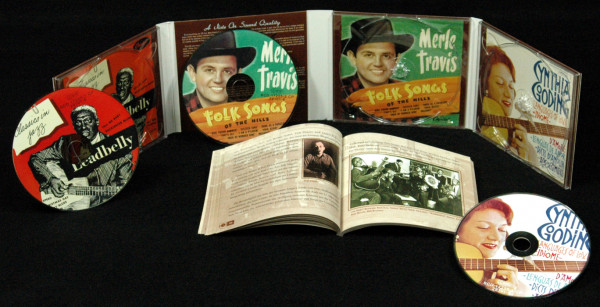
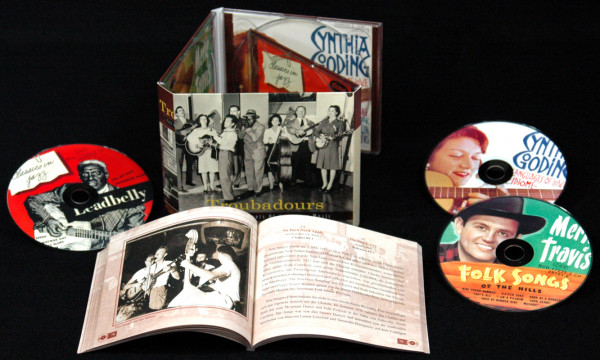
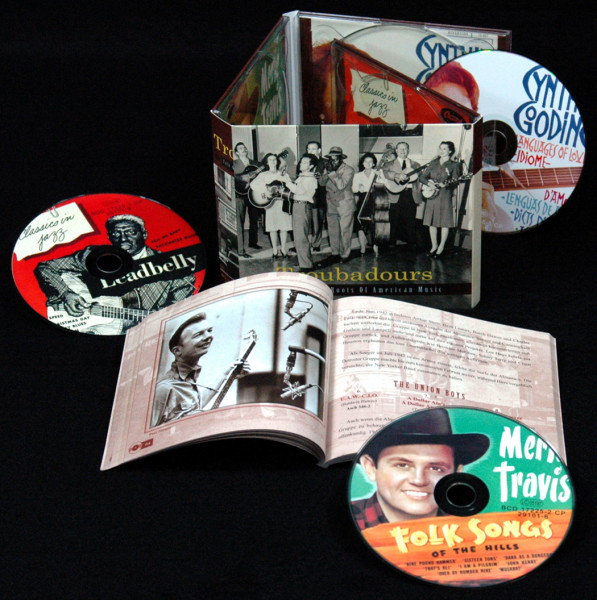
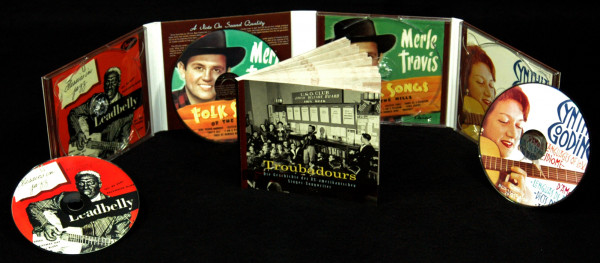
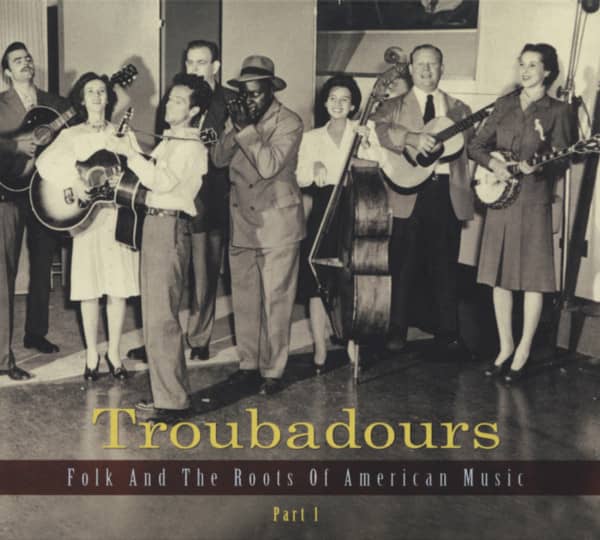
Various - Troubadours Vol.1, Folk And The Roots Of American Music (3-CD)
* incl. VAT / plus shipping costsDepending on the country of delivery, the VAT at checkout may vary.
Ready to ship today,
delivery time** appr. 1-3 workdays
Various - Troubadours: Vol.1, Folk And The Roots Of American Music (3-CD)
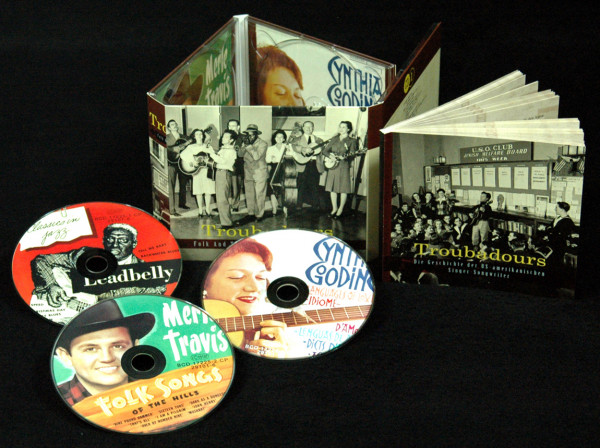
In the one hundred years that folk music has been recorded in the United States, the tradition has embraced ballads - mostly new, but some transplanted from Europe, political statements, personal introspection, and much more. Now the story is here from the 1920s to the 1970s and beyond in four exclusive 3-CD sets. Through this music, we feel it all from the isolation of early twentieth century Appalachia through the economic and political upheavals of the Depression, War, and Civil Rights eras to contemporary west coast singer-songwriters looking within for inspiration. The story is here: original artists and original versions in stunning sound with detailed notes from folk scholar Dave Samuelson.
The first set covers the period from the 1920s through to 1957. All the names you'd expect are here: the Carter Family, Woody Guthrie, Pete Seeger, the Weavers, Lead Belly, Cisco Houston, and many, many more. Here are the original versions of songs that have become classics and rallying cries: Wildwood Flower, Midnight Special, Rock Island Line, Wayfaring Stranger, So Long It's Been Good To Know You, This Land Is Your Land, 16 Tons, 900 Miles, Delia, and many, many more.
Video von Various - Troubadours - Vol.1, Folk And The Roots Of American Music (3-CD)
Article properties: Various - Troubadours: Vol.1, Folk And The Roots Of American Music (3-CD)
-
Artist: Various - Troubadours
-
Album titlle: Vol.1, Folk And The Roots Of American Music (3-CD)
-
Label Bear Family Records
-
Genre Folk
- Preiscode CP
- Edition 2 Deluxe Edition
-
Label preview_BCD17401
-
Artikelart CD
-
EAN: 5397102174018
- weight in Kg 0.25
| Various - Troubadours - Vol.1, Folk And The Roots Of American Music (3-CD) CD 1 | ||||
|---|---|---|---|---|
| 01 | I Never Will Marry | The Carter Family |
|
|
| 02 | Little Darling, Pal Of Mine | The Carter Family |
|
|
| 03 | Wildwood Flower | The Carter Family |
|
|
| 04 | The Midnight Special | Lead Belly |
|
|
| 05 | Western Plain (When I Was A Cowboy) | Lead Belly |
|
|
| 06 | Rock Island Line | Lead Belly |
|
|
| 07 | The Horse Named Bill | Carl Sandburg |
|
|
| 08 | Weave Room Blues | The Dixon Brothers |
|
|
| 09 | Joe Hill | Earl Robinson |
|
|
| 10 | The House I Live In | Earl Robinson |
|
|
| 11 | The Frozen Logger | Earl Robinson |
|
|
| 12 | One Meat Ball | Josh White |
|
|
| 13 | The Wayfaring Stranger | Burl Ives |
|
|
| 14 | Do Re Mi | Woody Guthrie |
|
|
| 15 | I Ain't Got No Home | Woody Guthrie |
|
|
| 16 | Pretty Boy Floyd | Woody Guthrie |
|
|
| 17 | Dusty Old Dust (So Long, It's Been Good To Know You) | Woody Guthrie |
|
|
| 18 | Babe O'mine | Woody Guthrie |
|
|
| 19 | Grand Coulee Dam | Woody Guthrie |
|
|
| 20 | Ramblin' Round | Woody Guthrie |
|
|
| 21 | Hard Travelin' | Woody Guthrie |
|
|
| 22 | This Land Is Your Land | Woody Guthrie |
|
|
| 23 | Philadelphia Lawyer | Guthrie, Woody & Houston, Cisco |
|
|
| 24 | I've Got To Know | Woody Guthrie |
|
|
| Various - Troubadours - Vol.1, Folk And The Roots Of American Music (3-CD) CD 2 | ||||
|---|---|---|---|---|
| 01 | Hard, Ain't It Hard | The Almanac Singers |
|
|
| 02 | Which Side Are You On | The Almanac Singers |
|
|
| 03 | Union Maid | The Almanac Singers |
|
|
| 04 | Union Train | The Almanac Singers |
|
|
| 05 | Sinking Of The Reuben James | The Almanac Singers |
|
|
| 06 | UAW-CIO | The Union Boys |
|
|
| 07 | A Dollar Ain't A Dollar Anymore | The Union Boys |
|
|
| 08 | Solidarity Forever | The Union Boys |
|
|
| 09 | Old Man Atom (Talking Atomic Blues) | Sam Hinton |
|
|
| 10 | Passing Through | Dick Blakeslee |
|
|
| 11 | Newspapermen Meet Such Interesting People | Vern Partlow |
|
|
| 12 | Winnsboro Cotton Mill Blues | Pete Seeger |
|
|
| 13 | The Death Of Harry Simms | Pete Seeger |
|
|
| 14 | No Irish Need Apply | Pete Seeger |
|
|
| 15 | Darling Corey | Pete Seeger |
|
|
| 16 | The Cry Of The Wild Goose | Terry Gilkyson |
|
|
| 17 | Sixteen Tons | Merle Travis |
|
|
| 18 | Dark As A Dungeon | Merle Travis |
|
|
| 19 | Wasn't That A Time | The Weavers |
|
|
| 20 | Banks Of Marble | The Weavers |
|
|
| 21 | The Hammer Song | The Weavers |
|
|
| 22 | Good-Night Irene | The Weavers |
|
|
| 23 | So Long, It's Been Good To Know You | The Weavers |
|
|
| 24 | Die Gedanken Sind Frei | Duncan & Lieberman & Sanders & Smith |
|
|
| Various - Troubadours - Vol.1, Folk And The Roots Of American Music (3-CD) CD 3 | ||||
|---|---|---|---|---|
| 01 | 900 Miles | Cisco Houston |
|
|
| 02 | Diamond Joe | Cisco Houston |
|
|
| 03 | Great American Bum | Cisco Houston |
|
|
| 04 | Jubilee | Jean Ritchie |
|
|
| 05 | Dear Companion | Jean Ritchie |
|
|
| 06 | Bootlegger's Song | Oscar Brand |
|
|
| 07 | Around Her Neck | Oscar Brand |
|
|
| 08 | Paper Of Pins | Brand, Oscar & Ritchie, Jean |
|
|
| 09 | Go Way From My Window | Cynthia Gooding |
|
|
| 10 | John Brown's Body | Ed Mccurdy |
|
|
| 11 | Raspberries, Strawberries (Ah Les Fraises Et Les Frambous) | Will Holt |
|
|
| 12 | The MTA | Will Holt |
|
|
| 13 | Delia | Bob Gibson |
|
|
| 14 | Abilene | Bob Gibson |
|
|
| 15 | Gotta Travel On | Paul Clayton |
|
|
| 16 | Who'll Gonna Buy You Ribbons When I'm Gone | Paul Clayton |
|
|
| 17 | Pay Day At Coal Creek | Paul Clayton |
|
|
| 18 | The Ballad Of Sigmund Freud | The Gateway Singers |
|
|
| 19 | Come To The Dance | The Gateway Singers |
|
|
| 20 | Marianne | The Easy Riders |
|
|
| 21 | Strolling Blues | The Easy Riders |
|
|
| 22 | Green Fields | The Easy Riders |
|
|
| 23 | Kari Waits For Me | The Easy Riders |
|
|
| 24 | Cindy Oh Cindy | Martin, Vince & Tarriers, The |
|
|
| 25 | The Banana Boat Song | The Tarriers |
|
|
| 26 | Those Brown Eyes | The Tarriers |
|
|
Troubadours
The history of the American singer-songwriters
Jackson Browne, Bob Dylan, Carole King, Joni Mitchell and James Taylor are usually cited as the founders of the contemporary singer-songwriter movement in America. The American songwriting tradition, however, goes back to the middle of the 19th century. It is deeply rooted in Anglo-Celtic ballads, Protestant revival hymns, African-American spirituals and work songs, and the minstrel and medicine shows. In addition, the English and American Romantics of the 18th and 19th centuries supplied ideas and role models for many of today's songwriters.
The experiences and energy of a young, motley nation in search of an identity provided the cultural backdrop for a rich folklore. Until the end of the First World War, the USA was essentially an agricultural nation, in places very sparsely populated. Folk songs were an ever-present part of daily life. They not only eased loneliness and monotonous work and offered relaxation during what were rather short evenings off, but also carried news as well as social and religious norms into remote areas. The close link between folklore and everyday life also helped to form a distinct American voice, as a new variant of the English language. In the later 19th century, individual pioneers began to draw on the folk pool for commercial and political purposes. Truly pioneering work was done, for example, by the Hutchinson Family from Milford, New Hampshire. They toured the United States with sacred and secular songs and often provided the musical backdrop for populist rallies. In the years before the First World War, the left-wing activists Joe Hill and Ralph Chaplin fashioned sardonic anthems for the Industrial Workers of the World out of traditional songs and hymns.
In the early twenties, Virginia-born Bentley Ball gave song recitals of Appalachian ballads, cowboy songs and even musical examples from some Native American tribes to fascinated urban audiences. From 1918 to 1920 he was the first to record folk standards such as Jesse James and The Dying Cowboy. Marion Try Slaughter, a Texas-born operetta singer who performed under the name Vernon Dalhart, recorded versions of The Wreck Of The Southern 97 and The Prisoner's Song four years later, heralding a new way of handling old material. Though by no means authentic, they caught the public's ear and sold several hundred thousand copies.
The minstrel tradition arose in the American South in the 1830s and had a lasting influence on various roots music styles. In the minstrel shows, white musicians imitated and caricatured black music, culture and speech. To conform to the racist norms of the time, they had to black up their faces. Ironically, the music being imitated was itself an imitation of the Irish-Scottish fiddle dance music of the day. Over time, the Celtic melodies and rhythms blended with African rhythms and styles of interpretation, and an increasingly distinctive American music emerged. After the Civil War, African Americans also appeared in the shows. Because of the prevailing racial segregation, however, they too had to black up their faces!
This kind of music was also used in the so-called medicine shows: travelling sales and entertainment events with music, acrobatics and every kind of sideshow. The climax was the appearance of a supposed doctor touting a miracle cure. These elixirs, usually high-proof home-distilled liquor rounded off with a few local herbs, could cure everything: warts, impotence, flu, bile complaints and, above all, headaches! Here, however, musicians of different cultures and races came together and inevitably exchanged ideas. The music met American frontier humour and developed wisdoms, lyrics and entertainment patterns that still hold true to this day. Today's folk canon and its dissemination, as well as generations of musicians and singers, would not have been possible without these travelling shows. The ideal – or cliché – of the truth-seeking, often suffering artist who wants to share his insights with the world certainly goes back to English Romanticism. From American counterparts such as Thoreau and Emerson come the sober, pragmatic virtues meant to help avoid repeating the mistakes of the Old World in the New. The parallels in political as well as philosophical and ethical awareness between the Romantic poets and their equally romantic colleagues of the 20th and 21st centuries are undeniable.
For the sake of clarity, we refer here only to performers who also toured with programmes and thus enriched the tradition of oral transmission in this way. From the middle of the 19th century there were also a few professional songwriters, such as the world-famous Stephen Foster (1826-1864). His 'Oh! Susanna' is perhaps America's best-known 'folk song'.
Speaking of singer-songwriters in the folk traditions of that era is, however, problematic. Apart from Carson Robison and other exceptions, most singers were referred to as songsters: the term describes musicians who drew on the large pool of minstrel, medicine-show, folk and pop songs and performed them at all kinds of public and private events. Their creative achievement lay in adapting the songs to the prevailing cultural conditions and to their own artistic ideas. Current events and world-shaking happenings, such as the sinking of the Titanic, were skilfully worked into old material. This quality makes the songsters the direct forerunners of today's singer-songwriters. 'Lead Belly', for example, judging by his repertoire and his way of working, would strictly speaking be more of a songster.
The I.W.W., or 'Wobblies', was an internationally organised trade union whose aims included the abolition of wages, which was meant to result in all workers being placed on an equal footing.
Copyright © Bear Family Records
A true gem
Vintage Rock 9-10/14 "A true gem!"
Record Collector 10/14 "Given its monumental scope, the series is hard to fault, most absorbing and highly enjoyable."
Ready to ship today, delivery time** appr. 1-3 workdays
Item has to be restocked
Ready to ship today, delivery time** appr. 1-3 workdays
This article is deleted and can no longer be ordered!
Ready to ship today, delivery time** appr. 1-3 workdays
Item has to be restocked
Ready to ship today, delivery time** appr. 1-3 workdays
Item has to be restocked
Ready to ship today, delivery time** appr. 1-3 workdays
Item has to be restocked