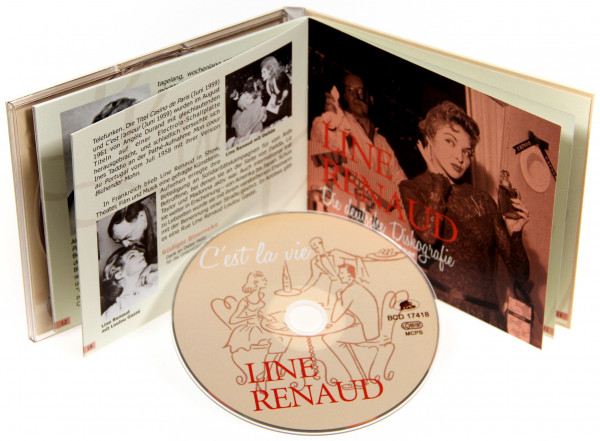
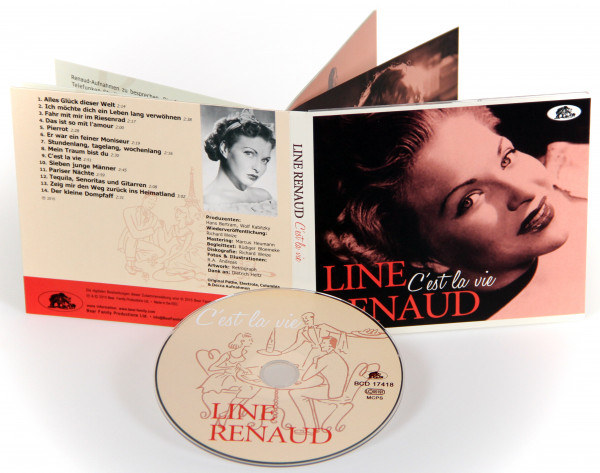
Line Renaud C'est la vie (CD)

* incl. VAT / plus shipping costsDepending on the country of delivery, the VAT at checkout may vary.
Ready to ship today,
delivery time** appr. 1-3 workdays
Line Renaud: C'est la vie (CD)
• , , ,French chansons are popular in Germany.
• , , ,As hardly any Germans were speaking French after WWII, chansonniers had to sing in German to be heard across the border.
• , , ,Line Renaud was a popular French Revue Star.
• , , ,Collection of her German language recordings.
In defiance of all the rivalries and wars in the last century, French chansons were popular entertainment in Germany. Although comprehension of the song lyrics was rather poor, they were consumed just like Baguette, Beaujolais or Camembert. In the Federal Republic of Germany after 1945 you were supposed to learn English in lieu of French. Consequently chansonniers from the neighboring country had to sing in German. In the case of Line Renaud it was advantageous that a German record company (Electrola) and a French record company (Pathé) were economically linked. Der kleine Dompfaff remains a negligible attempt in 1953. But then every endeavor has been made to make the acclaimed French Revue Star popular across the German border. In the movie '1000 Sterne leuchten' she appeared in person to present her German version of C'est la vie in cinemas in the Federal Republic. ,
As a result of the internationalization of the music industry she also went to the USA where she recorded with Dean Martin at the Capitol Recording Studio. After a few singles, Electrola lost interest in Line Renaud. But at the dawn of the 1960s the Teldec company sent producer Wolf Kabitzky and orchestra conductor Gert Wilden to Paris with prepared playbacks and German lyrics to overdub Line Renaud’s vocals. Wilden already had contributed his music to the movie '1000 Sterne leuchten'. They got along well. Wilden spoke perfect French and Renaud had already approached the German pronunciation. The repertoire was a weird mix of German Schlager music and American Country songs, and the spark wouldn't ignite on these sessions.
Like Renaud’s recordings for Electrola, her German Paris masters are part of an era when international recording stars from Louis Armstrong to Frank Zappa were experimenting with German lyrics. Only Jacqueline Boyer, Sascha Distel and Mireille Mathieu could prevail upon the German pop audience. Line Renaud continuously experienced international success as a revue star, also in the movies. ‘Bienvenue chez les Ch'tis’ was a huge box office success in 2008 with the 80-year-old Line Renaud playing the role of Antoine’s dominant mother.
Article properties: Line Renaud: C'est la vie (CD)
-
Artist: Line Renaud
-
Album titlle: C'est la vie (CD)
-
Genre Schlager und Volksmusik
-
Label Bear Family Records
- Preiscode AH
-
Artikelart CD
-
EAN: 5397102174186
- weight in Kg 0.2
| Renaud, Line - C'est la vie (CD) CD 1 | ||||
|---|---|---|---|---|
| 01 | Alles Glück dieser Welt | Renaud, Line |
|
|
| 02 | Ich möchte dich ein Leben lang verwöhnen | Renaud, Line |
|
|
| 03 | Fahr mit mir im Riesenrad | Renaud, Line |
|
|
| 04 | Das ist so mit l'amour | Renaud, Line |
|
|
| 05 | Pierrot | Renaud, Line |
|
|
| 06 | Er war ein feiner Moniseur | Renaud, Line |
|
|
| 07 | Stundenlang, tagelang, wochenlang | Renaud, Line |
|
|
| 08 | Mein Traum bist du | Renaud, Line |
|
|
| 09 | C'est la vie | Renaud, Line |
|
|
| 10 | Sieben junge Männer | Renaud, Line |
|
|
| 11 | Pariser Nächte | Renaud, Line |
|
|
| 12 | Tequila, Senoritas und Gitarren | Renaud, Line |
|
|
| 13 | Zeig mir den Weg zurück ins Heimatland | Renaud, Line |
|
|
| 14 | Der kleine Dompfaff | Renaud, Line |
|
|
Line Renaud
Lovers of French cinema know Line Renaud from comedies such as 'Gauner gegen Gauner' and 'Meine schöne Schwiegermutter' (to use their German titles), in which she appeared alongside Philippe Noiret and Jean-Claude Brialy, or Catherine Deneuve and Stéphane Audran. 'Bienvenue chez les Ch'tis', in which the 80-year-old played Antoine's domineering mother in 2008, became a major international box-office success. Anyone who went to the cinema back in the 1950s could even see Line Renaud in the German film '1000 Sterne leuchten', made 50 years before the 'Ch'tis'. This revue picture, with the mix-ups and confusions typical of the time, was also the starting point for her guest appearance on the German music scene, which stretched over five years. Her co-stars in the little Schlager film were the hitmakers Ralf Bendix and Chris Howland, both produced for Electrola by Cologne's Hans Bertram. At the same time as the filming, he also brought the Frenchwoman Renaud into the recording studio. She had already sung Stundenlang, tagelang, wochenlang for Bertram; now she got the chance to present C'est la vie in German cinemas.
The link to Electrola in Cologne came about because Line Renaud was under contract to its Paris sister company, Pathé. She had even made one earlier attempt there with the German titles Der kleine Dompfaff and Zeig mir den Weg zurück ins Heimatland. That was in 1953. In those days, recalling Johann Strauss's 'Der Zigeunerbaron' ('the bullfinch married us'), one could still have the bullfinch in the linden tree twittering of love. Homespun wisdom – youth and May pass, but true love lasts forever – was also the order of the day in Schlager. Line Renaud battled her way through the foreign language, and the French habit of dropping the H led to unintended comedy: "Wenn sich die (H)erzen finden". Zeig mir den Weg zurück ins Heimatland, on the other hand, was meant in all seriousness. Such homeland songs were booming at a time when the many refugees and expellees in the Federal Republic were mourning the lands of their birth. The accompanying organ underlines how Line Renaud sings of her 'longing' and agonises through her 'loneliness'.
That five years later she left her homeland and made the journey to the Rhine was not exactly a matter of course a good decade after the war. Charles de Gaulle and Konrad Adenauer had shaken hands in reconciliation in 1958, but in France the wounds were far from healed. Line Renaud's youth in French Flanders had been overshadowed by the horror of the German invasion. Born on 2 July 1928, she grew up as Jacqueline Enté in Pont-de-Nieppe, near Dunkirk. During the First World War the town had already been the scene of fighting between British and German troops, the outcome of which can be seen in the military cemetery there. In September 1944 fighters of the French resistance, the FFI (Forces françaises de l'intérieur), put to flight German soldiers who were trying to blow up the railway bridge at Pont-de-Nieppe on the Lille–Dunkirk line. Repeated attempts by German troops to retake the bridge failed, and many German soldiers were taken prisoner. The revenge was terrible: an SS unit stationed in Nieppe freed the prisoners, shot French prisoners and the next day executed 18 male villagers. Then they blew up the bridge, two days before the first British troops reached Pont-de-Nieppe.
In 2008 Line Renaud returned to her home village and, during her visit, recalled the horrors of the war. Back then she had stood anxiously at the roadside to see whether her father was among the French prisoners the Germans were driving through the village. And she had cheered with the others when the British liberated the town. But unlike Juliette Gréco, who was the same age and was drawn into the Résistance through her mother and sister, Jacqueline was not politicised by the presence of the FFI. Comparing the different paths of the two 'vedettes', both of whom first set foot on German soil in 1958/59, can help to characterise Line Renaud. Juliette Gréco, who had been arrested by the Gestapo and whose mother and sister were deported to the Ravensbrück concentration camp, found herself after the war in the orbit of existentialists such as Jean-Paul Sartre, who also wrote chanson lyrics for her. As the 'muse of Saint-Germain-des-Prés' – black-haired, dressed in black – she became the darling of the intellectuals. Line Renaud's path led first to Lille. There she auditioned for the conservatoire with chansons by the successful composer Louis 'Loulou' Gasté and was promptly engaged by Radio Lille as a singer under the pseudonym Jacqueline Ray. Only later, at the side of Gasté, who as a guitarist and banjo player had already accompanied Josephine Baker, did the blonde develop into a Paris revue star in body stocking and feather boa. But first things first.
She had inherited her love of music from her father, a lorry driver who played the trumpet in his spare time. Her mother, a shorthand typist, wanted her daughter to become a teacher. But at the age of seven Jacqueline was already taking her first step in another direction when she entered a singing competition. And during the war she sang in her grandmother's café in Armentières for the French and Allied soldiers billeted there. As Jacqueline Ray in Lille, she relied entirely on Gasté's repertoire, which after all had got her the radio job. At the end of the war she decided to venture onto the bigger stage of Paris. First stop: the music hall 'Folies Belleville'. In September 1945 she met Louis Gasté for the first time – he was 37, she was 16. The famous composer, who had played jazz with Django Reinhardt, discovered in her an Eliza Doolittle whom he – in the role of Professor Higgins, as in George Bernard Shaw's 'Pygmalion' – could transform from a provincial singer into a big-city star.
The changes were radical: from her name – her first name was shortened, her surname replaced by her grandmother's – to her hairstyle, her clothes, her stage manner and her singing style. Broadcasts on Radio Luxembourg made her name popular nationwide and earned her a recording contract with Pathé. Her recording of Ma Cabane au Canada, a Gasté composition from 1948, won her the 'Grand Prix du Disque'. Further milestones: the 'Théâtre de l'A.B.C.' and the 'Moulin Rouge', as well as her first film roles. In 1954 Line, by now Madame Gasté, was the main attraction at the 'Moulin Rouge'. One evening Bob Hope was in the audience. He made the next step in her career possible. Instead of the planned four days, she was kept busy in the States for four months. Besides guest appearances on his US television show, she received offers from New York's Waldorf Astoria and the 'Cocoanut Grove' in Los Angeles. America had a soft spot for French revues at the time, and Las Vegas could always use fresh supplies. Dean Martin saw the chance to enlarge his fan base in France and on 27 April 1955 recorded the songs Relax-Ay-Voo (in correct French 'Relaxez-vous', meaning 'relax') and Two Sleepy People with her at Hollywood's Capitol Recording Studio. In return, she tried to conquer America on the Capitol label with English versions of Gasté compositions.
From then on Line Renaud lived on two continents and later – as she confessed in her autobiography 'Et mes secrets aussi' – with two men. In Las Vegas in 1965 she met and fell in love with Nate Jacobson, later director of 'Caesar's Palace'. She stayed with him and Louis Gasté until their deaths. Her show business life, too – on stage and on television – was from then on divided between France and the USA. Revues at the 'Dunes' and revues at the 'Casino de Paris' were among the highlights. Her duet partners ranged from Johnny Mathis to Nana Mouskouri.
Louis Gasté, whose most famous composition Feelings was recorded by world stars such as Elvis Presley, Frank Sinatra and Sarah Vaughan, died in 1995. In 2002 Renaud dedicated the book 'Loulou, envoie-moi un arc-en-ciel' ('Loulou, send me a rainbow') to him, in which she insisted that Gasté was sending her signs from the beyond. That was entirely in keeping with the dream world she staged on stage. Her public persona, after all, included the pose and the grand gesture.
Unlike Juliette Gréco, who despite her reservations performed her chansons again and again in Germany's big cities, no tours of Germany by Line Renaud are known. At first Electrola in Cologne did not seem quite sure how to place her. This was just the start of the period when every international star who didn't run away was pressed into service in German by local producers – from Louis Armstrong to Frank Zappa. In June 1958 Hans Bertram presented Line Renaud with Margie Rayburn's Top 10 hit I'm Available from the previous year. The arrangement followed the original. Evidently nobody had thought of a French model; they preferred to bank on the popularity of American pop music. Where Line Renaud was to be placed on the German market was clear: the timbre of her voice lay somewhere between Lys Assia, Bibi Johns and Caterina Valente. The backing tracks had already been recorded when Line Renaud came into the studio. The language no longer seemed to give her any trouble, although an accent can be heard here and there. Whether she understood Ralph Maria Siegel's lyric when she sang Stundenlang, tagelang, wochenlang – a line about always wanting to gaze lovingly into her sweetheart's eyes – is open to question. With Siegel, Bertram had brought in a proven writer of the older generation. The B-side Mein Traum bist du (Ich bin so verliebt in dich), too – originally Lights Out, written by Billy Hill in the 1930s (with an original version from 1948 by Spade Cooley) – fitted seamlessly into the Schlager world of the 1950s, but did not stand out from it either.
For Electrola's next releases, the backing tracks for the filming of '1000 Sterne leuchten' were ready...
Excerpt from: Line Renaud – C'est la vie
Copyright © Bear Family Records
Die CD ist sehr interessant , gerade weil man die Interpretin in Deutschland wohl weniger kennt.
Die CD ist sehr gut, das Booklet ist einzigartig. Es hätten nur noch ein paar (französische) Titel mehr sein können.
eine sehr schöne CD
Ready to ship today, delivery time** appr. 1-3 workdays
the very last 1 available
Ready to ship today, delivery time** appr. 1-3 workdays
Max Greger's Dance Orchester: Strict Tempo Dancing- Slow Foxtrot (7inch,...
Item no.: 21621HIFIReady to ship today, delivery time** appr. 1-3 workdays
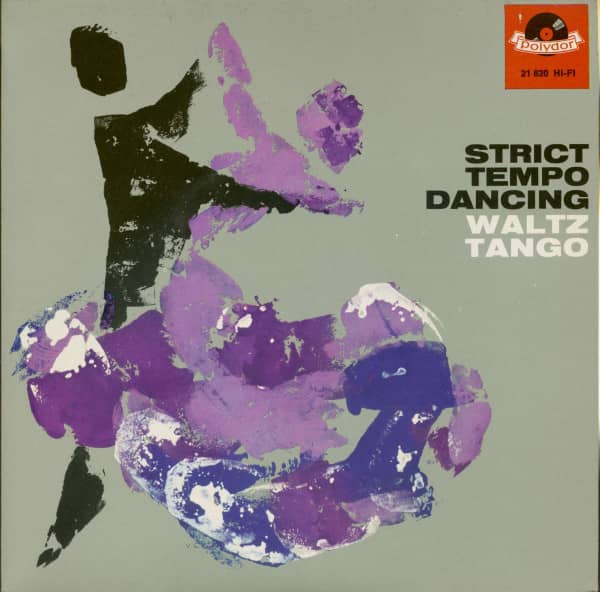
Ready to ship today, delivery time** appr. 1-3 workdays

Item has to be restocked
the very last 2 available
Ready to ship today, delivery time** appr. 1-3 workdays