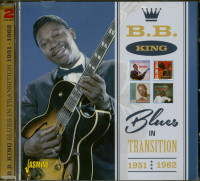
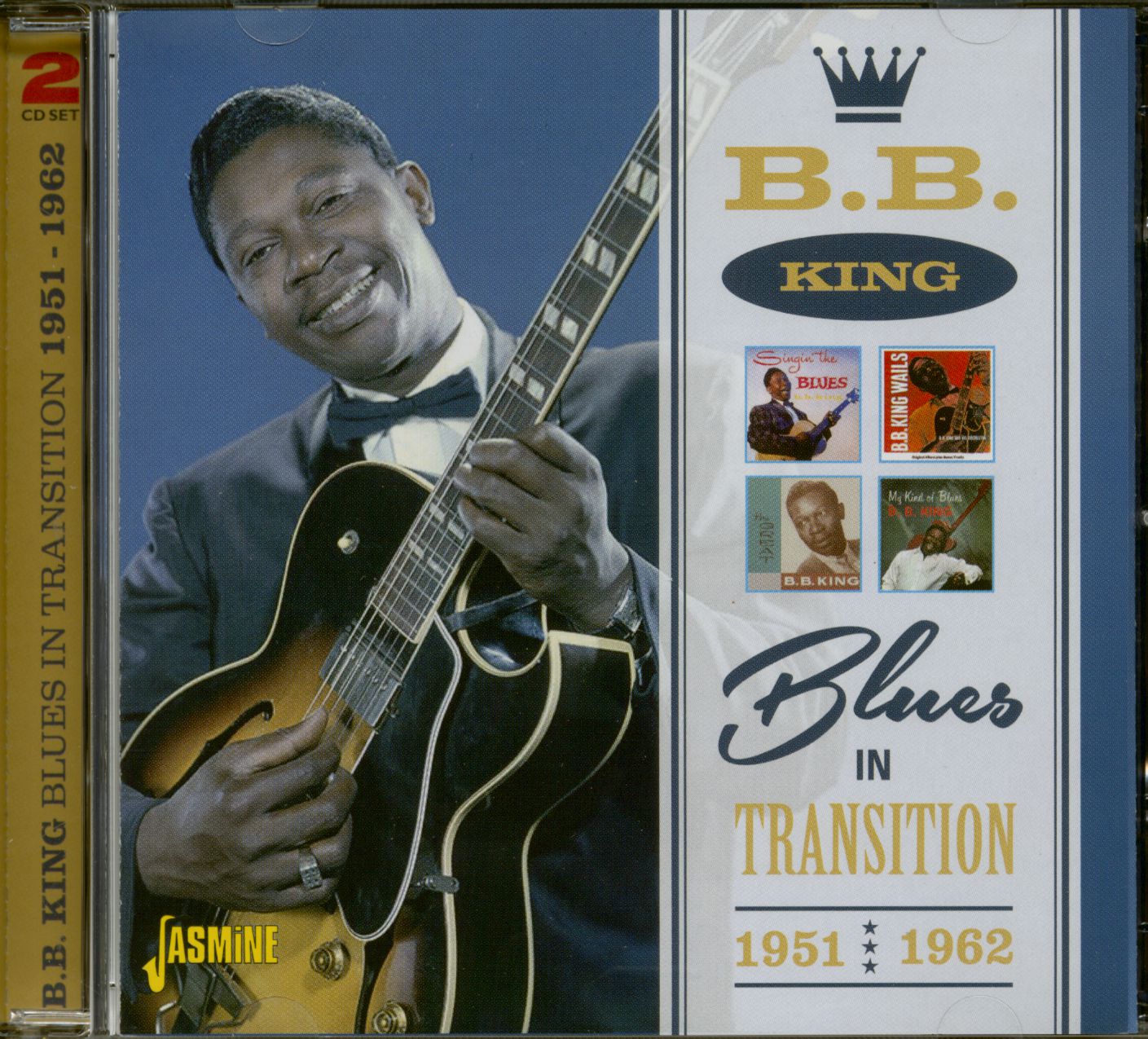
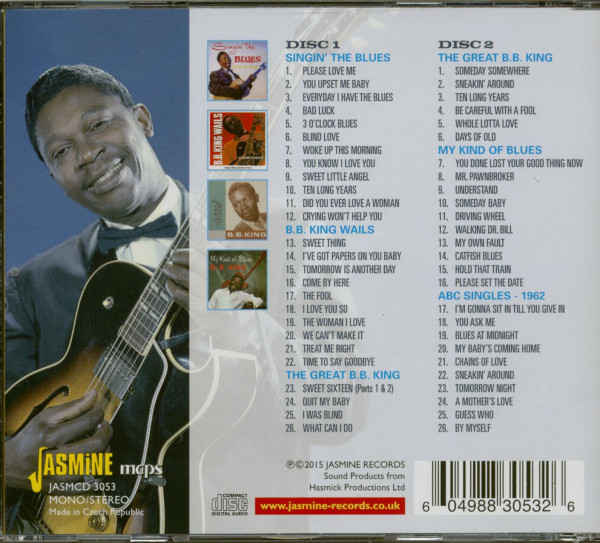
B.B. King Blues In Transition (2-CD)

* incl. VAT / plus shipping costsDepending on the country of delivery, the VAT at checkout may vary.
only 1x still available
Ready to ship today,
delivery time** appr. 1-3 workdays
- catalog number:CDJAS3053
- weight in Kg 0.14
B.B. King: Blues In Transition (2-CD)
By the '70s and the release of 'The Thrill Has Gone', B.B. King really was the 'King of The Blues' and this CD set is a great way to acquire some of his greatest hits and most influential recordings.
Article properties:B.B. King: Blues In Transition (2-CD)
Artist: B.B. King
Album titlle: Blues In Transition (2-CD)
Genre Blues
Label Jasmine Records
Artikelart CD
EAN: 0604988305326
- weight in Kg 0.14
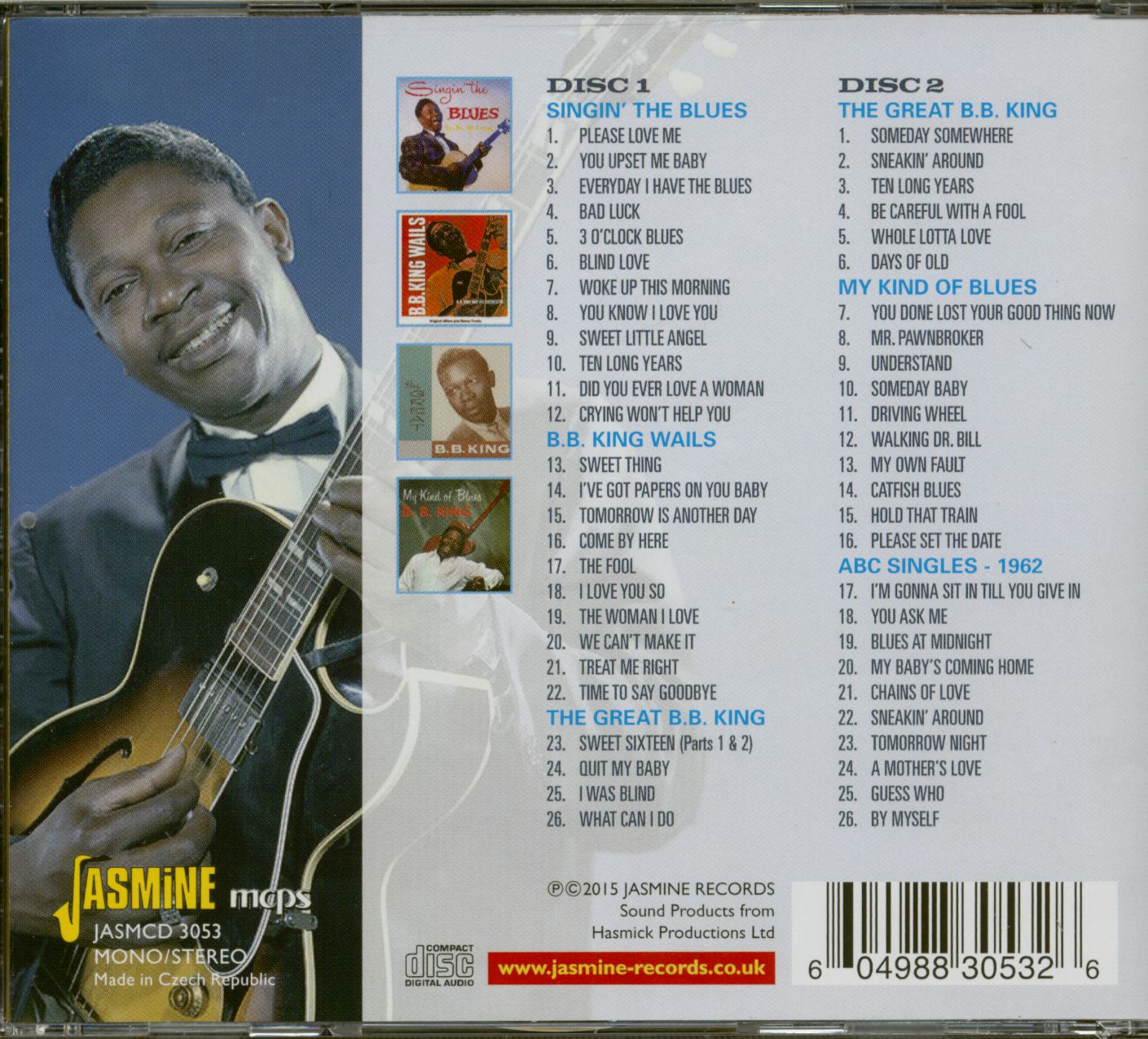
| King, B.B. - Blues In Transition (2-CD) CD 1 | ||||
|---|---|---|---|---|
| 01 | Please Love Me | B.B. King | ||
| 02 | You Upset Me Baby | B.B. King | ||
| 03 | Everyday I Have The Blues | B.B. King | ||
| 04 | Bad Luck | B.B. King | ||
| 05 | 3 O'clock Blues | B.B. King | ||
| 06 | Blind Love | B.B. King | ||
| 07 | Woke Up This Morning | B.B. King | ||
| 08 | You Know I Love You | B.B. King | ||
| 09 | Sweet Little Angel | B.B. King | ||
| 10 | Ten Long Years | B.B. King | ||
| 11 | Did You Ever Love A Woman | B.B. King | ||
| 12 | Crying Won't Help You | B.B. King | ||
| 13 | Sweet Thing | B.B. King | ||
| 14 | I've Got Papers On You Baby | B.B. King | ||
| 15 | Tomorrow Is Another Day | B.B. King | ||
| 16 | Come By Here | B.B. King | ||
| 17 | The Fool | B.B. King | ||
| 18 | I Love You So | B.B. King | ||
| 19 | The Woman I Love | B.B. King | ||
| 20 | We Can't Make It | B.B. King | ||
| 21 | Treat Me Right | B.B. King | ||
| 22 | Time To Say Goodbye | B.B. King | ||
| 23 | Sweet Sixteen (Parts 1 & 2) | B.B. King | ||
| 24 | Quit My Baby | B.B. King | ||
| 25 | I Was Blind | B.B. King | ||
| 26 | What Can I Do | B.B. King | ||
| King, B.B. - Blues In Transition (2-CD) CD 2 | ||||
|---|---|---|---|---|
| 01 | Someday Somewhere | B.B. King | ||
| 02 | Sneakin' Around | B.B. King | ||
| 03 | Ten Long Years | B.B. King | ||
| 04 | Be Careful With A Fool | B.B. King | ||
| 05 | Whole Lotta Love | B.B. King | ||
| 06 | Days Of Old | B.B. King | ||
| 07 | You Done Lost Your Good Thing Now | B.B. King | ||
| 08 | Mr Pawnbroker | B.B. King | ||
| 09 | Understand | B.B. King | ||
| 10 | Someday Baby | B.B. King | ||
| 11 | Driving Wheel | B.B. King | ||
| 12 | Walking Dr Bill | B.B. King | ||
| 13 | My Own Fault | B.B. King | ||
| 14 | Catfish Blues | B.B. King | ||
| 15 | Hold That Train | B.B. King | ||
| 16 | Please Set The Date | B.B. King | ||
| 17 | I'm Gonna Sit In Till You Give In | B.B. King | ||
| 18 | You Ask Me | B.B. King | ||
| 19 | Blues At Midnight | B.B. King | ||
| 20 | My Baby's Coming Home | B.B. King | ||
| 21 | Chains Of Love | B.B. King | ||
| 22 | Sneakin' Around | B.B. King | ||
| 23 | Tomorrow Night | B.B. King | ||
| 24 | A Mother's Love | B.B. King | ||
| 25 | Guess Who | B.B. King | ||
| 26 | By Myself | B.B. King | ||
B.B. King
16 September 1925 – 14 May 2015
If T-Bone Walker was the father of the electric blues guitar, then B.B. King is the gentleman who brought it to the masses. Over an unrivalled recording career that has now spanned more than six decades, he invented the guitar licks that define the genre. Born in the heart of the Mississippi Delta near Itta Bena on September 16, 1925, Riley B. King took T-Bone as one of his points of departure on guitar. 'But there were others like Lemon Jefferson – we called him Blind Lemon – Lonnie Johnson, Charlie Christian and Django Reinhardt,' says B.B. 'These were the people who were most influential.' Slide guitarist Bukka White, a star of prewar blues, was a cousin of his mother's and an early mentor – King wanted to imitate White's singing slide sound, but without using a bottleneck.
Shortly after arriving in Memphis in early 1949, King landed a slot on the pioneering radio station WDIA. 'I needed a job, a gig in one of the clubs,' says King. 'The club owners more or less pushed me into radio, because they said if I had a show, I could advertise the place I was playing, the way some of the other guys in town did. And when I went over and applied for a job at the radio station, to play there as a musician, they hired me the same day to play there by myself, more in a folk guitar style. After about two months my program was very, very popular, so I formed a trio. And around that time one of the disc jockeys left the station. When he left, they said: “Be the disc jockey.”' That was also where he became 'B.B.' – short for his earlier nickname 'Beale Street Blues Boy'. King cut his first two 78s for the Bullet logo in mid-1949, but his recording career really began a year later, when the Bihari brothers signed him to their RPM subsidiary. His early RPM releases were recorded at Sam Phillips' still young Memphis Recording Service. 'His studio was one of the first I had ever seen that was really a studio,' notes B.B.
But the rift between the Biharis and Phillips meant that B.B. King's first No. 1 R&B hit was cut elsewhere in Memphis in 1952. 'When we did “Three O'Clock Blues”, we recorded it at the YMCA,' says B.B. King. 'The Bihari brothers, who I recorded for, used to bring portable recording equipment when they came to town, like Ampex 600s. That kind of thing. They set it up in whatever empty room we could find.' B.B. recorded his next R&B chart-topper of 1953 in a more professional setting, Bill Holford's ACA Studios in Houston. By then B.B. King was already touring and no longer a deejay at WDIA. The arrangement of Woke Up This Morning (recorded with the band of tenor saxophonist Bill Harvey, which included pianist Connie Mack Booker, bassist James Walker, drummer Ted Curry, four horns and a conga player) switches briskly between a crisp Latin rhythm and full-on swing. B.B. King had come light years since his debut recordings, both vocally and on guitar (as a comparison with the earlier and very similar My Baby's Gone proves).
Once B.B. King had really got going, he was firmly on his way to being crowned the undisputed 'King of the Blues'. King developed into a road warrior of unmatched stamina and recorded a huge amount of material for the Bihari brothers' RPM label, including one hit after another. Please Love Me was B.B. King's second No. 1 R&B hit of 1953. Here he fulfils his dream of imitating the sound of a slide guitar with nothing but his fingers, on a Dust My Broom-style house rocker – he achieves the cutting attack of an Elmore James without using a bottleneck or retuning his guitar. Like his previous chart-topper Woke Up This Morning, Please Love Me was cut at ACA Studios in Houston with his horn-laden touring band led by tenor saxophonist Bill Harvey. Much as today, electric guitars were not exactly cheap in those early years, and B.B. was very attached to his – attached enough to risk his life rescuing it from the flames. 'I used to play at a place called Twist, Arkansas,' he recounts. 'For a while we played there every Friday and Saturday night. When it rained, Sundays too, because when it rained people didn't have to go to work the next day. Twist is a little plantation town. In winter it got pretty cold there. So they took something that looked like a big garbage pail. They half-filled it with kerosene. They lit the kerosene, and that's what we used for heat in the winter. The people who came there regularly usually danced around the container and never touched it. But on this particular night two guys started fighting. One of them hit the other so that he fell on the container. Then the kerosene ran across the floor. It was already burning; it looked like a river of fire. So everybody ran for the front door, me included.
'But when I got outside, I realized I had run out without my guitar. So I ran back in to get it. As I did, the building started to collapse around me. So I almost lost my life trying to save it. The next morning we found two men who had burned to death in there. We also found out that the two guys had been fighting over a woman. I never met her, but we learned that she was the cook and her name was Lucille. So I named my guitar Lucille, to remind me never to do anything that foolish again. I always say you can get another guitar, but not another B.B. King!' After cutting a string of groundbreaking hits for the Bihari brothers' RPM and Kent labels in L.A., which to a considerable extent defined the vocabulary of the electric blues guitar as we know it today, B.B. King moved in 1962 to one of the major labels, ABC-Paramount. So why was his biggest seller of 1964 back on Kent? Did No. 34 in the pop charts for Rock Me Baby show that the Biharis knew better than the suits at ABC how to get the best out of their former artist? Before leaving Kent, B.B. had recorded a reservoir of titles from which the Biharis could draw for years to come, competing directly with his new releases on ABC. But why had it taken them so long to dig up Rock Me Baby? The no-frills, straight-ahead stomper was sparer and rougher than the more polished production techniques ABC applied to its new signing (which was probably one of the main reasons why B.B. had not yet landed a bigger seller for his new label).
Unlike most of B.B. King's horn-driven recordings, Rock Me Baby has him accompanied only by a rhythm section (Maxwell Davis, Jimmy McCracklin and Lloyd Glenn are all named as possible pianists on the session). The roots of Rock Me Baby go back to Arthur 'Big Boy' Crudup's 1944 original Rock Me Mama, although B.B. King may have started from Texas blues guitarist Lil' Son Jackson's 1950 recording Rockin' And Rollin' – or from a combination of the two. The original Kent single lists B.B. King and Joe Bihari (under his pseudonym Joe Josea) as writers, not Big Boy or Lil' Son, which was common practice at Kent. When B.B. had a huge success in 1960 with his remake of Big Joe Turner's 1952 hit Sweet Sixteen, the same writer names appeared on the label – without crediting the actual composer, Atlantic Records founder Ahmet Ertegun. B.B.'s Rock Me Baby is the definitive version of the song – Otis Redding followed with a hot cover dominated by Steve Cropper's vicious guitar, and countless others followed. B.B. King keeps his guitar licks short and to the point, right on the money – by now he had pared his solos down to the essentials and did not waste a single note. The mood is similar to B.B. King's classic 1960 Crown album 'My Kind Of Blues', on which he was backed only by a trio led by Glenn. 'That was my favorite album,' says King. 'Because we went into the studio one night with a rhythm section and just cut it in one or two takes.
'We actually did the whole LP in one night, in a couple of hours. It was just fun to play.' Like no other blues guitarist of his generation, B.B. King kept an eye on musical trends and adapted his own approach accordingly. As a result, he remained consistently more popular with a broader audience over a long period than most of his musical contemporaries. At times, however, this resulted in recordings that diluted his sound rather than enhancing it. But for the most part the modernizations of B.B.'s sound were well executed, kept him in the R&B charts and frequently even took him into the pop lists after he scored a big crossover success with The Thrill Is Gone in 1970 (found on the next CD). 'If you don't do something similar to what's being played today, your records won't get played. I learned that a long time ago,' he says. 'Sometimes I get criticized for things that some people think a blues singer, a blues musician, shouldn't play. But I think, let them criticize me. I play what I feel. I play what I like. I did that when I recorded “Three O'Clock Blues”, and that's how I'll keep on doing it.' In 1962 King had ventured from the Bihari brothers' Kent label, where he was marketed exclusively to an R&B audience (his Crown LPs for the Biharis were all budget-priced albums – not exactly good for one's self-esteem), to the major record company ABC-Paramount. The company had Black artists with pop potential such as Lloyd Price, The Impressions and Ray Charles under contract, but it took B.B. several years after the move to re-establish himself with R&B fans. Sometimes his qualities were buried in overblown arrangements, but in 1964 ABC got everything right on his legendary album 'Live At The Regal' ('Blues Is King', a follow-up recorded live at the Burning Spear nightclub in Chicago, was even hotter).
The two-part Don't Answer The Door (1966) and the snarling Paying The Cost To Be The Boss (1968) were also strong singles that sold well. B.B. King was already working with superstars from outside the blues scene when in 1973 he cut the sinuous To Know You Is To Love You, set firmly in a minor key, the title song of an LP that brought B.B. closer than ever before to the realms of soul music. Producer-arranger-keyboardist Dave Crawford gave the guitarist the smooth, buoyant Philly soul sound by recording him with the elegant rhythm section that powered the city's nonstop hit machine at the time: Earl Young (drums), Ronnie Baker (bass), Norman Harris, Roland Chambers and Bobby Eli (guitars) and Larry Washington on congas. As a guest, co-writer Stevie Wonder could be heard on keyboards, his shimmering electric piano crisply underscoring B.B. King's vocals.
Wonder had written the song with his then wife Syreeta Wright for her 1972 MoWest album 'Syreeta', and she also released it as a single. B.B., the old pro, turned To Know You Is To Love You into a #12 R&B and #38 pop hit in 1973. After two decades of extremely busy recording activity and a mountain of R&B hits, B.B. King finally broke through to the broad American mainstream audience in 1970 with his classic reinterpretation of a rather obscure blues by Roy Hawkins. Perhaps it was the imposing strings, the gentle minor-key mood or the winning combination of B.B. King's incisive vocals and the terse guitar licks, played right on the money, that he drew from his 'Lucille' (nobody said so much with so few notes). Most likely it was all of these together.
In B.B. King's hands, The Thrill Is Gone instantly became a blues standard. B.B. had never before made it as high as No. 15 in the pop charts, but in early 1970 The Thrill got him there. No. 3 in the R&B charts surely pleased the blues veteran too, for B.B. never let his sound gather dust. Hawkins, a blues pianist from Richmond, California, had been part of the same Modern Records label family as B.B. in the early 1950s – in 1951 he reached No. 6 in the R&B charts with the song he had composed with Galveston, Texas-born songwriter Rick Darnell. The two writers had the bad luck that The Thrill had meanwhile fallen into such obscurity that they were initially not correctly credited as composers on B.B. King's remake. Instead, the royalties went to Art Benson and Dale Pettite, who had at some point written the even more obscure The Thrill Is Gone (From Yesterday's Kiss). In any case, B.B. completely reworked the gloomy blues and opened up a whole new audience for himself with it. 'Better late than never,' says B.B. King. 'I think it had to do with the timing back then. Because I didn't do anything different.' B.B. had long had The Thrill Is Gone in the back of his mind and was delighted to be able to record it in June 1969 at the Hit Factory in New York with Paul Harris on keyboards, Jerry Jemmott on bass, Herbie Lovelle on drums and Hugh McCracken on second guitar.
ABC BluesWay producer Bill Szymczyk did not share his enthusiasm until he heard the basic track and hit on the idea of adding strings. When The Thrill Is Gone came out as a single and as the closing highlight of B.B. King's 'Completely Well' LP, some blues purists were horrified. 'I was criticized by some people who said: “Oh, B.B. King, the blues with violins!” But they didn't realize that long before, back in the '50s, I had done songs like “My Heart Will Always Belong To You” and things like that with strings and a choir on them,' says B.B. King. 'I must have done about eight or ten titles with strings and choir. Back then it wasn't a crossover success, so I guess it was just time. I think the song was good.' Suddenly B.B. was a guest on 'The Ed Sullivan Show' and other renowned US television programs.
Szymczyk later produced the Eagles. B.B. was the B.B. King of the Blues long before he cut The Thrill Is Gone – and he still is. Since then he has had many more hits and still tours the globe tirelessly. But more than any other recording, this one has become his signature tune – no other song made him as well known. 'We were slowly being noticed by the pop audience even before that,' says the undisputed King of the Blues. 'But when we did “The Thrill”, that really opened the doors for us.'
Bill Dahl, from PLUG IT IN! TURN IT UP! Electric Blues 1939-2005 – The Definitive Collection!
“Plug It In! Turn It Up! – Electric Blues 1939 – 2005” on Bear Family Records received the prestigious award in the category 'Best Historical Album' at the Blues Music Awards in Memphis, Tennessee, on May 9. The unique 12-CD documentation offers for the first time a comprehensive look at the history of this important genre, regardless of the boundaries set by individual record companies. Our author Bill Dahl from Chicago was there and accepted the award in front of some 1,300 blues musicians, journalists and fans. The Blues Music Awards, presented every year in Memphis for the best blues releases, are regarded as the most important award worldwide and are also known as the 'Oscars of the Blues'.
Copyright © Bear Family Records

Item has to be restocked

Ready to ship today, delivery time** appr. 1-3 workdays

Ready to ship today, delivery time** appr. 1-3 workdays

Item has to be restocked


Ready to ship today, delivery time** appr. 1-3 workdays

Ready to ship today, delivery time** appr. 1-3 workdays

Ready to ship today, delivery time** appr. 1-3 workdays

Ready to ship today, delivery time** appr. 1-3 workdays

Ready to ship today, delivery time** appr. 1-3 workdays
Ready to ship today, delivery time** appr. 1-3 workdays


only 1x still available
Ready to ship today, delivery time** appr. 1-3 workdays

the very last 2 available
Ready to ship today, delivery time** appr. 1-3 workdays

Ready to ship today, delivery time** appr. 1-3 workdays