
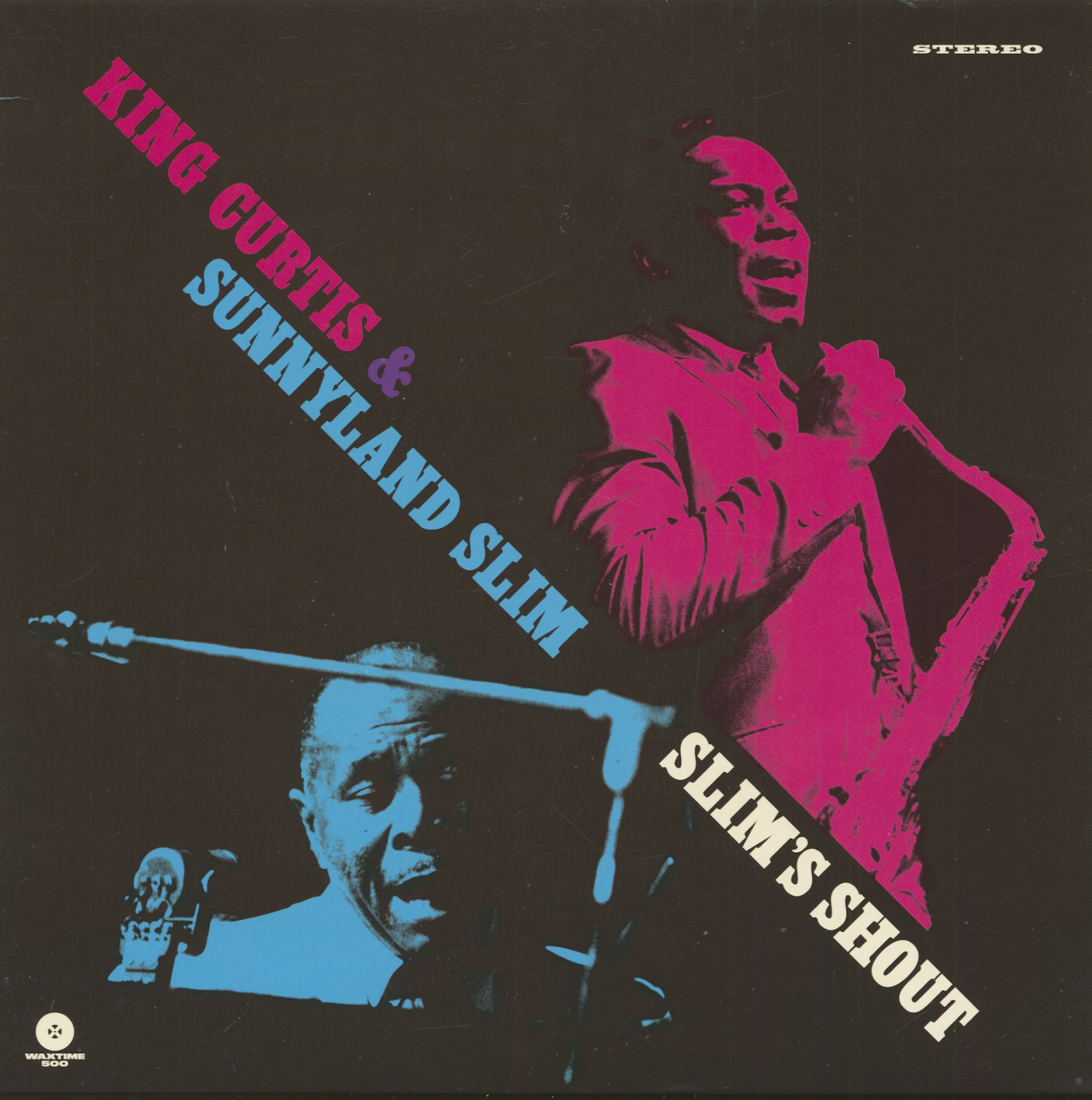
King Curtis & Sunnyland Slim King Curtis And Sunnyland Slim - Slim's Shout (LP, 180g Vinyl)


* incl. VAT / plus shipping costsDepending on the country of delivery, the VAT at checkout may vary.
Item is temporarily out of stock.
Approx. delivery time: up to 3 weeks. (as far as available at the supplier - can be faster, but sometimes unfortunately not)
- catalog number:LPWAX408703
- weight in Kg 0.3
King Curtis & Sunnyland Slim: King Curtis And Sunnyland Slim - Slim's Shout (LP, 180g Vinyl)
Although he was relatively unknown by the listening public during his career, King Curtis gained a reputation for his rough-cutting saxophone sound thot perfectly complemented rousing R&B numbers, as well as blues and soul music. His staccato style on the tenor sax (known as 'a yokety sax') is instantly recognizable. His trademark was a honking Texas tenor sound inspired by his main influences, such os Illinois Jocquet, Rod Bostic, and Arnett Cobb, albeit with a rock & roll edge. King Curtis (born Curtis Ousley on February 7, 1934, in Fort Worth, Texas) was a dynamic sox player whose work graced countless blues and R&B recording sessions. His bubbling, stutter-style playing brought a touch of ion and a whole ton of R&B and blues in the early 1960s. One of the great singer-piano players of the 20th century, Sunnyland Slim introduced his own powerful brand of Mississippi Delta-blues piano and helped build post-World War II Chicago into a major center for the performance and recording of classic acoustic and electrified blues. Sunnyland Slim (bom Albert Luandrew, on September 5, 1907, near Vance, in the Mississippi Delta) worked with blues greats like Ma Rainey and Little Brother Montgomery, and fostered the careers of many others, most notably Muddy Waters. In the liner notes to the album Sunnyland Train, Slim was described as a man 'who reveled in the hardscrabble, often profane blues life, yet could see - and taught others to see - the handiwork of God in people from church sisters to streetwalkers, a man whose faith enabled him to travel the hard, dangerous rood of a bluesman and yet never fall prey to bitterness, self-destruction or despair.'
For more than 50 years, the towering Sunnyland Slim rumbled the ivories around the Windy City, playing with virtually every local luminary imaginable and backing the great majority in the studio at one time or another. Slim's first recording was as a singer with Jump Jackson's bond on the Specialty label in September 1946. His first recordings as a leader were on the Hy-Tone and Aristocrat labels in late 1947. Slim continued performing until his death on March 17, 1995 (he died in Chicago of complications stemming from kidney failure). Like so many other blues musicians, the legendary Sunnyland Slim never achieved a level of mass appeal in accord with his stature in American music history.
This essential release presents the blues masterwork Slim's Shout (released on Prestige/Bluesville in 1961). The album was recorded by Rudy Van Gelder in his studio at Englewood Cliffs, New Jersey, and features Slim as o leader, accompanied by Curtis and other jou session players from the New York City scene, such as organist Robert Banks, bassist Leonard Gaskin, and drummer Belton Evans. Here Sunnyland Slim runs through a bunch of his own standards in pristine stereo sound. Highlights include 'The Devil Is a Busy Man,' 'Shake It,' and 'It's You Baby,' os well as the remake of 'Sunnyland Special' - one of Slim's most celebrated tunes.
Even though the original liner notes to Slim's Shout state that it was his debut album, he had actually previously recorded on LP titled Chicago Blues Session for the small local label 77 Records.
The 2 bonus tracks contained on this collector's LP vinyl limited edition, 'Everytime I Get to Drinkin'' and an earlier reading of 'Brownskin Woman,' belong to Chicago Blues Session.
Gary Blailock
ORIGINAL LINER NOTES: In its continuing project to finally record again major blues singers who for years have largely been just names in auction lists of out-of-print records, Prestige's Bluesville series now provides Sunnyland Slim with his first album. A friend of Big Bill and many of the other blues storytellers who based themselves in Chicago, Sunnyland wos on Muddy Waters' first records and mode several memorable sides through the years under his own name.
Sunnyland begins this album with one of the oldest themes in the blues - a mon forgotten in prison. His accompaniment (the some as on Roosevelt Sykes' second Bluesville album, The Honeydripper) is suitably strong and uncomplicated. Sunnyland recalls the kind of piano that grew up in Southern turpentine camps, barrelhouses and bravely informal 'cafés' in his 'Slim's Shout,' which also includes a sloshing solo by Texas-born King Curtis.
'The Devil Is a Busy Man' is a recurring theme in Sunnyland Slim's conversations. Sunnyland has had more than slight experience with women who one not nearly so guileless as they appear 'There are so many ways,' he was saying while talking about this song, 'to act a fool. The one thing about life I can tell you is don't ever be too sure.'
Sunnyland doesn't read music. Accordingly, he first gets a story - or sometimes just a title - in his mind. When the story's done, he works the music out on the piano (or they may grow together). 'Brownskin Woman,' for example, is on illustration of the Sunnyland Slim method. 'I was riding on a Lake Street car and I looked at a woman. She was the prettiest woman, she was naturally stacked. 1 got my book and pencil out and put down, 'Brownskin Woman.' Back home, back in the kitchen where I work, wrote this song.' Like many blues, the message is existential. Let's make it today, because tomorrow I may be gone. King Curtis, as in the other tracks, shouts agreement and underlines the urgency of getting what love you con while it's there. But love has often proved so transitory that Sunnyland Slim can't help but end the song by threatening what he earlier said he feared. Tomorrow he may be gone.
'Shake It' puts Sunnyland into the role of an autumnal lover who reassures his young 'mama' that he still has what it takes. There is no time for long-range, euphemistic courting. The girl will get a Cadillac and a diamond ring (well, something) if she heeds his appeal. If she doesn't, she won't get a damn thing.
'Decoration Day' is a blues for Sunnyland's wife, Freddie Lee, who died last year. 'Baby How Long' is Sunnylond's version of Leroy Corr's 'How Long Blues.' The 'Sunnyland Special' is on easy rolling blues with organist Banks first supplying the boogie-woogie figure the pianist would normally be playing in his left hand, and then Banks takes over for a remarkably limber solo of his own. Banks con make the organ scream, but fortunately, he can also make it swing gently, though always firmly. King Curtis digs in too with a characteristically hot, driving solo. Sunnyland, by the way, still plays some organ but would like to take some courses. 'It's the feet port that bothers me, the other part I can do.'
'Harlem Can't Be Heaven' presents a wishfully roseate view of city women ('if you find a real ugly woman in Harlem, she's either rich or from some other town'). Blues singers who come from the country often put down country women in their songs, but I coped it's the country life those girls remind them of that's the main target. The final, rocking 'It's You Baby' is another tale of how a city woman can twist a man, but Sunnyland's blues don't cry about this perennial trap. There are some pleasures in it too, after all.
After the date, Sunnyland was asked how he determines the keys in which he sings. 'I just know them. 1 just follow my voice. Tomorrow, if my voice is different - maybe from whiskey - I'm in another key.' In the blues, what works is right. Sunnyland, as a final note, got his nickname because when he was coming up, a popular blues began 'I thought I heard that low down dirty Sunnyland.' He sang that blues well, and with the conviction that comes from knowing how low down o man can be. 'After a while, I was Sunnyland to the people who heard the song.' Sunnyland's been telling the blues for a long time and he's mode a lot of sessions, but he's particularly proud of this, his first album. 'This is the best session I ever had in my life. 1 never enjoyed nothing no better.'
Nat Hentoff (co-editor The Jon Review)
Article properties:King Curtis & Sunnyland Slim: King Curtis And Sunnyland Slim - Slim's Shout (LP, 180g Vinyl)
Interpret: King Curtis & Sunnyland Slim
Album titlle: King Curtis And Sunnyland Slim - Slim's Shout (LP, 180g Vinyl)
Genre Blues
- Geschwindigkeit 33 U/min
- Vinyl record size LP (12 Inch)
- Record Grading Mint (M)
- Sleeve Grading Mint (M)
- Vinyl weight 180g Vinyl
Label WAXTIME
Artikelart LP
EAN: 8436559464239
- weight in Kg 0.3
King Curtis
& The Noble Knights
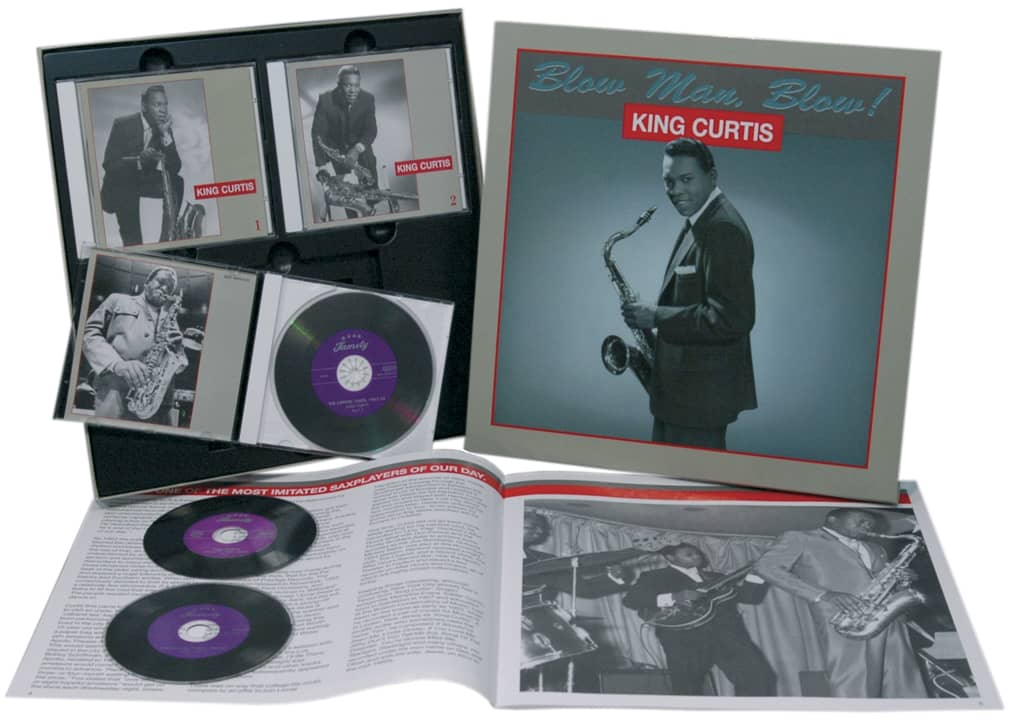
König Curtis
Die edlen Ritter
"Play that one called 'Soul Twist,'" singt Sam Cooke in Having A Party und unterstreicht die Tatsache, dass dies 1962 ein ziemlich großer Hit war: #1 R&B und #17 Pop. Es war auch die erste Platte auf Bobby Robinson's Enjoy Label (das Label, auf dem Robinson behauptet, die erste Rap-Platte von Grandmaster Flash veröffentlicht zu haben, obwohl dies umstritten ist). Robinson war ein afroamerikanischer Unternehmer, der Gladys Knight, Lee Dorsey, Wilbert Harrison und viele andere für seine zahlreichen Labels, darunter Fire and Fury, verpflichtet hatte. Enjoy Records war eine Prägung, die er 1962 mit seinem Bruder Danny begann, der diese Platte koproduzierte.
König Curtis (Curtis Ousley) wurde am 7. Februar 1934 in Fort Worth geboren und war zehn, als er den Klang hörte, der sein Leben verändern würde. "Es war Louis Jordan", sagte er 1971 zu Mike Hennessey. "Ich hörte ihn im Radio und sagte meiner Mutter, dass ich dieses Instrument mehr als alles andere spielen wollte." Gefragt, als er das Saxophon aufnahm, sagte Curtis am 12. Mai 1945. Sehr bald entwickelte er sein Markenzeichen Staccato-Phrasierung und verdiente 240 Dollar pro Woche in den Clubs - mehr als der Direktor der Schule, die er besuchen sollte. "Ich mochte Gene Ammons, Dexter Gordon, Lester Young und Sonny Stitt", sagte Curtis. "Ich grub auch Ben Webster und Coleman Hawkins für Balladen, (Stan) Getz für die Einrichtung, Charlie Parker für die Technik." Als Curtis 1952 nach New York ging, um einen Onkel zu besuchen, konnte er schön spielen, er konnte hart spielen, er konnte Jazz spielen, und er konnte R&B spielen. Er engagierte sich für eine Paket-Show und machte 1952 seine ersten Aufnahmen mit Bob
Kent für eine Tochtergesellschaft von Prestige Records. Bald darauf ging er zurück nach Fort Worth, um ein Musikstipendium anzunehmen. Dann kam Lionel Hampton durch die Stadt und suchte einen Saxophonisten.
Hamp löste sich in New York auf, und Curtis blieb. Es dauerte nicht lange, bis er zur Sitzungsarbeit gerufen wurde. "Ich sah, dass sich die Musik spaltete", sagte er zu Mike Hennessey, "und ich hatte den kommerziellen Geschäftssinn, um zu erkennen, dass der ausgefallene Jazz nicht an die Öffentlichkeit gelangte." Der erste Auftragnehmer, der Curtis regelmäßig einsetzte, war Jesse
Stone, der A&R'd Sessions für Groove und Atlantic durchführte. "Um 1956 machten Sam `The Man' Taylor und ich die ganze Tenorarbeit", sagte Curtis. "Er hat den Stil wirklich initiiert, und ich habe viel von ihm gelernt, als wir beide in der Alan Freed Band spielten. Ich machte etwa sechzehn Aufnahmedaten pro Woche und bekam $41,25 für eine dreistündige Sitzung, aber ich konnte sehen, ob ich so weitermachte, dass ich mich selbst ausbrannte, also machte ich meinen minimalen Sitzungspreis hundert Dollar, und die Arbeit kam immer noch rein, also reduzierte ich auf acht Sitzungen pro Woche." Meistens spielte Curtis nach Feierabend im Small's Paradise. Er machte ein paar Aufnahmen unter seinem eigenen Namen, von denen keine etwas bedeutete. Die meisten seiner Songs waren Grooves oder Shouts, aber er schrieb (und spielte auf) Buddy Holly's Reminiscing und schrieb später Soul Serenade, die eine fast ellingtonische Lyrik hat.
Im Gespräch mit Art Turco erinnerte sich Bobby Robinson daran, Curtis in Small's Paradise zu sehen. "Ich fand heraus, warum er nie einen Treffer hatte", sagte er. "Was falsch war, war, dass er zu viel gehupt hat." Jede Platte, die er von Anfang bis Ende blies. Ich sagte: "Hör zu, wir öffnen das hier mit der Gitarre." Er hatte einen Anfall." Und so spielte Soul Twist mit Billy Butler (dem Gitarristen auf Honky Tonk) und dem Organisten Paul Griffin, und nachdem er mehr Hits gespielt hatte, als er zählen konnte, hatte King Curtis endlich einen #1 R&B-Hit mit seinem eigenen Namen darauf.
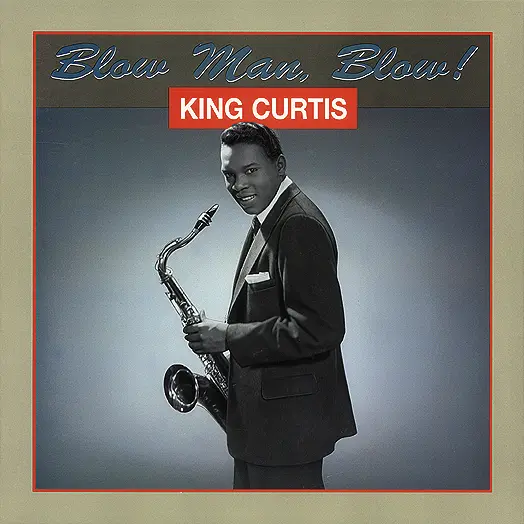
King Curtis Capitol Years 1962-1965 (3-CD)
Read more at: https://www.bear-family.de/curtis-king-capitol-years-1962-1965-3-cd.html
Copyright © Bear Family Records
Ready to ship today, delivery time** appr. 1-3 workdays

Ready to ship today, delivery time** appr. 1-3 workdays

only 1x still available
Ready to ship today, delivery time** appr. 1-3 workdays

only 1x still available
Ready to ship today, delivery time** appr. 1-3 workdays


only 1x still available
Ready to ship today, delivery time** appr. 1-3 workdays


only 2x still available
Ready to ship today, delivery time** appr. 1-3 workdays

Ready to ship today, delivery time** appr. 1-3 workdays
This article is deleted and can no longer be ordered!
This article is deleted and can no longer be ordered!


Ready to ship today, delivery time** appr. 1-3 workdays
Ready to ship today, delivery time** appr. 1-3 workdays
the very last 1 available
Ready to ship today, delivery time** appr. 1-3 workdays

Ready to ship today, delivery time** appr. 1-3 workdays
only 1x still available
Ready to ship today, delivery time** appr. 1-3 workdays
only 1x still available
Ready to ship today, delivery time** appr. 1-3 workdays