
Hank Williams Hank 100 - Greatest Radio Hits (2-LP)


* incl. VAT / plus shipping costsDepending on the country of delivery, the VAT at checkout may vary.
Item is temporarily out of stock.
Approx. delivery time: up to 3 weeks. (as far as available at the supplier - can be faster, but sometimes unfortunately not)
- catalog number:LP538886201
- weight in Kg 0.46
Hank Williams: Hank 100 - Greatest Radio Hits (2-LP)
- 1923 - 2023 A Centennial Celebration of the King of Country Music
- Brand new Best of by Hank Williams celebrating the 100th anniversary of the "King Of Country Music", 1923 - 2023.
- Available on 2LP and 1CD and includes 25 of his greatest hits presented in a unique live & radio performances
- - Collection lovingly curated by Grammy Award winner Cheryl Pawelski and mastered by Grammy Award winner Michael Graves.
- - Liner notes by Grammy Award winner and Hank Williams historian, Colin Escott including the legendary classics: "Hey Good Lookin'" (#1 / 1941) , "Moanin' The Blues" (#1/1951), "Jambalaya (On The Bayou)" (#1 / 1952), "Cold, Cold Heart" (#1/1951) , "Move It On Over" (#4 / 1947), "Lovesick Blues" (#1 /1949) & many more.
Article properties:Hank Williams: Hank 100 - Greatest Radio Hits (2-LP)
Interpret: Hank Williams
Album titlle: Hank 100 - Greatest Radio Hits (2-LP)
Label BMG
Genre Country
- Geschwindigkeit 33 U/min
- Vinyl record size LP (12 Inch)
- Record Grading Mint (M)
- Sleeve Grading Mint (M)
Artikelart LP
EAN: 4050538886207
- weight in Kg 0.46
| Williams, Hank - Hank 100 - Greatest Radio Hits (2-LP) LP 1 | ||||
|---|---|---|---|---|
| 01 | Move It On Over | Hank Williams | ||
| 02 | I'm A Long Gone Daddy | Hank Williams | ||
| 03 | A Mansion On The Hill | Hank Williams | ||
| 04 | Lovesick Blues | Hank Williams | ||
| 05 | Wedding Bells | Hank Williams | ||
| 06 | Mind Your Own Business | Hank Williams | ||
| 07 | You're Gonna Change (Or I'm Gonna Leave) | Hank Williams | ||
| 08 | Lost Highway | Hank Williams | ||
| 09 | There'll Be No Teardrops Tonight | Hank Williams | ||
| 10 | I Just Don't Like This Kind Of Livin' | Hank Williams | ||
| 11 | Long Gone Lonesome Blues | Hank Williams | ||
| 12 | Why Don't You Love Me? | Hank Williams | ||
| Williams, Hank - Hank 100 - Greatest Radio Hits (2-LP) LP 2 | ||||
|---|---|---|---|---|
| 01 | They'll Never Take Her Love From Me | Hank Williams | ||
| 02 | Why Should We Try Anymore? | Hank Williams | ||
| 03 | Moanin' The Blues | Hank Williams | ||
| 04 | Nobody's Lonesome For Me | Hank Williams | ||
| 05 | Cold, Cold Heart | Hank Williams | ||
| 06 | Dear John | Hank Williams | ||
| 07 | I Can't Help It (If I'm Still In Love With You) | Hank Williams | ||
| 08 | Hey Good Lookin' | Hank Williams | ||
| 09 | (I Heard That) Lonesome Whistle | Hank Williams | ||
| 10 | I'm So Lonesome I Could Cry | Hank Williams | ||
| 11 | Jambalaya (On The Bayou) | Hank Williams | ||
| 12 | I'll Fly Away | Hank Williams | ||
| 13 | I Saw The Light | Hank Williams | ||
Hank Williams
Geb. 17. 9.1923 in Georgiana - Alabama gest. 1. 1. 1953
Record Labels: Sterling, MGM, Metro, CMF, Polydor
Erster No.1-Hit: Lovesick Blues (1949)
Hiram Hank Williams, ein begabter Komponist und ein ausdrucksstarker Sänger, der sogenannte Shakespeare Of Country Music, wurde zu einem epocheprägenden Künstler, der auch in der Pop-Musik seine Spuren und seinen Einfluß hinterlassen hat. Sein relativ kurzer Lebensweg war geprägt durch Schwierigkeiten, Probleme und Spannungen, verursacht durch Minderwertigkeitskomplexe und eine unglückliche Ehe mit Audrey Williams.
All diese Probleme, Kompromisse und Streitigkeiten werden in seinen Songs reflektiert, die er zwischen 1946 und 1952 auf Schallplatten eingespielt hat. Seine Trunksucht führte dazu, dass er von der Grand Ole Opryentlassen wurde. Krank und seelisch ausgebrannt starb Hank Williams auf dem Rücksitz seines Cadillacs. Er war auf dem Weg zu einer Show in Canton - Ohio. Seine Band, die Drifting Cowboys, war eine der besten und ideenreichsten All-Star-Bands der Country-Szene. Williams selbst hat eine Fülle von Songs und großen Hits hinterlassen, von denen die meisten zu Country Evergreens wurden. Erinnert sei nur an Jambalaya, Cold, Cold Heart oder Your Cheatin` Heart. 1961 wurde Hank Williams in die Country Music Hall Of Fame aufgenommen.
Ein paar wichtige Stationen seines Lebens:
Am 11. 12. 1946 die erste Aufnahmesession,
am 11.6.1949 die erste Show an der Grand Ole Opry,
am 29.5.1952 die Scheidung von Audrey Williams,
am 18. 10. 1952 heiratete er die außergewöhnlich hübsche Billie Jean Jones Eshlimar.
Über ihr erstes Zusammentreffen mit Hank Williams erzählte Billie Jean später: Als Hank mich sah, kam er einfach auf mich zu und sagte in seinem heimischen Slang: "If You Ain't Married, Ole Hank`s Gonna Marry You. You're About The Purtiest Thing I Ever Saw."
Hank Williams was to me the first rock 'n' roll singer.
Don Everly
Hank Williams war für mich der erste Rock'n' Roll Sänger.
Don Everly
 Als Hank Williams' erste M-G-M Platte im Juni 1947 Radiosender und Southern Juke Jo erschien, stand die Countrymusik vor einer seismischen Wende. Western-Swing und Cowboy-Crooners wurden immer beliebter, ebenso wie die traurigen Wehklagen von Roy Acuff und trompetengetriebene Jukebox-Neuheiten. Eddy Arnold und Red Foley beherrschten die Charts mit fein geschliffenen Platten, die mehr in der Stadt als zu Hause klangen. Abgesehen von einigen wenigen ausgewählten Künstlern mit etablierter regionaler Ausstrahlung, ignorierten die großen Labels meist südöstliche Sänger, die zu'hillbilly' klangen, und überließen diesen Markt aggressiven Independent-Labels. Als King Records in Cincinnati anfing, beeindruckende Verkaufszahlen mit roher, unverschämt ländlicher Musik zu erzielen, nahmen die Majors Notiz davon, blieben aber auf Kurs.
Williams's Move It On Over war nicht Ernest Tubb's, Floyd Tillman's oder Moon Mullican's Texas honky tonk. Es war etwas Frisches und Aufregendes, das leidenschaftliche Acuffian Phrasierung mit einem hochvolumigen Backbeat direkt aus den späten 30er Jahren in Chicago verbindet. Es rockte wie verrückt und stellte Hank Williams als bedeutende Stimme in der Countrymusik vor.
Williams' frühe Jahre und Einflüsse wurden an anderer Stelle ausführlich dokumentiert. Der New Yorker Schriftsteller Roger Williams (no relation) schrieb 1970 die erste bedeutende Biographie ('Sing A Sad Song: A Life Of Hank Williams'; Doubleday). Die nächsten fünfzehn Jahre brachten weitere Biographien von Jay Caress, Chet Flippo und George William Koon, unter anderem. Dr. Charles K. Wolfe und Bob Pinson haben auch zu unserem Verständnis von Williams' Leben, Musik, Karriere und Aufnahmen beigetragen. Diese Studien wurden durch Colin Escotts'Hank Williams: A Biography' (Little, Brown & Co., 1994) und seine Notizen zu Mercury Records' umfangreicher 1998er Compact Disc Anthologie'The Complete Hank Williams' weitgehend verdrängt.
Hiram 'Hank' Williams wurde am 17. September 1923 in Mount Olive Community, Alabama, als zweites Kind von Elonzo Huble Williams (1891-1970) und Jessie Lillie Belle Skipper (1898-1955) geboren. Lon Williams, ein Eingeborener aus Lowndes County, Alabama, war Lokomotivführer für ein Holzfällerunternehmen, als er Lillie Skipper traf. Das Paar kämpfte finanziell nach ihrer Heirat im November 1916 und verließ sich dabei oft auf die Hilfe von Lillies Familie und das magere Einkommen aus einem kleinen Gemischtwarenladen in ihrem Haus. Lon Williams wurde im Juli 1918 in die Armee eingezogen und verbrachte einen Teil der nächsten elf Monate in Frankreich. Während seines Militärdienstes erlitt er eine schwere Kopfverletzung bei einer betrunkenen Schlägerei um eine Frau oder einem Sturz von einem Lastwagen. Obwohl er sich offensichtlich erholte, verursachte die Verletzung irreparable neurologische Schäden, die später wieder auftauchten.
Nach der Rückkehr aus dem Krieg arbeitete Lon Williams sporadisch auf den Holzplätzen, während Lillie als Krankenschwester, Konservenfabrikantin und Näherin arbeitete. Ihr erstes Kind, Irene, wurde im August 1922 geboren, ein Jahr später folgte Hank.
Das Leben war hart, aber die Familie kam zurecht. Sonntags sang und spielte Lillie in der Mount Olive West Baptist Church. In einem seiner seltenen Print-Interviews erinnert sich Hank an diese Tage an den San Francisco-Journalisten Ralph J. Gleason. "Meine früheste Erinnerung ist, dass ich auf diesem Organhocker sitze und schreie", sagte er. "Ich muss fünf, sechs Jahre alt und lauter als alle anderen gewesen sein."
Seine Eltern bemerkten, dass ihr Sohn eine geschwollene Stelle an seiner Wirbelsäule hatte, ein Geburtsfehler, der später als Spina Bifida Occulta diagnostiziert wurde. Wenn es nicht operativ korrigiert wird, kann das Rückenmark von der Wirbelsäule nach außen hernien. Hank's Zustand wurde nicht behandelt. Als er älter wurde, ging die Krankheit weiter, so dass er anfällig für Rückenverletzungen und lähmende Schmerzen war.
Bald nach dem Börsencrash von 1929 wurde Lon durch ein Gehirn-Aneurysma beeinträchtigt, das wahrscheinlich durch seine frühere Kopfverletzung ausgelöst wurde. Vorübergehend unfähig zu sprechen und sein Gesicht gelähmt, wurde er im November in ein Krankenhaus der Veteranenverwaltung in Biloxi eingeliefert. Er lebte nie wieder bei seiner Familie.
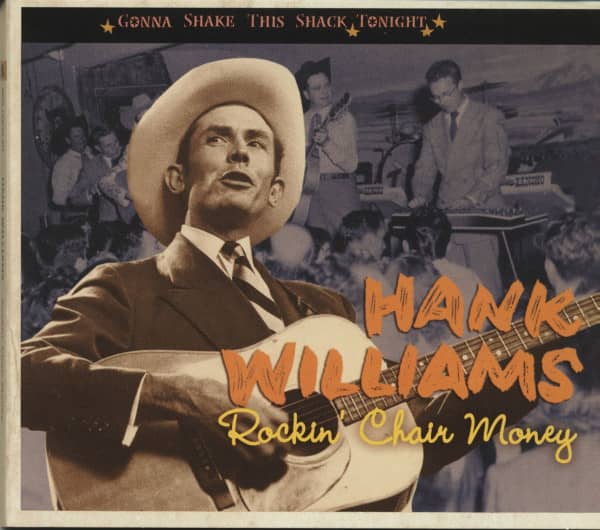
from booklet BCD16636 - Hank Williams Rockin 'Chair Money - Gonna Shake This Shack Tonight
Read more at: https://www.bear-family.de/williams-hank-rockin-chair-money-gonna-shake-this-shack-tonight.html
Copyright © Bear Family Records
Ready to ship today, delivery time** appr. 1-3 workdays

Ready to ship today, delivery time** appr. 1-3 workdays

Ready to ship today, delivery time** appr. 1-3 workdays
only 1x still available
Ready to ship today, delivery time** appr. 1-3 workdays
Ready to ship today, delivery time** appr. 1-3 workdays

Ready to ship today, delivery time** appr. 1-3 workdays
the very last 1 available
Ready to ship today, delivery time** appr. 1-3 workdays
Ready to ship today, delivery time** appr. 1-3 workdays
Ready to ship today, delivery time** appr. 1-3 workdays
Ready to ship today, delivery time** appr. 1-3 workdays


This article is deleted and can no longer be ordered!

Item has to be restocked
Ready to ship today, delivery time** appr. 1-3 workdays

Ready to ship today, delivery time** appr. 1-3 workdays

This article is deleted and can no longer be ordered!

the very last 2 available
Ready to ship today, delivery time** appr. 1-3 workdays