
Who was/is Barbara Thalheim ? - CDs, Vinyl LPs, DVD and more
Barbara Thalheim
Die Kinder der Nacht
"Right from the first songs, everyone senses that she has a special way of making chansons," wrote the East German music magazine 'Melodie & Rhythmus' in 1976. Barbara Thalheim is one of the singer-songwriters who shaped the GDR's own chanson style. In the seventies she is accompanied by a classical string quartet; in the eighties her music moves between Kurt Weill's new-harmonic song style and the popular rock of the day. It was in this phase, in 1985, that she recorded the title song of her LP Die Kinder der Nacht (The Children of the Night), which compares the children of the night to light bulbs that simply were never switched off.
The lyrics were written by the journalist and author Fritz-Jochen Kopka, born in 1944, with whom Barbara Thalheim lived until the early nineties. The singer was born in Leipzig in 1948, the daughter of a respected communist who had emigrated to France in the early thirties, was sent to the Dachau concentration camp after the German occupation in 1942, and survived.
Barbara Thalheim trains as a shorthand typist, works as a messenger girl, theatre stage manager and cultural organiser, and joins the Oktoberklub – an East Berlin political song group founded in 1966 with a musical mix of chanson, song, folk and rock. She then trains as a pop singer at the Fachschule für Unterhaltungskunst and studies externally at the Hanns Eisler Academy of Music. During this time, in 1971, Thalheim's first single Frühling in der Schönhauser appears; in 2004 it was covered by Nylon, the Berlin band around chanteuse Lisa Bassenge.
In the early seventies Barbara Thalheim became a Stasi informer, 'IM Elvira'. "I was naive," she later says, "for a long time I didn't question what was happening around me. For me, the GDR world was intact." But that intact world began to crack for the "fiery socialist", as a school friend saw her – which is why that friend told her nothing of her plans to flee. And so in 1978, one year before its collaboration with Thalheim ended, the Stasi opened a 'control' file on her alongside the 'perpetrator' file, common practice with those considered wavering.
When in 1980 she protests in West German media against performance bans imposed on GDR artists in Western Europe, she is expelled from the ruling SED party, is herself banned from travelling abroad until 1984, and is repeatedly banned from performing in the GDR as well. This led to contact with church circles and to regular appearances in East German churches. Her songs become more critical – in 1987, for example, she sings of the wish to live without regulations and dictates instead of going round in circles within an apparatus: an illusion, as she herself concedes, yet some dreams are already coming closer.
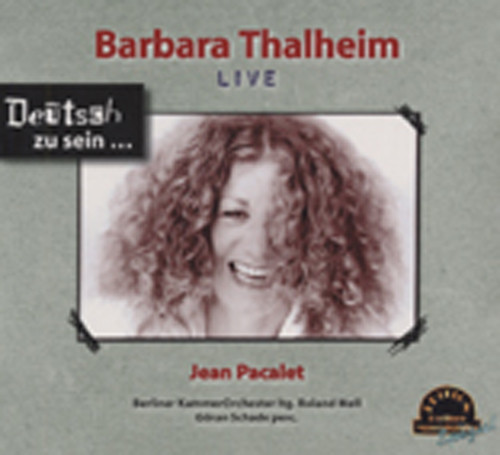
After the fall of the Wall the chanteuse mourns not so much the old GDR as "what the GDR could have been" ('Die Zeit', 1991). Despite her reservations about reunified Germany, she manages to re-establish herself professionally: through a joint tour and record with the rock group Pankow, in GDR times one of the best-known bands with provocative undertones ("Like many writers, they were among the established greats of aesthetic subversion," wrote 'Rolling Stone' magazine in 1999), and through her collaboration with the French accordionist Jean Pacalet.
Asked by interviewer Ulrike Hempel in May 2010, "Does your life sometimes seem strange to you?", Barbara Thalheim replies: "You mean in Adorno's sense: there is no right life in the wrong one? I asked myself that question just as often in my first life as in my second, present one. In the past my conflicts were often ideological, but never a threat to my existence; today they are above all material and therefore threaten my existence. The leap from really existing socialism into socially reacting existentialism is something that I, and not only I, have not managed well."
From: Various – Das deutsche Chanson, Teil 3 (3-CD)
Copyright © Bear Family Records
Copyright © Bear Family Records®. Copying, also of extracts, or any other form of reproduction, including the adaptation into electronic data bases and copying onto any data mediums, in English or in any other language is permissible only and exclusively with the written consent of Bear Family Records® GmbH.

Item has to be restocked