
Who was/is Django Reinhardt ? - CDs, Vinyl LPs, DVD and more
Django Reinhardt
There are three categories of artists. There are those who are called good musicians during their lifetime, but whose true genius is only recognised after their death. Then there are the musicians who are celebrated and honoured in their lifetime but who fall more and more into oblivion after their death, because people realise that they no longer have much to say to those who come after them. And finally there are the musicians who seem greater the more years have passed since their death. Django Reinhardt belongs to the last group. I still remember the years 1934 and 1935, when I received the first records by the Hot Club Quintet. At that time Stephane Grappelly was still regarded as the more brilliant musician compared with Reinhardt. Ten years later the comparison had been reversed. And another ten years later it was the Americans who made it clear to the Europeans that there had been only one musician in the history of jazz who, as a European, could serve as a model for the Americans – none other than Django Reinhardt. And so it has remained to this day. No European jazz musician has yet emerged who in turn has influenced the Americans, let alone founded a kind of school over there on the strength of his records.
This "Milestones" record shows, in a nutshell as it were, Django Reinhardt the man and the musician – that indescribable mixture of gypsy vagabond life and closeness to nature, of French joie de vivre and sensuality, and of Americanism that made up Django Reinhardt the man and musician. The very first bars of "Minor Swing" are moving in their nostalgic minor key, from which Django soon breaks out with great temperament. The evergreen "Georgia" is sung by Freddy Taylor, a black American entertainer with whom Django had appeared in 1935 at the exclusive "Villa d'Este" on the Champs-Elysées. This recording brought about my first personal encounter with the great guitarist. The remaining titles on side one show Django in various guises. There is the solo on unamplified guitar, "Echoes of Spain". Not jazz, mind you, but pure music, such as may have come to him as he thought of the gypsies on their pilgrimage to Saintes-Maries-de-la-Mer. The duo "Out of Nowhere" with violinist Grappelly shows him not only as a sensitive accompanist in a chamber music setting but also as a player of incredible sensitivity in his handling of harmony.
The recording of "Lady Be Good", with what was then a summit meeting of three violinists, should come as a surprise to anyone who believes the violin was only made popular by modern pop-jazz. The opening and closing choruses were arranged by Django; he himself plays the first improvisation, followed by Michel Warlop (1911-1947), then Stephane Grappelly and finally, with double stops, Eddie South, the black violinist from the USA who played at the Ritz Hotel in Paris in 1937, the year of the World's Fair there. Equally surprising for many will be Bach's Double Concerto in D minor for two violins, interpreted by South and Grappelly, accompanied only by Django Reinhardt. Back then, in the shellac era, the A-side presented the theme more or less as written, but in swing style, and the B-side the improvisation. In the April 1938 issue of the magazine "Jazz Hot", Hugues Panassié wrote at the time: "It would be wrong to claim that Bach should gain from a jazz interpretation, but attention should be drawn to the more or less direct relationship between the music of Bach and jazz."
In the years before the war, Paris was to European jazz what Harlem was to American jazz, especially in 1937. And everyone who came to the Seine wanted to play with Django. "Crazy Rhythm" features two of the most important of them: Coleman Hawkins and Benny Carter. The title is a milestone in the progress of European jazz, for it shows two European and two American saxophonists in competition: first André Ekyan (alto) and Alix Combelle (tenor), followed by Benny Carter (alto) and Coleman Hawkins (tenor, with two choruses). For once, Grappelly plays piano here. In one week in April 1937 the Quintet went into the studio three times to record 17 titles which, as a coherent body of work, must be counted among the most magnificent achievements in jazz history, comparable to the milestones of Armstrong's Hot Five and Hot Seven of 1927/28 or the Ellington sessions of 1940 with Jimmy Blanton. Three of these titles have been placed on side two: the evergreen "Rose Room" (on whose harmonies Ellington later built "In A Mellotone"), the typical Django composition "Tears" and the train imitation "Mystery Pacific".
It is astonishing how much tone painting is possible with string instruments alone! "Nuages", Django's most popular composition, could not be left out. It was created when Grappelly and Reinhardt had been separated by the war; Hubert Rostaing's clarinet took the place of the violin. No less beautiful, if not quite as well known, is "Manoir de mes rêves", recorded after the war by Django with a big band of American soldiers. A pre-war recording from the heyday of the unique French Quintet completes the round. I know of no other jazz musician to whom renowned poets have raised a monument in verse, but Django's art was glorified by no fewer than two poets. One is James Jones in his novel "From Here to Eternity" (see the quotation in the Django Reinhardt double album of the "Serie 2000"). The other is none other than Jean Cocteau. When he first heard and met Django, Django inspired him to one of the characters in "Les enfants terribles", and after his death Cocteau wrote: "His rhythm was as much his own as the stripes are a tiger's; they were in his skin."
Dietrich Schulz-Köhn
Copyright © Bear Family Records
Copyright © Bear Family Records®. Copying, also of extracts, or any other form of reproduction, including the adaptation into electronic data bases and copying onto any data mediums, in English or in any other language is permissible only and exclusively with the written consent of Bear Family Records® GmbH.
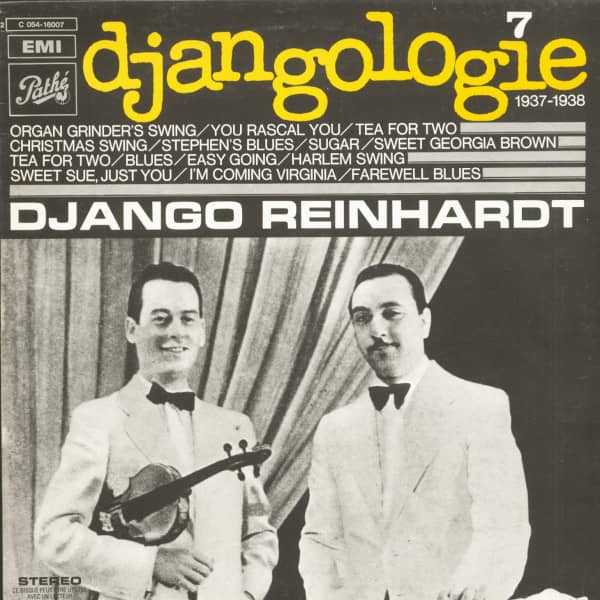
the very last 1 available
Ready to ship today, delivery time** appr. 1-3 workdays
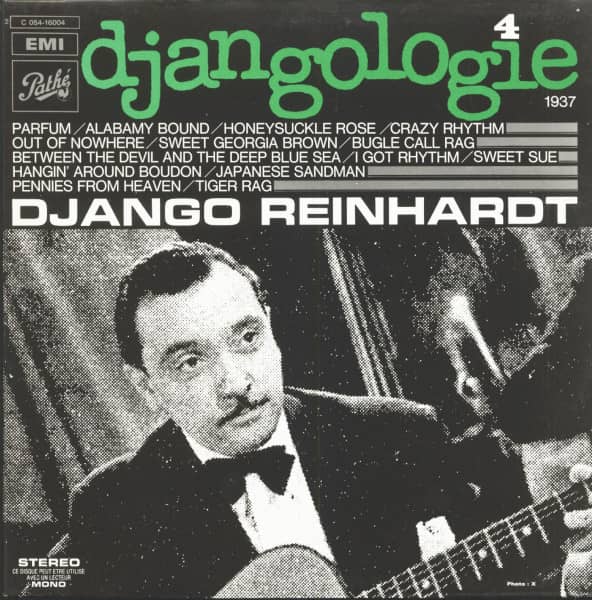
only 1x still available
Ready to ship today, delivery time** appr. 1-3 workdays
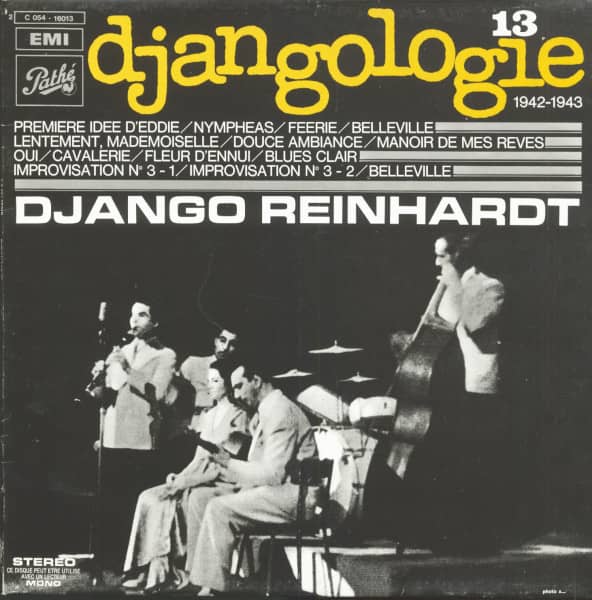
the very last 1 available
Ready to ship today, delivery time** appr. 1-3 workdays
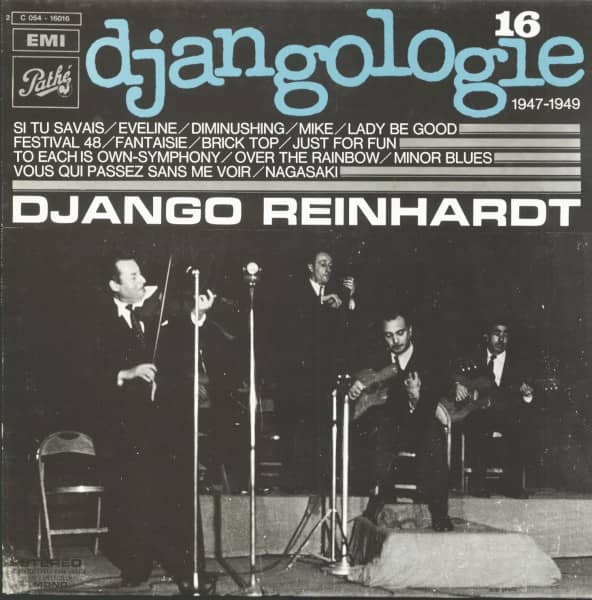
the very last 1 available
Ready to ship today, delivery time** appr. 1-3 workdays
the very last 1 available
Ready to ship today, delivery time** appr. 1-3 workdays
the very last 1 available
Ready to ship today, delivery time** appr. 1-3 workdays
Item has to be restocked
Item has to be restocked