Joe Meek I Hear A New World - An Outer Space Music Fantasy by Joe Meek(LP)
* incl. VAT / plus shipping costsDepending on the country of delivery, the VAT at checkout may vary.
Item is temporarily out of stock.
Approx. delivery time: up to 3 weeks. (as far as available at the supplier - can be faster, but sometimes unfortunately not)
- catalog number:LPPOPPY019
- weight in Kg 0.23
Joe Meek: I Hear A New World - An Outer Space Music Fantasy by Joe Meek(LP)
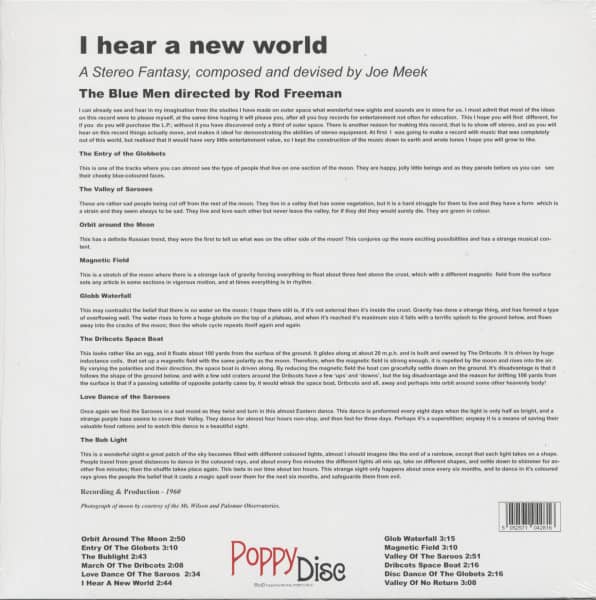
Long out of print, highly sought after "space music fantasy by Joe Meek". A classic of incredibly strange music, electronica, pre-Beatles Britpop, or all of the above.
Whichever way you look at it, "I Hear A New World" was and is the masterpiece of the master of sound, Joe Meek.Recorded as usual partly at home with secret equipment, and partly at the state-of-the-art Lansdowne studio that he pretty much designed himself, it is a spectacular stereo spectacle that was almost unknown in British pop recordings of the time and for many years after. Beautifully remastered here and restored to its original track order, just as Meek planned and promoted it when he marketed it as the ideal stereo test recording for hi-fi stores. Only one EP of less than half of the compiled work was originally released.
The story of Joe Meek, the master of the RGM sound, is well known to all music lovers; the innovations, the hits, the eventual sad ending. This album, with its early electronic super stereo sounds, from the hopeful early days of his career, has become a legend. In its September 1998 issue, music magazine The Wire listed the album in the article "100 Records That Set The World On Fire (When No One Was Listening!)," examining both Meek's and the album's profound, if almost secret, influence on many modern music makers.
This first true vinyl edition of the complete album in its original track order is a must-have for all lovers of the unusual in music.
Article properties:Joe Meek: I Hear A New World - An Outer Space Music Fantasy by Joe Meek(LP)
Joe Meek
Meek came from Gloucester and did his National Service in the RAF as a radio technician in the early Fifties. In 1953, he came out and went to work as an engineer at the IBC studio, at that time one of only two independent studios in London. There he engineered records by Frankie Vaughan (`Green Door'), Denis Lotis, Lita Roza, Shirley Bassey, Anne Shelton, Harry Secombe and Petula Clark. In 1956, Meek went to work for Denis Preston at Lans-downe Studios, where he was engineer on several of Lonnie Donegan's early hits, including 'Cumberland Gap' and `Don't You Rock Me Daddy-O' as well as trad jazz records by Humphrey Lyttelton and Chris Barber. He also began dabbling in songwriting and in 1958 wrote Tommy Steele's Tut A Ring On Her Finger'.
Leaving Lansdowne in 1960, Meek built his own studio in a flat above a shop in Holloway, North London, equipping it with £3,000 worth of second-hand equipment. He called it RGM Sound and simultaneously activated his own label, Triumph, going against all odds at a time when British pop was monopolized by the three major labels.
A cover version of an American hit, 'Angela Jones' by Michael Cox, reached the Top Ten in June, 1960 but none of Triumph's other releases were successful and Meek discontinued the label in favour of tape-lease deals with the majors. He scored the following year with John Leyton's eerie, futuristic 'Johnny Remember Me' and 'Wild Wind', Mike Berry's poignant `Tribute to Buddy Holly' and several smaller hits by the Outlaws (with Richie Blackmore) who backed many of Meek's artists on record.
In 1962, a combination of Meek's session musicians recor-ded an instrumental he wrote titled `Te!star', under the name of the Tornados, which proved his biggest selling hit, reach-ing No. 1 in both Britain and America. In production terms, it still remains far ahead of contemporary records. The Tor-nados followed up with several slightly less successful records including 'Robot', 'Globetrotter' and 'Ice Cream Man' be-fore being swamped in the ensuing Merseybeat craze. Never-theless, Meek scored early in 1963 with Mike Berry's 'Don't You Think It's Time' and in 1964 with the Honeycomb's `Have I The Right', but found the going hard in the mid-Sixties.
He had no hits in 1966 and faced with increasing anxiety through personal problems, blew his brains out with a shotgun on February 3, 1967.

Item has to be restocked

Item has to be restocked

Ready to ship today, delivery time** appr. 1-3 workdays

only 2x still available
Ready to ship today, delivery time** appr. 1-3 workdays

Ready to ship today, delivery time** appr. 1-3 workdays

Ready to ship today, delivery time** appr. 1-3 workdays

Ready to ship today, delivery time** appr. 1-3 workdays

Item has to be restocked

Item has to be restocked

only 1x still available
Ready to ship today, delivery time** appr. 1-3 workdays