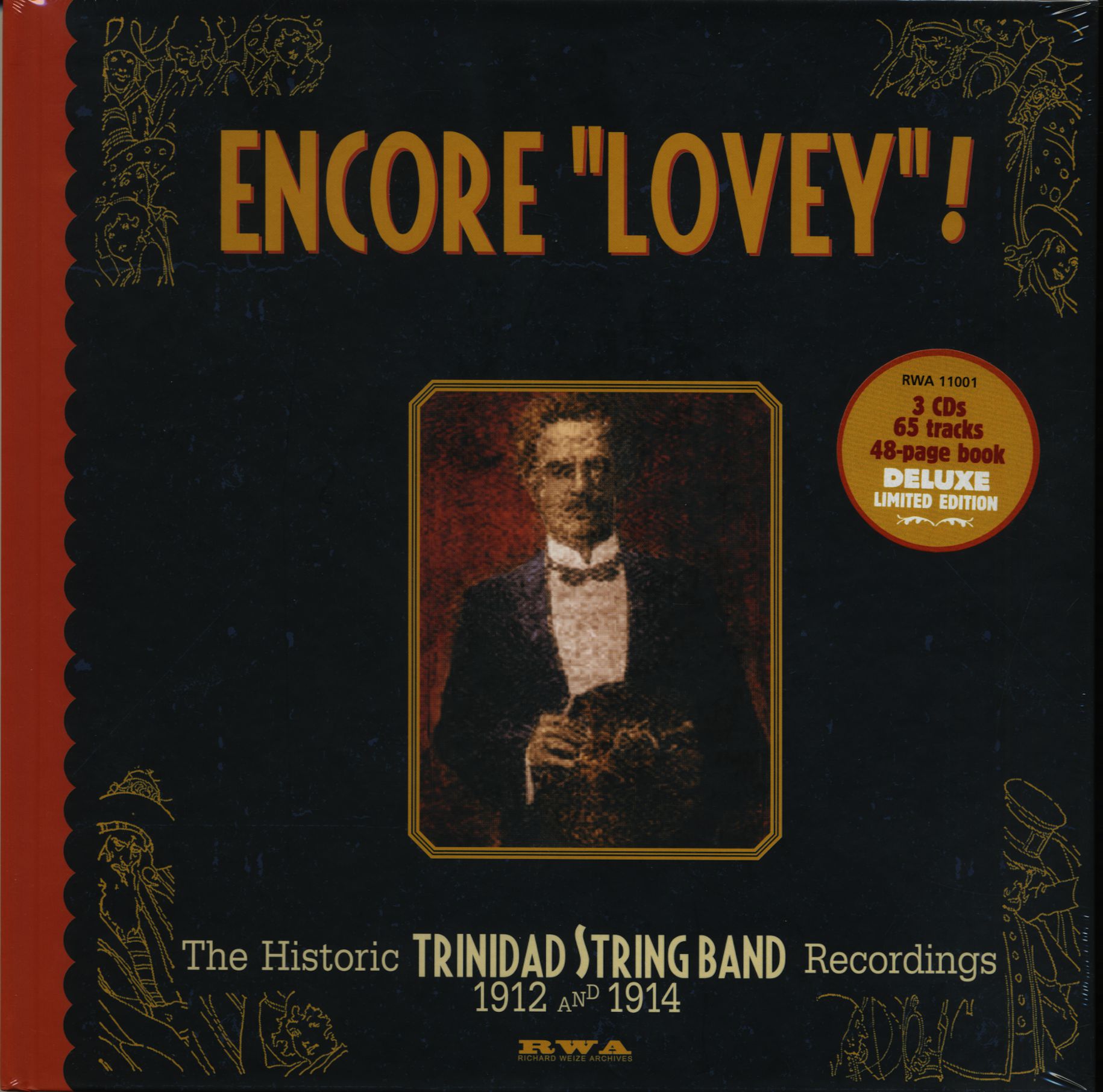
Lovey's Original Trinidad String Band Encore 'Lovey'! (Historic Recordings 1912/1914) (3-CD)

* incl. VAT / plus shipping costsDepending on the country of delivery, the VAT at checkout may vary.
Ready to ship today,
delivery time** appr. 1-3 workdays
- catalog number: CDRWA11001
- weight in Kg 0.62
Lovey's Original Trinidad String Band: Encore 'Lovey'! (Historic Recordings 1912/1914) (3-CD)
(Richard Weize Archives) 65 tracks, CD in a 48-page deluxe hardcover book (English, 27 cm x 27 cm) with pictures and liner notes, limited edition, magnificent documentation of the Caribbean formation led by bandleader and violinist “Lovey”
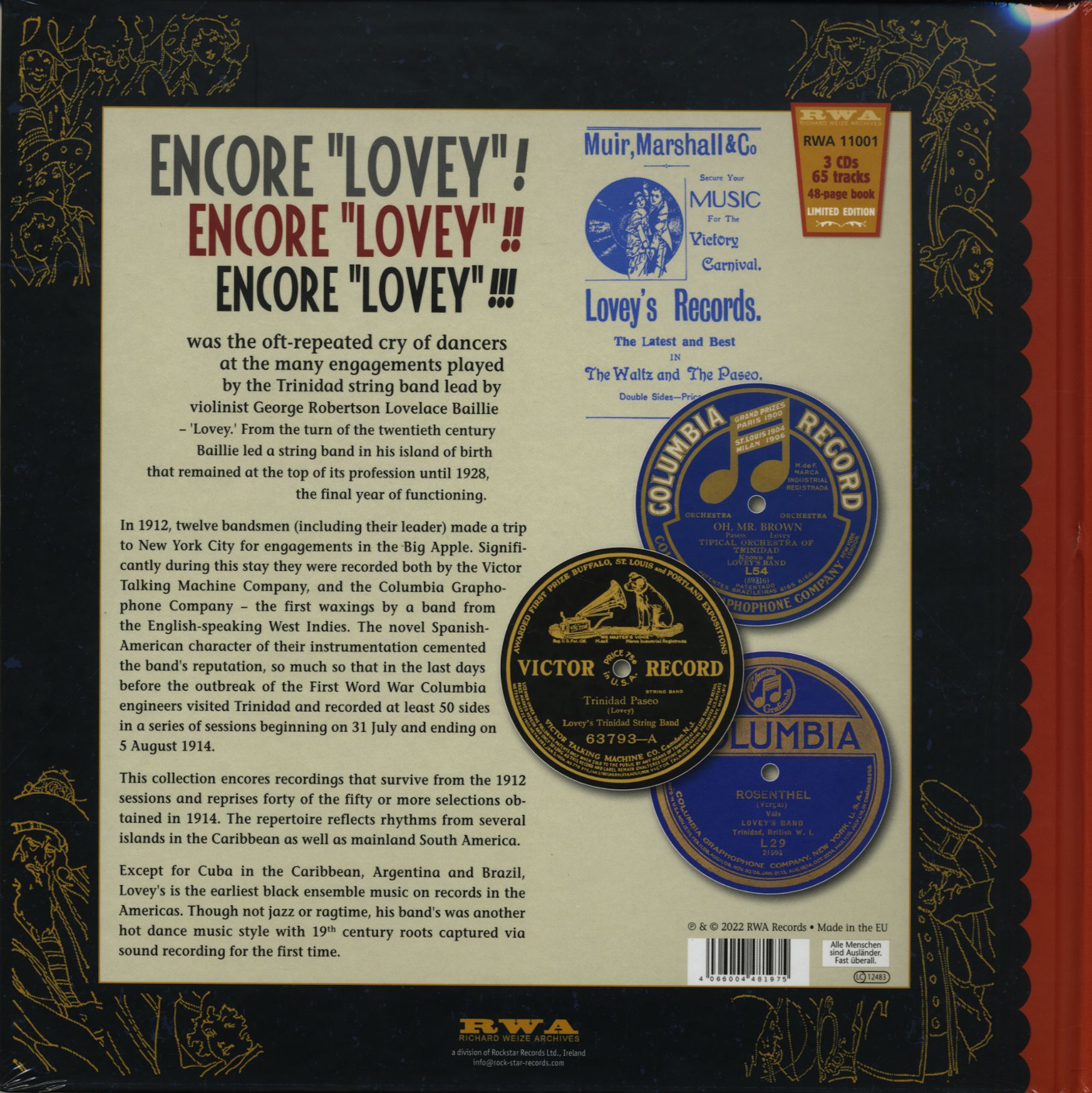
“Encore Lovey!” was the recurring cry of the dancers at the numerous performances of the Trinidad String Band under the direction of violinist George Robertson Lovelace Baillie, aka “Lovey.”
Since the turn of the 20th century, Baillie had led a string orchestra on his native island, which existed until 1928. In 1912, the band traveled to New York to play in the “Big Apple.” During this stay, they were recorded by both the Victor Talking Machine Company and the Columbia Graphophone Company—the very first recordings of a band from the English-speaking West Indies.
The novel Spanish-American character of their music cemented their reputation so much that in 1914, engineers from Columbia Trinidad visited them and recorded at least 50 more songs in a series of sessions. This collection contains the recordings from the 1912 sessions, as well as 40 of those made in 1914. The band's style reflected rhythms from several Caribbean islands and the South American mainland and was, apart from jazz and ragtime, another hot dance music style with roots in the 19th century. Apart from very few recordings from Cuba, Argentina, and Brazil, this is the earliest black ensemble music recorded on disc in America.
Article properties: Lovey's Original Trinidad String Band: Encore 'Lovey'! (Historic Recordings 1912/1914) (3-CD)
-
Interpret: Lovey's Original Trinidad String Band
-
Album titlle: Encore 'Lovey'! (Historic Recordings 1912/1914) (3-CD)
-
Genre Country
-
Label Richard Weize Archives
-
Artikelart CD
-
EAN: 4066004481975
- weight in Kg 0.62
FIRST RECORDINGS BY STRING BANDS AND CHANTWELLS
 The first recordings of idiomatic Trinidad music were made in the U.S.A. in 1912 when, at the encouragement of American tourists who had recently visited the island, a twelve-man group led by the violinist George Baillie (Lovey) travelled to New York City for concert engagements. Both the Victor Talking Machine Company and the Columbia Graphophone Company recorded Lovey's Trinidad String Band. Their performances, all instrumentals, featured paseos, Spanish waltzes and even Argentinean tangos, Spanish Main dance rhythms popular in the island during this period.22
Two years later, at the end of July-beginning of August 1914, Lovey's band made further recordings for Columbia. This was just at the commencement of the First World War, for on August 1, Britain declared war on Germany. The War, however, had no immediate effect in the British West Indies. In the middle of the same month,the Victor Talking Machine Company (of Camden, New Jersey, U.S.A.) sent its team to the island "to make a complete repertoire of Trinidad's "local" music, including "'Calypsos,' 'Paseos,' Spanish Waltzes, Two Steps, Patois and East Indian songs by local performers." The arrival of the company's representatives was reported in both the Mirror and Port-of-Spain Gazette on August 28. The Mirror provided a few extra particulars: "We understand that Mr. Henry Julian, formerly of 'White Rose' has been practising assiduously for the above purpose and that several other bands and performers have been engaged."23
Excepting September 6, recording sessions were held every day between the 3rd and 16th of the month. Victor's principal artist was the pianist and well-known string band leader, Lionel Belasco. Henry Julian (Iron Duke/Julian White Rose) recorded under the sobriquet J. Resigna. The other participants were Jules Sims (whose calendas were sung in French Creole), S. M. Akberali and Gellum Hossein (of East Indian ancestry), and the Orquesta de Venezolana de Chargo (probably made up of Trinidad creoles, some of Venezuelan descent).
The initial batch of Victor releases from these sessions was distributed in time for the 1915 Carnival (Mirror, February 8) and, excepting "sacred Mohammedan chants" by S. M. Akberali, virtually all the performances are of secular music played or sung by black creoles. Complimenting the waltzes and paseos recorded by the Belasco Orchestra, the Mirror went on to observe "A novelty in creole music is afforded in calypsos after the, rendering of 'Julian White Rose,' the celebrated chantrel, whose voice has lost none of its sweetness." They noted also that "the Bamboo Band "Kalendar" is a new feature which will appeal to lovers of originality." 24 While the other repertoire reflected degrees of "respectability," the stick-fighting calendas sung by Jules Sims and chorus, accompanied by tamboo-bamboo, represented the defiant and sometimes violent extremity of black creole society that did not conform with colonial ideals of decorum.
Various Calypso 1938-1940 (10-CD)
Read more at: https://www.bear-family.de/various-calypso-1938-1940-10-cd.html
Copyright © Bear Family Records

Ready to ship today, delivery time** appr. 1-3 workdays

Ready to ship today, delivery time** appr. 1-3 workdays
Ready to ship today, delivery time** appr. 1-3 workdays

Ready to ship today, delivery time** appr. 1-3 workdays
Ready to ship today, delivery time** appr. 1-3 workdays
the very last 2 available
Ready to ship today, delivery time** appr. 1-3 workdays

Item has to be restocked

only 2x still available
Ready to ship today, delivery time** appr. 1-3 workdays
Ready to ship today, delivery time** appr. 1-3 workdays