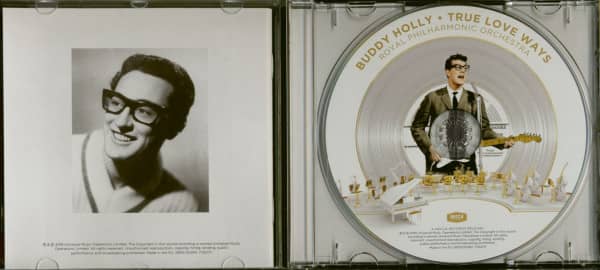
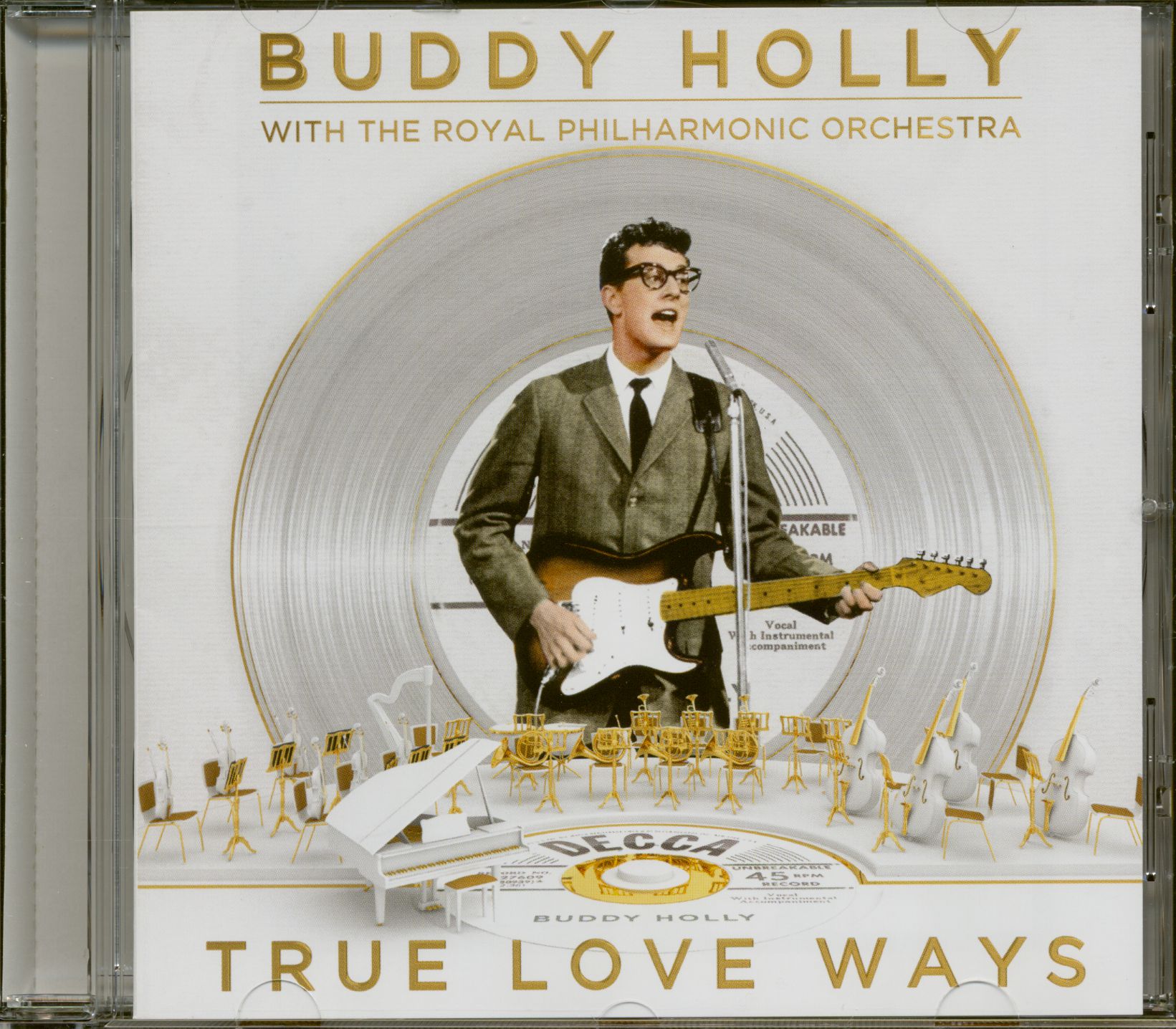
Buddy Holly with the Royal Philharmonic Orchestra True Love Ways (CD)
* incl. VAT / plus shipping costsDepending on the country of delivery, the VAT at checkout may vary.
Item is temporarily out of stock.
Approx. delivery time: up to 3 weeks. (as far as available at the supplier - can be faster, but sometimes unfortunately not)
- catalog number:CDDECCA2171
- weight in Kg 0.107
Buddy Holly with the Royal Philharmonic Orchestra: True Love Ways (CD)
Hello Buddy Holly and Cricket fans everywhere,
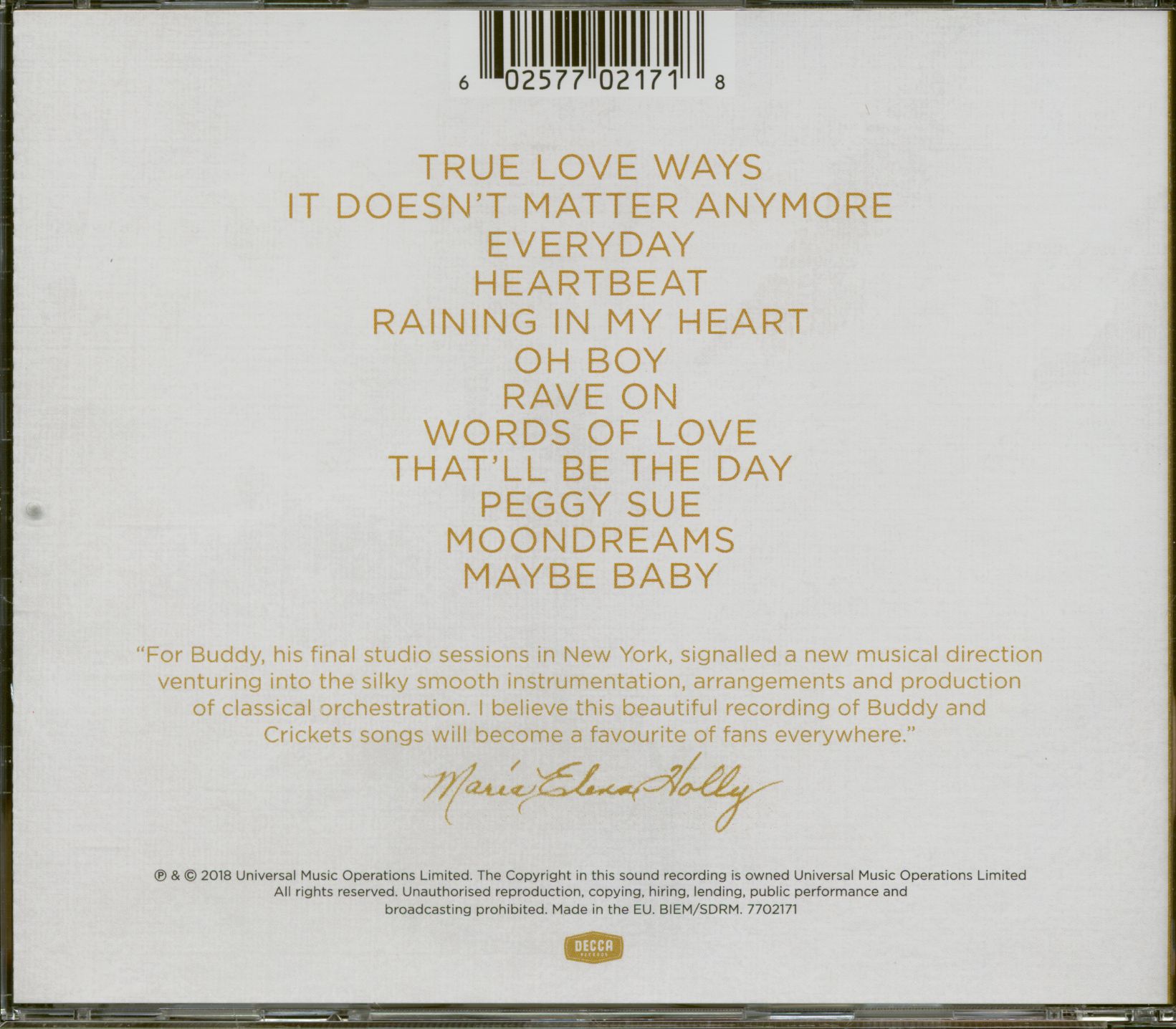
First, I would like to express my personal gratitude to you all, for your resolute devotion over so many years, in supporting the music legacy of Buddy and The Crickets. For Buddy, his final studio sessions in New York, where Dick Jacobs produced those beautiful orchestral arrangements, signalled a new music direction.
At the time, many of Buddy's worldwide dedicated followers may have doubted such a major transformation would work. From the incredibly successful hard-edged guitar driven Rock 'n' Roll style and sound Buddy and The Crickets had made their own, and then venturing into the silky smooth instrumentation, arrangements and production of classical orchestration, it was certainly a bold career move. But, just as Buddy's instinct in exploring creative, music innovation had proven positive so often previously, he passionately believed this form of popular music he was pioneering would also be successful.
Within months of Buddy's tragic passing, it would soon become the familiar sound of the pre-Beatles early 1960's hit recordings, heavily influenced by Buddy's own orchestral New York sessions. So, it is with immense pride for my beloved Buddy, that I wholeheartedly endorse and support this brilliant new release.
Following the same format as Buddy's friends and music giants Elvis and Roy, whose wonderful orchestral recordings have become so successful, I believe this beautiful, sympathetically produced classical Royal Philharmonic Orchestra recording of Buddy and Crickets songs will be welcomed and greeted with great enthusiasm, and become a favorite of fans everywhere.
My warm thanks and congratulations go out to the Royal Philharmonic Orchestra and everyone at Decca for the care and respect they have provided in producing a brilliant homage, tenderly embracing the incomparable music legacy of Buddy Holly and The Crickets.
Sincerely and with love,
Maria Elena Holly
Article properties:Buddy Holly with the Royal Philharmonic Orchestra: True Love Ways (CD)
Interpret: Buddy Holly with the Royal Philharmonic Orchestra
Album titlle: True Love Ways (CD)
Genre Rock'n'Roll
Label BMG Music
Artikelart CD
EAN: 0602577021718
- weight in Kg 0.107
| Holly, Buddy - True Love Ways (CD) CD 1 | ||||
|---|---|---|---|---|
| 01 | True love ways | Buddy Holly with the Royal Philharmonic Orchestra | ||
| 02 | It doesn't matter anymore | Buddy Holly with the Royal Philharmonic Orchestra | ||
| 03 | Everyday | Buddy Holly with the Royal Philharmonic Orchestra | ||
| 04 | Heartbeat | Buddy Holly with the Royal Philharmonic Orchestra | ||
| 05 | Raining in my heart | Buddy Holly with the Royal Philharmonic Orchestra | ||
| 06 | Oh boy | Buddy Holly with the Royal Philharmonic Orchestra | ||
| 07 | Rave on | Buddy Holly with the Royal Philharmonic Orchestra | ||
| 08 | Words of love | Buddy Holly with the Royal Philharmonic Orchestra | ||
| 09 | That'll be the day | Buddy Holly with the Royal Philharmonic Orchestra | ||
| 10 | Peggy sue | Buddy Holly with the Royal Philharmonic Orchestra | ||
| 11 | Moon dreams | Buddy Holly with the Royal Philharmonic Orchestra | ||
| 12 | Maybe baby | Buddy Holly with the Royal Philharmonic Orchestra | ||
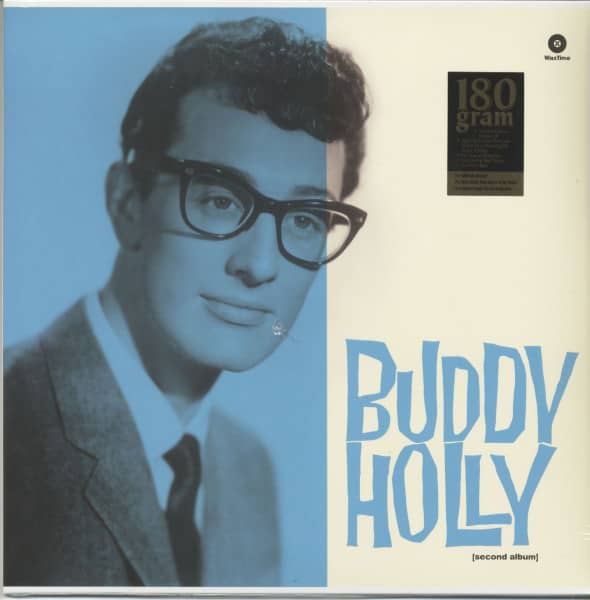
Buddy Holly
Buddy Holly was born Charles Hardin Holley on 7 September 1936 in Lubbock, Texas. Lubbock's geographical location meant that during his formative years Holly would have heard hillbilly, Mexican and black music on the radio, and this cosmopolitan musical background was to prove crucial to the versatility he displayed in his own work. As a youngster he took up the violin but soon switched to guitar. He showed an early interest in C&W, and while still at school he had his own show on KDAV, the local radio station. He was partnered by Bob Montgomery, and in 1954 they made some hillbilly demo recordings that were released posthumously as Holly In The Hills. Together with bassist Larry Welborn, Buddy and Bob sometimes filled the "local talent" slots when touring package shows visited the area. As a result of this exposure, and with the help of KDAV disc jockey Dave Stone, Nashville agent Eddie Crandall and publisher Jim Denny, Buddy Holly was signed by Decca in 1956 to cut some singles in Nashville. Two were released without success, and before his Decca contract came up for renewal Holly began looking elsewhere, reckoning that the option would not be taken up.
Although Decca treated Holly rather insensitively (that is, no more and no less unsympathetically than any other hopeful), these early sessions produced at least two Holly classics, "Midnight Shift" and "Rock Around With Ollie Vee", and Holly worked with musicians such as Sonny Curtis and Jerry Allison, who were later to be involved with the Crickets. Allison and Holly had been school friends and had often played together as a drums-and-guitar duo. The limitations of this line-up helped them develop their style: the smooth shifts from rhythm to lead in Buddy's guitar playing and the versatility of Jerry's drumming. When the two started playing together professionally in 1955, it was still unusual to find drums in a country line-up. Shortly after his last Decca session, Holly began working at Norman Petty's studio in Clovis, New Mexico.
Petty, who was also a middle-of-the-road bandleader, was a pioneer of the small independent recording studio, and he was unusual too in that he charged by the song rather than by the hour, which took the pressure off the musicians. In February 1957 Holly, Allison and Welborn, together with a vocal quartet that included future Cricket Niki Sullivan, recorded "That'll Be The Day" and "I'm Looking For Someone To Love". Petty first offered the songs to Roulette in New York, since they had already had hits from his studio with Buddy Knox and Jimmy Bowen. They were not interested, but Holly and the Crickets were soon signed by Coral. The record reached No. 3 in America and No. 1 in Britain, and was followed with almost equal success by "Oh Boy" / "Not Fade Away". By this time Joe Mauldin had become the Crickets' bassist, with Niki Sullivan on rhythm guitar. Soon afterwards Petty, who had quickly assumed a managerial role, began recording both with the Crickets and with Holly solo, although the musicians were often the same. Holly's first hit under his own name was "Peggy Sue" in late 1957, followed in Britain by "Listen To Me" and in both countries by "Rave On" and the Bobby Darin number "Early In The Morning" (by this time, mid-1958, Holly had begun recording in New York without the Crickets as well as in Clovis). After a British tour with the Crickets that year, Holly married Maria Elena Santiago and moved to New York. The rest of the Crickets did not want to make the move and so split from Holly. That was probably inevitable. Petty tried to broaden Holly's career, and one of the first results was recording him with the Dick Jacobs Orchestra (notably "It Doesn't Matter Anymore").
Holly's backing group on live dates at this time included Tommy Allsup, whom he had earlier brought into the Crickets to play lead guitar (it is a mistake to assume that Holly filled this role on all his records). Other notable musicians Holly worked with at this time were saxophonist King Curtis and the young Waylon Jennings, whose first solo recording, "Jole Blon", was produced by Buddy Holly. At the beginning of 1959 Holly's career stood at a crossroads. Despite his considerable early impact both with the Crickets and as a solo artist, and despite his own single-minded drive for success and the efforts he made to lay the foundation for a long career, there was little in strictly commercial terms to suggest (except with hindsight) that he was any different from many other rock musicians of the time.
He died on 3 February 1959, together with Ritchie Valens and the Big Bopper, shortly after taking off from Mason City airport in Iowa, on the way between package tour dates in Clear Lake and Fargo. His current record, "Heartbeat", had barely made a dent in the Hot Hundred. The first posthumous release, "It Doesn't Matter Anymore" / "Raining In My Heart", was a big hit in America and Britain.
In Britain a series of overdubbed tapes issued by Norman Petty kept him in the charts until the mid-sixties, while an album of his best-known tracks was still in the Top Ten of the budget-price charts ten years on. Buddy Holly said: "We owe it all to Elvis." Countless stars of the sixties are similarly in his debt. Buddy Holly was one of the two great singer/songwriter/musicians of fifties pop (the other being Chuck Berry). He was a pioneer of the standard two guitars/bass/drums line-up, and of double-tracking. Almost everything a rock/pop song can say was said decades ago by the 22-year-old Buddy Holly.
Copyright © Bear Family Records

Ready to ship today, delivery time** appr. 1-3 workdays

only 1x still available
Ready to ship today, delivery time** appr. 1-3 workdays

only 1x still available
Ready to ship today, delivery time** appr. 1-3 workdays

Item has to be restocked

Item has to be restocked

Ready to ship today, delivery time** appr. 1-3 workdays

Ready to ship today, delivery time** appr. 1-3 workdays

Ready to ship today, delivery time** appr. 1-3 workdays

Item has to be restocked