
Who was/is Dzyan ? - CDs, Vinyl LPs, DVD and more
Dzyan
The quintet Dzyan from the Mannheim/Frankfurt am Main area was “one of the darkest gems of the early-'70s krautrock scene, creatively blending elements of rock, improvised jazz, electronics and Asian ethnic music into something very special” (ALLMUSIC). The band's name was taken from the 'Book of Dzyan', a fictitious, supposedly very old and secret Indian book of creation. The band was founded at the end of 1971 by multi-instrumentalist and composer Reinhard Karwatky in Groß-Gerau, near Frankfurt am Main. The other members were Harry Krämer, Jochen Leuschner, Gerd Ehrmann and Ludwig Braum. The quintet began rehearsing at the beginning of 1972 and, after only two months – without having played a single gig – recorded its self-titled debut, which was released on the small German label ARONDA.
A “fascinating album that still sounds fresh today” (COSMIC EGG). Dzyan played a “slightly jazzy form of progressive rock with a touch of Wolfgang Dauner, parts of Frank Zappa's 'Hot Rats' and some Van Der Graaf Generator-style saxophone elements” (KRAUTROCK MUSIKZIRKUS). After the recordings were completed and shortly before the debut was released, Krämer (to study guitar in Frankfurt am Main) and Braum (to the Koblenz Symphony Orchestra) left the group. A month later Eddy Marron (g, voc, saz) (ex-Vita Nova) and Lothar Scharf (dr, ex-Volker Kriegel Band) joined the line-up, and in the second half of 1972 the band moved distinctly towards jazz rock. After Leuschner and Ehrmann left in November 1972 and Scharf († 2009) in May 1973, Dzyan was reduced to the trio of Marron, Karwatky and Peter Giger (dr, perc). This purely instrumental version of Dzyan changed its sound from prog rock to jazz with Asian elements.
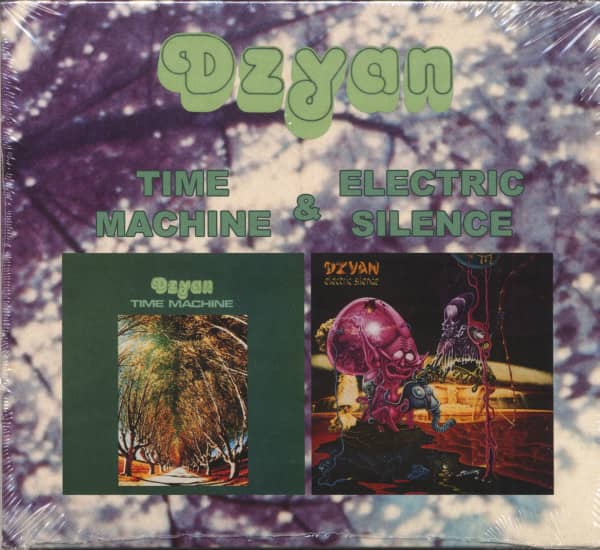
Later in 1973 the trio went into the Dierks Studio and recorded the album 'Time Machine', which was produced by Peter Hauke and released in November 1973 on the BACILLUS label. The album offered “astonishing evidence of freaked-out fusion jazz tracks, mixed with strange experiments and plenty of mysticism” (PROGARCHIVES). “Interesting jazz rock, at times laced with folkloric elements and every so often casting a sideways glance towards the Mahavishnu Orchestra” (JAZZ PODIUM). This “really strong jazz-rock record was among the best that was produced in this field in Germany in the '70s. The whole thing also had a certain krautish rawness and roughness that could give the music a very individual, likeable touch” (BABYBLAUE SEITEN).
At the beginning of 1974 drummer Giger left the band for a few months to work as a session musician for the jazz label ECM and to go on tour with Eberhard Weber (ex-Wolfgang Dauner Group). During his absence Mark Hellmann (dr) of the Dave Pike Set stepped in. When Giger returned to the band, Dzyan sounded completely different again, as Marron and Karwatky had experimented with a wide range of acoustic instruments and delved more deeply into ethnic and experimental music. The trio's next album, 'Electric Silence' (1974), was again recorded at the Dierks Studio and produced by former Karlheinz Stockhausen engineer Toby Hrycek-Robinson. With it, “probably the best German band in the jazz-rock field” (JAZZ PODIUM) released “their masterpiece. It passionately combined stylish jazz rock with wonderful Far Eastern elements. A very pleasant journey through 'kraut' and 'cosmic' extravaganzas” (PROGARCHIVES).
In any case, 'Electric Silence' was surely “among the strangest, but also the most impressive and most original things produced in the border zone between jazz and rock in Germany” (BABYBLAUE SEITEN). At the end of 1974, with the departure of the last remaining original member, Reinhard Karwatky, this final Dzyan line-up also fell apart. That was the end of the band's story. “Much like Embryo, Between, Agitation Free and others, Dzyan had found their own way of integrating elements of ethnic music into the archetypal jazz and rock styles of the '70s” (COSMIC DREAMS). Together with jazz bassist Gunter Lenz (ex-Albert Mangelsdorff Quintet), Marron and Giger formed the trio Giger-Lenz-Marron, which “sounded a bit like a jazzier and less experimental version of Dzyan” (ALLMUSIC). This trio released two albums, 'Beyond' (1976) and 'Where The Hammer Hangs' (1978). In the meantime – in the summer and autumn of 1974 – Marron was also a member of Missus Beastly…
KRAUT! is a fine cross-section of krautrock in four volumes, sorted by region – North, Centre, South and Berlin – with the biggest hits, lots of long-forgotten music and the most important songs.
Burghard Rausch, June 2020
Copyright © Bear Family Records
Copyright © Bear Family Records®. Copying, also of extracts, or any other form of reproduction, including the adaptation into electronic data bases and copying onto any data mediums, in English or in any other language is permissible only and exclusively with the written consent of Bear Family Records® GmbH.
only 1x still available
Ready to ship today, delivery time** appr. 1-3 workdays