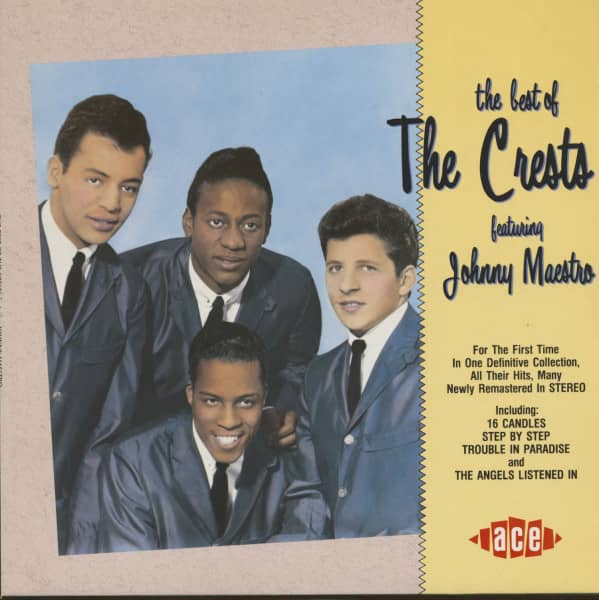
The Crests The Best Of The Crest (LP, US Pressing)
* incl. VAT / plus shipping costsDepending on the country of delivery, the VAT at checkout may vary.
Ready to ship today,
delivery time** appr. 1-3 workdays
- catalog number: LPR170948
- weight in Kg 0.21
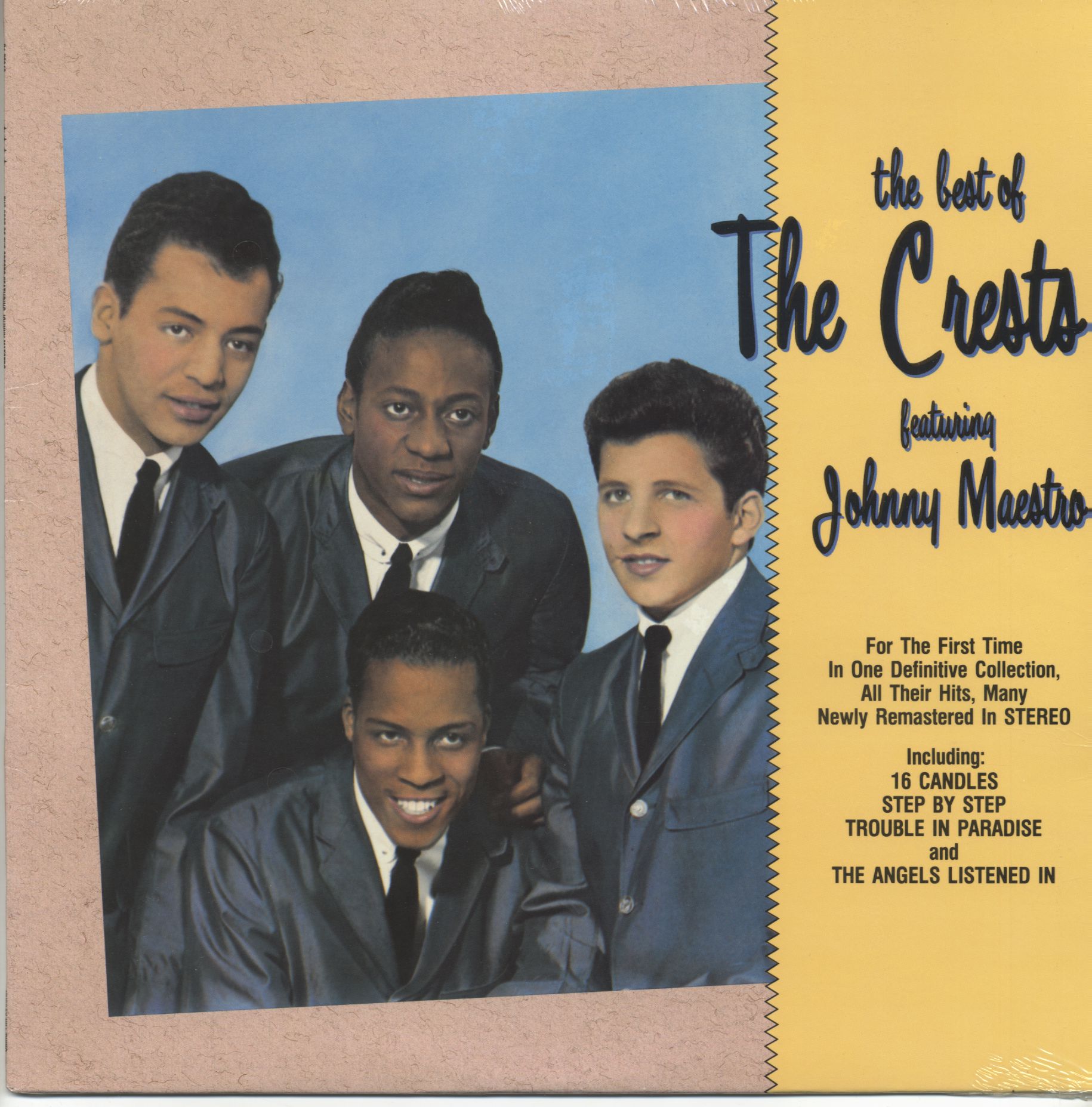
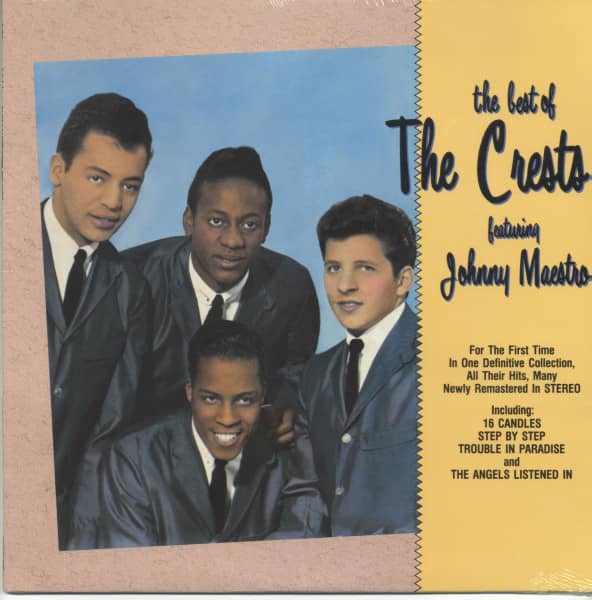
The Crests: The Best Of The Crest (LP, US Pressing)
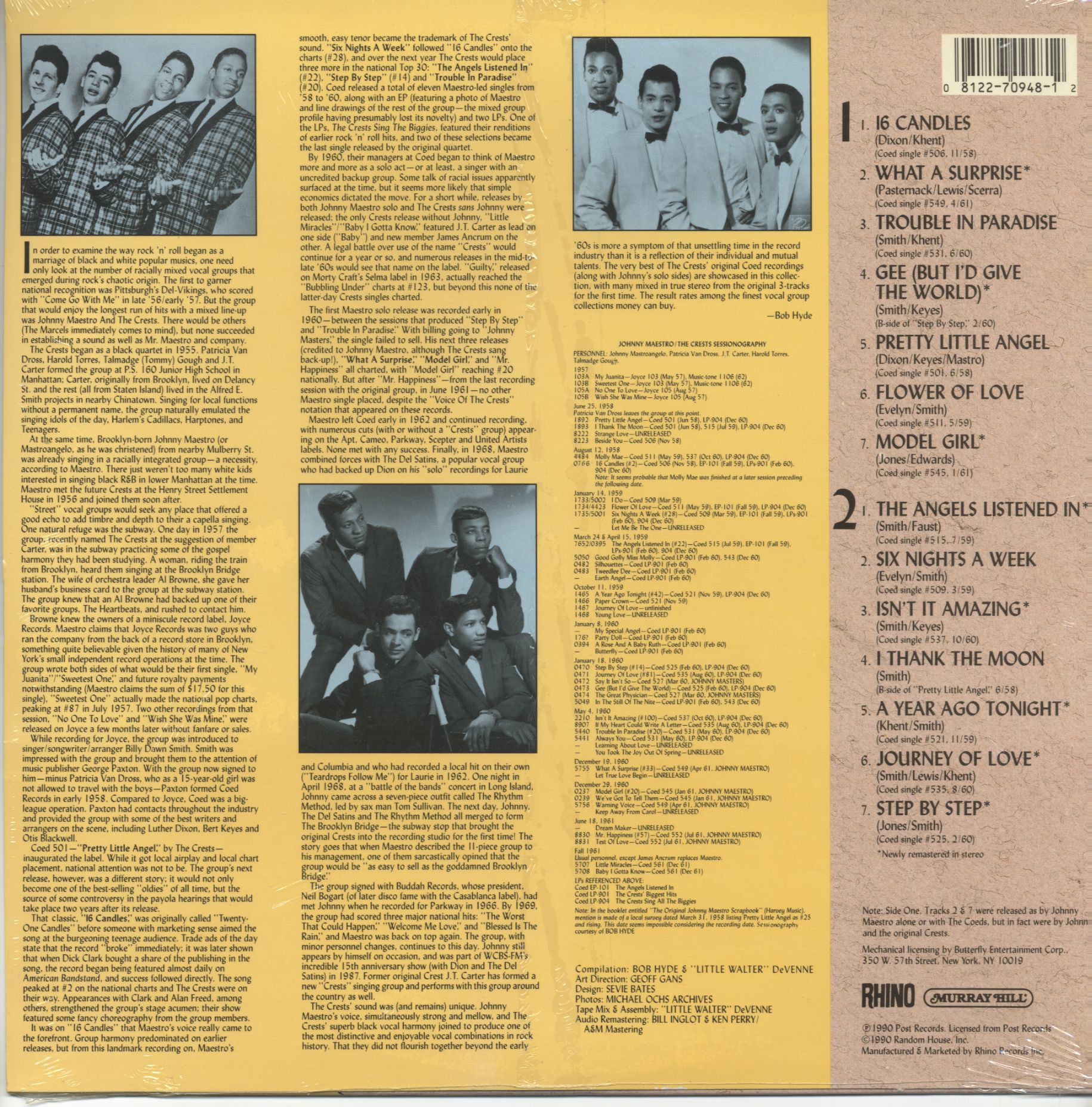
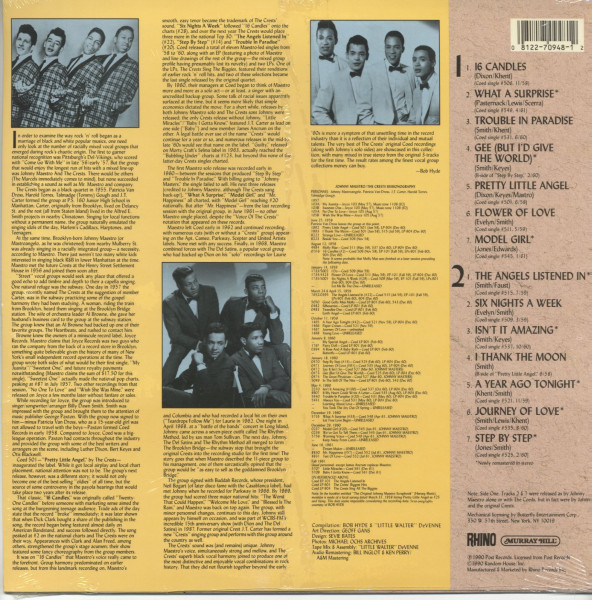
In order to examine the way rock 'n' roll began as a marriage of black and white popular musics, one need only look at the number of racially mixed vocal groups that emerged during rock's chaotic origin. The first to garner national recognition was Pittsburgh's Del-Vikings, who scored with "Come Go With Me" in late '56/early '57. But the group that would enjoy the longest run of hits with a mixed line-up was Johnny Maestro And The Crests. There would be others (The Marcels immediately comes to mind), but none succeeded in establishing a sound as well as Mr. Maestro and company. The Crests began as a black quartet in l955. Patricia Van Dross, Harold Torres, Talmadge (Tommy) Gough and J.T. Carter formed the group at P.S. l6O Junior High School in Manhattan, Carter, originally from Brooklyn, lived on Delancy St. and the rest (all from Staten Island) lived in the Alfred E. Smith projects in nearby Chinatown. Singing for local functions without a permanent name, the group naturally emulated the singing idols of the day, Harlem`s Cadillacs, Harptones, and Teenagers.
At the same time. Brooklyn-born Johnny Maestro (or Mastroangelo. as he was christened) from nearby Mulberry St. was already singing in a racially integrated group-a necessity, according to Maestro. There just weren't too many white kids interested in singing black REB in lower Manhattan at the time. Maestro met the future Crests at the Henry Street Settlement House in l956 and joined them soon after.
"Street" vocal
groups would seek any place that offered a good echo to add timbre
and depth to their a capella singing. One natural refuge was the
subway. One day in l957 the group. recently named The Crests at the
suggestion of member Carter, was in the subway practicing some of the
gospel harmony they had been studying. A woman. riding the train from
Brooklyn, heard them singing at the Brooklyn Bridge station.
The wife
of orchestra leader Al Browne, she gave her husband's business card
to the group at the subway station. The group knew that an Al Browne
had backed up one of their favorite groups. The Heartbeats, and
rushed to contact him. Browne knew the owners of a miniscule record
label. Joyce Records. Maestro claims that Joyce Records was two guys
who ran the company from the back of a record store in Brooklyn,
something quite believable given the history of many of New York's
small independent record operations at the time. The group wrote both
sides of what would be their first single, "My
Juanita"/"Sweetest Onel' and future royalty payments
notwithstanding (Maestro claims the sum of $l7.50 for this single),
"Sweetest One" actually made the national pop charts.
peaking at #87 in July l957. Two other recordings from that session,
"No One To Love" and "Wish She Was Mine?' were
released on Joyce a few months later without fanfare or sales. While
recording for Joyce, the group was introduced to
singer/songwriter/arranger Billy Dawn Smith. Smith was impressed with
the group and brought them to the attention of music publisher George
Paxton. With the group now signed to him-minus Patricia Van Dross,
who as a 15-year-old girl was not allowed to travel with the
boys-Paxton formed Coed Records in early l958. Compared to Joyce.
Coed was a big league operation. Paxton had contacts throughout the
industry and provided the group with some of the best writers and
arrangers on the scene, including Luther Dixon, Bert Keyes and Otis
Blackwell.
Coed 501 -"Pretty Little Angeli' by The Crests-
inaugurated the label. While it got local airplay and local chart
placement, national attention was not to be. The group`s next
release, however. was a different story, it would not only become one
of the best-selling "oldies" of all time, but the source of
some controversy in the payola hearings that would take place two
years after its release.
That classic, "16 Candles?' was
originally called "Twenty- One Candles" before someone with
marketing sense aimed the song at the burgeoning teenage audience.
Trade ads of the day state that the record "broke"
immediately, it was later shown that when Dick Clark bought a share
of the publishing in the song, the record began being featured almost
daily on American Bandstand, and success followed directly. The song
peaked at #2 on the national charts and The Crests were on their way.
Appearances with Clark and Alan Freed. among others, strengthened the
group's stage acumen: their show featured some fancy choreography
from the group members. It was on “16 Candles” that Maestro's
voice really came to the forefront. Group harmony predominated on
earlier releases, but from this landmark recording on. Maestro's
smooth. easy tenor became the trademark of The Crests' sound. "Six
Nights A Week" followed " 16 Candles' onto me charts (#28),
and over the next year The Crests would place three more in the
national Top 30: "The Angels Listened In" (#22), "Step
By Step" (# 14) and "Trouble In Paradise" (#20). Coed
released a total of eleven Maestro~led singles from '58 to '60, along
with an EP (featuring a photo of Maestro and line drawings of the
rest of the group-the mixed group profile having presumably lost its
novelty) and two LPs. One of the LPs, The Crests Sing The Biggies,
featured their renditions of earlier rock 'n' roll hits, and two of
these selections became the last single released by the original
quartet.
By 196O, their managers at Coed began to think of Maestro
more and more as a solo act-or at least. a singer with an uncredited
backup group. Some talk of racial issues apparently surfaced at the
time. but it seems more likely that simple economics dictated the
move. For a short while, releases by both Johnny Maestro solo and The
Crests sans Johnny were released, the only Crests release without
Johnny. "Little Miracles"/"Baby l Gotta Knowl'
featured J.T. Carter as lead on one side ("Baby") and new
member James Ancrum on the other. A legal battle over use of the name
"Crests" would continue for a year or so. and numerous
releases in the mid-to- late '6Os would see that name on the label.
"Guilty' released on Morty Craft`s Selma label in l963, actually
reached the “Bubbling Under" charts at # 123, but beyond this
none of the latter-day Crests singles charted.
The first Maestro solo
release was recorded early in 1960-between the sessions that produced
"Step B Step" and "Trouble In Paradise' With billing
going to "Johnny Masters' the single failed to sell. His next
three releases (credited to Johnny Maestro. although The Crests sang
back-up), "What A Surprise?' "Model Girl' and Happiness"
all charted, with "Model Girl" reaching #20 nationally. But
after "Mr. Happiness"-from the last recording session with
the original group, in June 1961 -no other Maestro single placed,
despite the "Voice Of The Crests" notation that appeared on
these records.
Maestro left Coed early in l962 and continued
recording, with numerous cuts (with or without a "Crests"
group) appearing on the Apt, Cameo, Parkway, Scepter and United
Artists labels. None met with any success. Finally, in 1968, Maestro
combined forces with The Del Satins, a popular vocal group who had
backed up Dion on his "solo" recordings for Laurie and
Columbia and who had recorded a local hit on their own ("Teardrops
Follow Me") for Laurie in 1962. One night in April 1968, at a
"battle of the bands" concert in Long Island, Johnny came
across a seven-piece outfit called The Rhythm Method. led by sax man
Tom Sullivan. The next day, Johnny. The Del Satins and The Rhythm
Method all merged to form The Brooklyn Bridge—the subway stop that
brought the original Crests into the recording studio for the first
time! The story goes that when Maestro described the ll-piece group
to his management, one of them sarcastically opined that the
€|'0(,l|J would be "as easy to sell as the goddamned Brooklyn
I' ge. The group signed with Buddah Records, whose president. Neil
Bogart (of later disco fame with the Casablanca label}, had met
Johnny when he recorded for Parkway in 1966. By 1969. the group had
scored three major national hits: "The Worst That Could Happen’
"Welcome Me Love‘ and "Blessed Is The Rainin’ and
Maestro was back on top again. The group, with minor personnel
changes. continues to this day. John still appears by himself on
occasion, and was part of WCBS-FM’s incredible l5th anniversary
show (with Dion and The Del Satins) in l987. Former original Crest
J.T. Carter has formed a new "Crests" singing group and
performs with this group around the country as well.
The Crests’
sound was (and remains) unique. Johnny Maestro voice, simultaneously
strong and mellow. and The Crests' superb black vocal harmony joined
to produce one of the most distinctive and enjoyable vocal
combinations in rock history. That they did not flourish together
beyond the early '60s is more a symptom of that unsettling time in
the record industry than it is a reflection of their individual and
mutual talents. The very best of The Crests’ original Coed
recordings (along with Johnny's solo sides) are showcased in this
collection, with many mixed in true stereo from the original 3-tracks
for the first time. The result rates among the finest vocal group
collections money can buy.
Video von The Crests - The Best Of The Crest (LP, US Pressing)
Article properties: The Crests: The Best Of The Crest (LP, US Pressing)
-
Interpret: The Crests
-
Album titlle: The Best Of The Crest (LP, US Pressing)
-
Genre R&B, Soul
- Geschwindigkeit 33 U/min
- Vinyl record size LP (12 Inch)
- Record Grading Mint (M)
- Sleeve Grading Mint (M)
-
Label Rhino Records
-
Artikelart LP
-
EAN: 0081227094812
- weight in Kg 0.21
| Crests, The - The Best Of The Crest (LP, US Pressing) LP 1 | ||||
|---|---|---|---|---|
| 01 | 16 Candles | The Crests | ||
| 02 | What A Surprise | The Crests | ||
| 03 | Trouble In Paradise | The Crests | ||
| 04 | Gee (But I'd Give The World) | The Crests | ||
| 05 | Pretty Little Angel | The Crests | ||
| 06 | Flower Of Love | The Crests | ||
| 07 | Model Girl | The Crests | ||
| 08 | The Anges Listened In | The Crests | ||
| 09 | Six Nights A Week | The Crests | ||
| 10 | Isn't It Amazing | The Crests | ||
| 11 | I Thank The Moon | The Crests | ||
| 12 | A Year Ago Tonight | The Crests | ||
| 13 | Journey Of Love | The Crests | ||
| 14 | Step By Step | The Crests | ||
The Crests
Step By Step
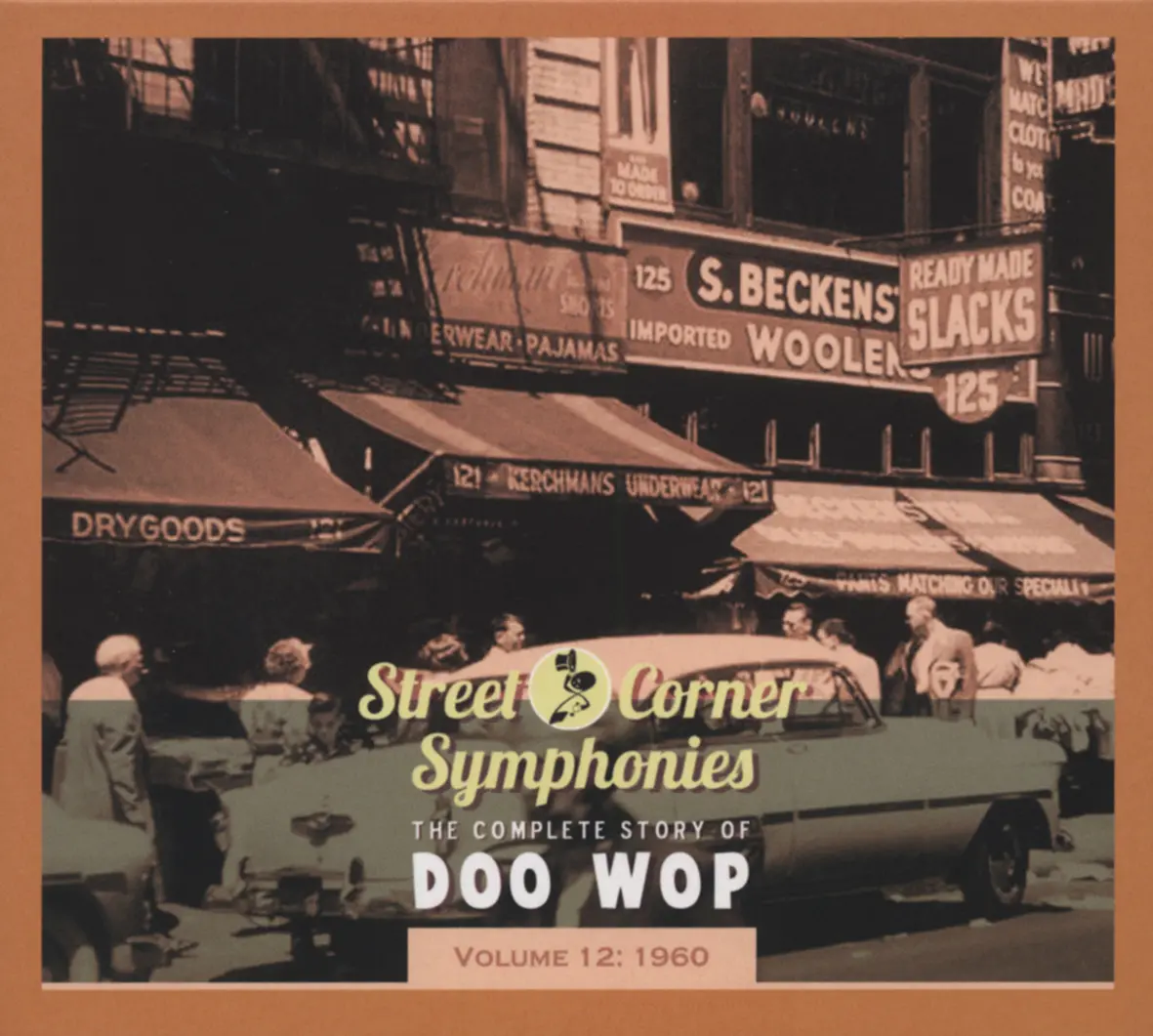
Johnny Maestro and his Crests had a good thing going at Coed Records. Co-owner George Paxton was a music publisher whose output displayed a polish that a lot of New York indies lacked. The Crests had been Coed's flagship group since their 16 Candles just missed topping the pop hit parade (you'll find it on our 1958 edition).
Maestro's powerhouse leads and the harmonies of second tenor Tommy Gough, baritone Harold Torres, and bass J.T. Carter ensured that the multi-ethnic Crests kept posting hits: Six Nights A Week, Flower Of Love, and The Angels Listened In in 1959 alone. Step By Step, written by house songsmiths Ollie Jones (a former member of The Ravens and Cues) and Billy Dawn Smith, sailed to #14 pop in the spring of '60 with Gee (But I'd Give The World) residing on the opposite side.
"That got us back up in the Top Ten again," said the late Maestro. "It was a good song." Coed spared no expense. "That was great. The sound was phenomenal, the first time being there in the studio with live strings. A beautiful sound." Paxton's studio demeanor was calm. "He was kind of laidback. He never really had much to say. It was mostly the arrangers who had most of the say in the recordings. He'd throw his two cents in once in a while. He'd always be there, of course. But Bert Keyes and Billy Dawn, they were very instrumental in all of our recordings."
Between Step By Step and its Top 20 followup Trouble In Paradise, The Crests were flying high. But trouble loomed on the horizon. "'Trouble In Paradise,' I think, was the beginning of the end for the Crests,” said Maestro. "The record company told us that sales started diminishing because of the integration of the group, and they felt that we couldn't get any national exposure on national TV because of that. So they made the decision to start recording us separately - me as a soloist, and the group with another singer. We were young, we just really had no say-so in anything. And they kind of told us to what to do, so we just followed them and figured they knew what they knew what they were talking about.”
Maestro became a solo at Coed, nailing three 1961 hits. But he wasn't happy. "Being with a group all my life - all my vocal life, anyway - I was really used to being with the group in the studio and onstage. I had that support," he said. "So after a couple of records, I left the record company and just started traveling around the country with a band." Meanwhile, The Crests soldiered on without him. Maestro was singing with The Del-Satins, Dion's vocal group on Runaround Sue, but they wanted a bigger sound. They merged in 1966 with a horn band called The Rhythm Method. A new name was in order for the 11-piece outfit. "Someone at our manager's office made a comment, 'It's gonna be easier to sell the Brooklyn Bridge than sell a group of this size!'" laughed Johnny.
Buddah Records boss Neil Bogart wanted The Brooklyn Bridge to go bubblegum, but Maestro had heard a Jimmy Webb composition on a 5th Dimension album. "I said, 'This is a great song. I think we should arrange it our way and go into the studio,'" he said.The Brooklyn Bridge's Wes Farrell-produced rendition of Worst That Could Happen went gold in early '69, soaring to #3 pop. They scored lesser hits through 1970 and were still going strong when Maestro died March 24, 2010.
Various - Street Corner Symphonies 1960 Vol.12
Read more at: https://www.bear-family.de/various-street-corner-symphonies-1960-vol.12.html
Copyright © Bear Family Records
the very last 1 available
Ready to ship today, delivery time** appr. 1-3 workdays


Ready to ship today, delivery time** appr. 1-3 workdays

Item has to be restocked
only 1x still available
Ready to ship today, delivery time** appr. 1-3 workdays

the very last 1 available
Ready to ship today, delivery time** appr. 1-3 workdays

Ready to ship today, delivery time** appr. 1-3 workdays

Ready to ship today, delivery time** appr. 1-3 workdays

This article is deleted and can no longer be ordered!

Ready to ship today, delivery time** appr. 1-3 workdays
the very last 1 available
Ready to ship today, delivery time** appr. 1-3 workdays
Ready to ship today, delivery time** appr. 1-3 workdays
Ready to ship today, delivery time** appr. 1-3 workdays

Ready to ship today, delivery time** appr. 1-3 workdays
Ready to ship today, delivery time** appr. 1-3 workdays