
Trio Farther Along (2-LP)
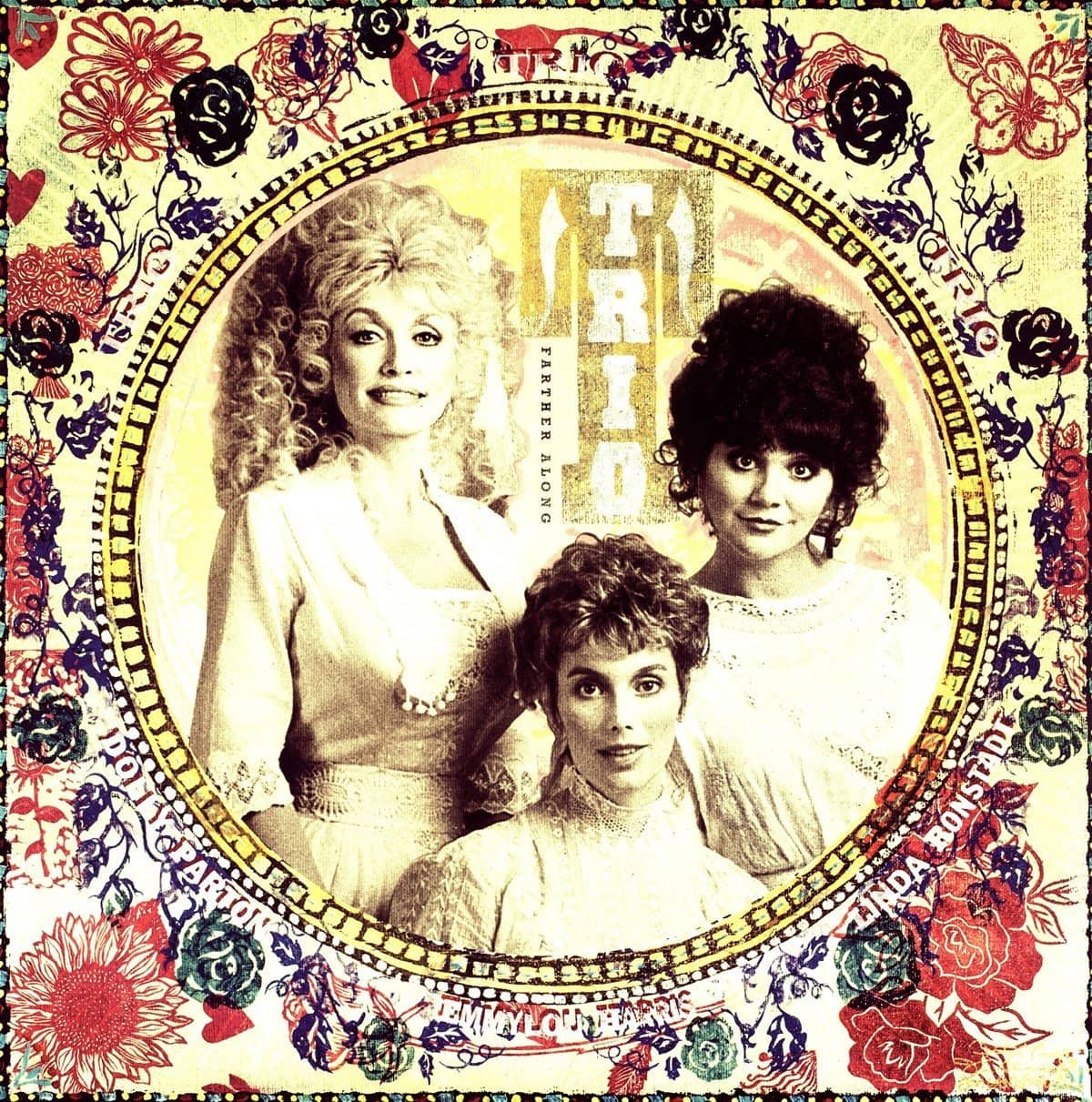
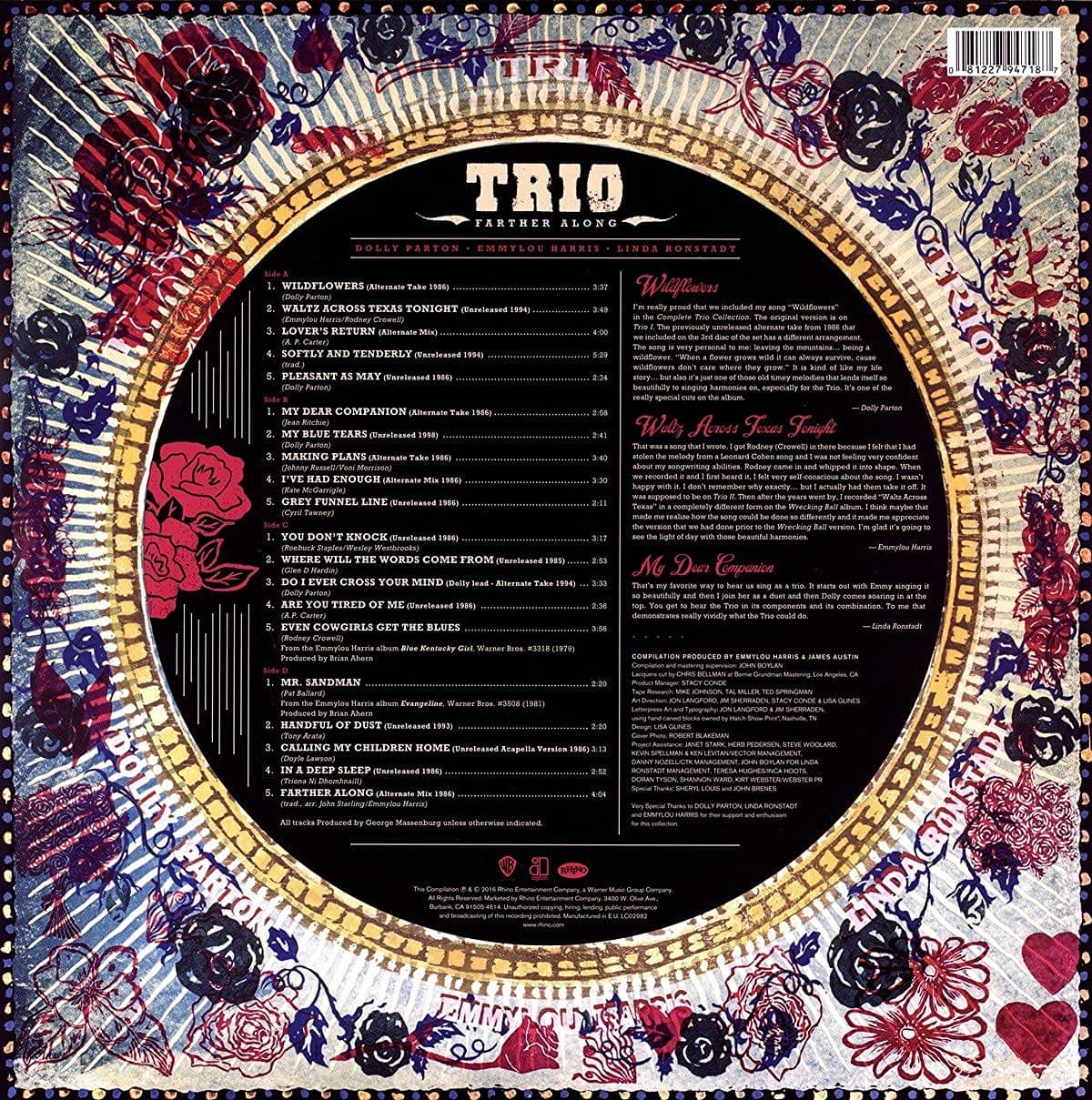


- catalog number:LPRN794718-B
- weight in Kg 0.48
Trio: Farther Along (2-LP)
Article properties:Trio: Farther Along (2-LP)
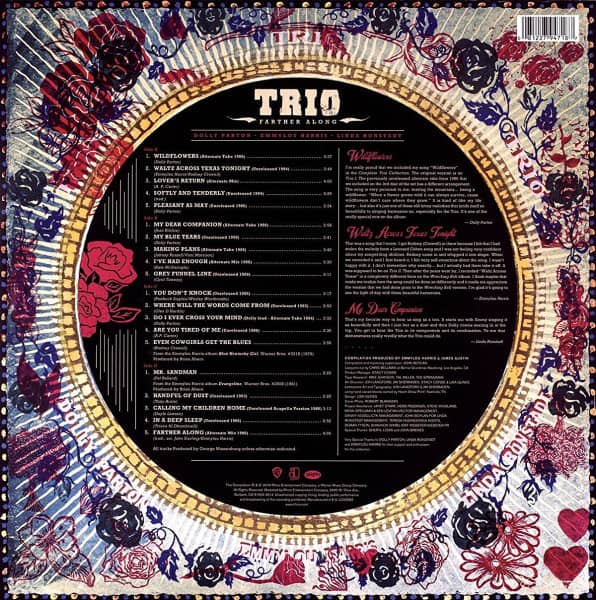
| Trio - Farther Along (2-LP) LP 1 | ||||
|---|---|---|---|---|
| 01 | Wildflowers (Alternate Take Unreleased 1986) | Trio | ||
| 02 | Waltz Across Texas Tonight (Unreleased 1994) | Trio | ||
| 03 | Lover's Return (Alternate Mix - Unreleased) | Trio | ||
| 04 | Softly and Tenderly (Unreleased 1994) | Trio | ||
| 05 | Pleasant As May (Unreleased 1986) | Trio | ||
| 06 | My Dear Companion (Alternate Take 1986) | Trio | ||
| 07 | My Blue Tears (Unreleased 1998) | Trio | ||
| 08 | Making Plans (Alternate Take 1986) | Trio | ||
| 09 | I've Had Enough (Alternate Mix 1986) | Trio | ||
| 10 | Grey Funnel Line (Unreleased 1986) | Trio | ||
| Trio - Farther Along (2-LP) LP 2 | ||||
|---|---|---|---|---|
| 01 | You Don't Knock (Unreleased 1986) | Trio | ||
| 02 | Where Will the Words Come from (Unreleased 1985) | Trio | ||
| 03 | Do I Ever Cross Your Mind (Dolly Lead Alternate Take 1994) | Trio | ||
| 04 | Are You Tired of Me (Unreleased 1986) | Trio | ||
| 05 | Even Cowgirls Get the Blues | Trio | ||
| 06 | Mr Sandman | Trio | ||
| 07 | Handful of Dust (Unreleased 1993) | Trio | ||
| 08 | Calling My Children Home (Unreleased Acapella Version 1986) | Trio | ||
| 09 | White Snow (Unreleased 1986) | Trio | ||
| 10 | Farther Along (Alternate Mix 1986) | Trio | ||
Trio NDW
Stephan Remmler (voc, syn, casio)
Gert 'Kralle' Krawinkel (g, voc)
Peter Behrens (dr, voc)
“Our policy is not to say anything about the time before Christmas 1980” (Remmler), for those historic Christmas days of that year were the birthdays of Trio. This secrecy (“nobody cared about us before, so we're not telling anything about it either” – Stephan Remmler) could not be kept up for long, however, for the past of a band this hip – whose single Da Da Da was released in 30 countries and sold more than 13 million copies worldwide, and whose debut album 'Trio' was released simultaneously in 20 countries – does not remain unexplored and undiscovered.
With a “maximum of imagination, playful wit and spontaneity, and a minimum of instruments and other equipment” (Munzinger-Archiv), Trio played a decisive part in shaping the Neue Deutsche Welle in the early '80s. Stephan Remmler from Bremerhaven and Gert Franz Alexander Krawinkel from Cuxhaven had already made music together on the North Sea coast in the mid-'60s. With their bands MacBeats and Just Us they contributed significantly to building up a rock scene in the Bremerhaven/Nordenham area. After Just Us split up, Remmler and Krawinkel each wanted to pursue their own musical ambitions from 1969 onwards. Remmler tried his luck under the pseudonym 'Rex Carter' (with moustache and poodle hairdo) and the unsuccessful single I Know It's Over / Now I'm Leaving Home (1971). Krawinkel founded the band Cravinkel with George B. Miller and Klaus George Meier (later Wolfsmond), which released two albums in the psychedelic blues-rock sound of the late '60s that was fashionable at the time.
Peter Behrens (Peter Behrens Janssen) was at that time (the early '70s) the drummer of the psychedelic krautrock band Silberbart and likewise remained unsuccessful. In January 1979 a Just Us reunion concert with Remmler and Krawinkel met with a positive response, so the two decided to make another attempt at breaking into the music business. They gave up their jobs as teachers and in July founded a company called Just Us Music Productions GmbH, whose aim was to produce successful music. Remmler and Krawinkel rented a house in Großenkneten (in the district of Regente) for 600 Deutschmarks a month – in the triangle between Oldenburg, Cloppenburg and Bremen – lived there in a kind of commune and promoted band projects under the name Wind, sometimes with more than 25 participants. During this time Behrens also joined them, because Remmler and Krawinkel had advertised for drummers in the newspaper. Behrens, who was unemployed at the time, now spent every day at the house and rehearsed alone with Remmler and Krawinkel, because the other musicians usually only had time at weekends.
At the beginning of 1980 part of the stage equipment had to be sold for lack of money, and Remmler and Krawinkel then decided to make music with Behrens alone. The three worked out a stage show planned down to the smallest detail and named themselves Trio after the number of band members. A first self-produced 10" EP appeared in February 1981 in an edition of 333 copies at 3 x 3 Deutschmarks and was meant to serve as an application to record labels. Through word of mouth, their unusual and quirky live performances became something of a sensation. Behrens' drum kit (stage name Karl Knapp) looked like a pupil's experimental set-up in a music lesson and consisted of a floor tom, a hi-hat and a bass drum, which he played standing up. “The decisive thing was that in the end we did without a bass guitarist. When we saw that the music sounded so much more interesting, we only used our minimal concept as a matter of principle. Those who heard us thought at first we were a joke. But it was just a representation of our difficulties and our limited means” (Remmler).
Krawinkel used an old portable valve amplifier for his guitar, and Remmler mumbled, talked, cracked jokes, communicated with the audience and sang in German and English – partly through a throat microphone that sounded like a telephone receiver. A copy of the demo LP was presented to Louis Spillmann of the major label PHONOGRAM. He particularly liked the song Sunday You Need Love Monday Be Alone, and above all the professional live performance persuaded him to offer Trio a record deal. Klaus Voormann (former Manfred Mann bassist, designer of the Beatles' 'Revolver' cover and talent scout for the PHONOGRAM label) was assigned as Trio's producer. In the summer of 1981, under his direction, the recordings for Trio's self-titled debut album took place in a converted stable in Husum, Schleswig-Holstein. In October 1981 the debut album was released in a sleeve with a carrying handle and an enclosed single. What remained somewhat hidden on the record, however, was what made them a success live: Trio's visual presentation.
Since they refused to play in larger cities and clubs, the three toured Germany's record shops to promote the album directly on the spot. In the afternoons Trio played in the shops, in the evenings in the clubs. During this tour Remmler was given a toy keyboard and used it to compose Da da da ich lieb dich nicht du liebst mich nicht. The song made it into the group's set list, was well received by audiences and was later chosen by Klaus Voormann for a single production. In February 1982 ARD's 'Rockpalast' produced a show with Trio. Their other concerts in the spring were completely sold out – purely through word of mouth and the enthusiasm of the media. A recording of the 1982 tour, which already featured the first version of Da da da, was released as a music cassette and was thus “the first record that only exists on cassette” (advertising). At the beginning of May 1982 Trio also performed Da da da on the ZDF 'Hitparade'. The studio version of Da da da had been recorded at the beginning of 1982 at the Yello studio in Zurich. Voormann played a discreet bass, and Annette Humpe (Ideal) later added the female voice in the chorus in Berlin – anonymously.
From February 1982 the single stormed the charts, reached no. 2, went gold and set off on a triumphal march around the entire globe. The accompanying debut album – onto which the song was subsequently added – fared just as well. In the autumn of 1982 the single Anna – Lassmichrein Lassmichraus (English: Anna – Letmein Letmeout) was released and effortlessly continued the success. In the autumn of 1983, after a two-year break, came the next album, 'Bye Bye', which for the first time was received less favourably by the critics. This time the record sleeve was divided into fields that were rented out/sold as advertising space – the income from the advertising fields went to Greenpeace. In November Trio played concerts in the USA (including at the Ritz in New York) and Canada, which were celebrated by the press.
During a break in 1984 the three musicians were active in various projects. Remmler produced the duet Feuerwerk with the twelve-year-old singer Nina and took part as narrator in a new production of Prokofiev's 'Peter und der Wolf'. Krawinkel worked in the studio with Marius Müller-Westernhagen, and Behrens appeared in front of the camera in Hans-Christoph Blumenberg's film '1.000 Augen' – alongside Barbara Rudnik, Armin Mueller-Stahl, Karin Baal, Peter Kraus, Hannelore Hoger and others. In the autumn of 1985 Trio returned with a multimedia double whammy, which, however, turned out to be a resounding flop. The band had ventured into a feature film – but Dominik Graf's film 'Drei gegen Drei' (featuring Ralf Wolter, Peer Augustinski and Ute Lemper in supporting roles, among others) met with…
Burghard Rausch
Copyright © Bear Family Records

Item has to be restocked

Item has to be restocked


This article is deleted and can no longer be ordered!

This article is deleted and can no longer be ordered!

This article is deleted and can no longer be ordered!

This article is deleted and can no longer be ordered!

This article is deleted and can no longer be ordered!