
Who was/is Tassilo - Bruno Ganz & Axel Milberg ? - CDs, Vinyl LPs, DVD and more
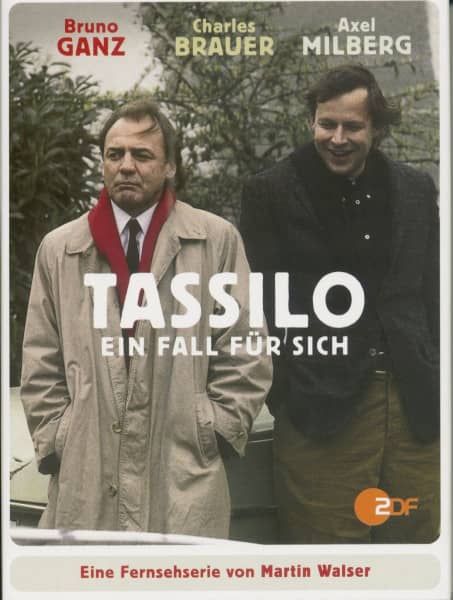
Tassilo - Bruno Ganz & Axel Milberg
“Based on material by Martin Walser”
How Tassilo S. Grübel came to television
Someone (or was it a woman?) failed to return the script – even though page 2 expressly states that the manuscript is the property of West-Film GmbH & Co. KG. “Passing it on to third parties is only permitted with the approval of the production. The script must be returned to the production at the end of filming.” Nevertheless, the manuscript, dated 10 October 1988, turned up at an online antiquarian bookseller. “Die Abenteuer des Tassilo S. Grübel” (The Adventures of Tassilo S. Grübel) – evidently the working title of the series – “by Martin Walser” is printed on the cover page, followed by the details: screenplay: Hermann Naber; adaptation: Martin Walser and Hajo Gies; shooting script: Hartmut Grund. This already hints that the whole thing was not exactly cast in a single mould.
A complicated genesis. First, the simple version: six radio plays became a six-part television series.
Walser invented the idiosyncratic and unorthodox detective Tassilo S. Grübel in 1974 for his radio play “Die Verteidigung von Friedrichshafen”. There is a gap in the market – “plenty of very wealthy people all around this lake and still no proper detective agency” – which he intends to exploit. But the people living around Lake Constance first have to realise that they need him. “Tassilo has recognised that awakening needs plays an ever greater role in every line of business,” is how Walser describes the basic idea. “People only grasp how important a detective is once you produce a little danger.” And so, with the help of his friend Hugo – every Sherlock Holmes needs a Dr Watson – Tassilo stages a threat. The gang of blackmailers presents itself in thoroughly businesslike fashion: “Cyclops Gotham, Inc.” reads the letterhead – educated gangsters: the Cyclopes of Greek antiquity are combined with the American pop myth of Batman, Gotham City being his base of operations, and international references are cited. The very names – the repulsive businessman James Blickle, Georg Feuerstein, the “little junior entrepreneur”, Mia von Mufflings and Baron Oschatz-Totensen – reveal that the author was taking an ironic swipe at Lake Constance society. In the radio play, a WDR/SWF/BR production, Wolfgang Reichmann voiced Tassilo, Sabine Sinjen Biddie and Susi Nicoletti Tassilo's mother.
Walser had not had a sequence, let alone a series, in mind, but the ensemble of characters and the Lake Constance setting evidently gave the author so much pleasure that he wrote another radio play the following year: “Lindauer Pietà”. The cast of the first play was no longer available; this time Heinz Meier and Ricarda Benndorf voiced Tassilo and Biddie, Lina Carstens was Tassilo's mother, and Brigitte Horney could be heard in the one-off role of Maximiliane Metzger-Fürst. “Säntis” followed in 1978, directed by a filmmaker, Alf Brustellin. He was able to engage a whole string of prominent names: Josef Bierbichler as Tassilo, Maria Singer as his mother, Franziska Walser and Edgar Selge in supporting roles, plus Ilse Pagé and Karl Lieffen. After a break of almost ten years came, in quick succession, “Das Gespenst von Gattnau” (1987), “Hilfe kommt aus Bregenz” (1988) and “Zorn einer Göttin” (1989). In the last two of these radio plays, Hugo was voiced by Charles Brauer, who played James Blickle in the television series.
Even before the last of the six “Tassilo” radio plays had been broadcast, the first scripts for the TV adaptation were ready. Walser left this work to Hermann Naber, a renowned radio drama dramaturge and director who headed SWF's radio drama department from 1965 to 1998. “I find it almost unsavoury to adapt oneself,” Walser explained. “The idea is paralysing; it doesn't arouse any urge to work at all. You always want to preserve what you have already done.” Several of his novels had already been filmed, and he had also collaborated on screenplays on various occasions; he found “the results of this conversion of several radio plays into several television films” to be “on the whole, compared with earlier experiences, bearable to satisfactory to pleasant”. An author, he said, has no business complaining about how TV people handle other people's texts. “If he hands his material over to another medium, he sells the rights, and then he no longer has the rights. That is not only a financial act, it is also an aesthetic act. In return for receiving money, he gives up the right to decide. Of course they still show him the product, and of course I said I would like to read the scripts, and above all that I would like to revise the dialogue. I worked on the dialogue right up to the end.” For everything else he accepted no responsibility.
On the fourth Sunday of Advent 1990, ZDF invited the press to Munich's elegant Hilton hotel for a screening in the presence of Martin Walser and Bruno Ganz. According to a report in the “Süddeutsche Zeitung”, general contentment spread through the Salon Dürer on that television afternoon – until there was suddenly an uproar. The author objected that the opening credits did not read “Based on a radio play by Martin Walser” but “Based on material by ...”. Literary genres have their reputations too: “Based on a novel” would have been fine, “Based on a stage play” would still have passed, but a film “based on a radio play” ... the television people believed this would make them look ridiculous in the eyes of the viewers. “False labelling,” Walser fumed. When the ZDF representative then went on to explain that the crime series would not be broadcast in prime time at 8.15 pm but an hour later, that the expected audience share was 16 per cent, and that the series' heavy reliance on dialogue was explained by its literary origins, Walser protested vehemently and defended “dear sister radio drama” against her overbearing brother, television.
In time for the start of the broadcast of “Tassilo – Ein Fall für sich” (from 17 February 1991, on Sundays), the six episodes were available as Suhrkamp paperbacks. Each cover always featured a still from the film, yet what was printed was the radio play text, and at the end came the broadcast dates and cast of the radio play, not the credits of the television film. The publisher attempted a curious balancing act: on the one hand it wanted to satisfy the author, who wished to see his work in print rather than the adaptation; on the other it wanted to profit from television. On the covers of five of the books it placed a so-called flash: diagonally across the lower right-hand corner it read “Tassilo – Ein Fall für sich. Jetzt im ZDF” (now on ZDF). On the sixth volume, “Tassilo: Säntis”, this note is missing. And the film still on its cover shows a Tassilo who does not look even remotely like Bruno Ganz.
Walser wrote six Tassilo radio plays, but the sixth film of the television series is not based on any of his pieces. Responsibility for the screenplay of “100 Jahre Blickle” lay not with Hermann Naber but with the series' film editor: “Screenplay Rolf Basedow, based on characters by Martin Walser” is the deviating wording in the credits. This final episode has a somewhat different tone, quite apart from Tassilo's silly masquerade. But why was Walser's radio play “Säntis” not filmed as the capstone of the mini-series?
Because it had already been filmed five years earlier. In its series “Alles aus Liebe”, ZDF broadcast “Säntis” on 24 August 1986, directed by Rainer Boldt, with Vitus Zeplichal as Tassilo, Ilse Hofmann, Gunnar Möller and Hellmuth Karasek, who played a critic. Even then the screenplay had been written by Hermann Naber. The idiosyncratic private detective – “an eccentric of his profession who turns his surveillance reports into literary texts”, as one critic noted – went down well with television audiences and critics alike. “Please don't take this entirely seriously – that stood invisibly above every scene, and above the language too, which contrasted gently stilted pathos with everyday phrases,” wrote the “Hamburger Abendblatt”. The journalist made a show of his expertise: “The film transferred a remarkable amount of the original story to the television medium.” Except that Walser never wrote a story of that title, only a radio play. The press response to the series “Tassilo – Ein Fall für sich” was mixed. Walser was a case for the arts pages, and the reviewers approached the matter with a corresponding lack of humour ...
Excerpt from: BVD20115
Copyright © Bear Family Records
Copyright © Bear Family Records®. Copying, also of extracts, or any other form of reproduction, including the adaptation into electronic data bases and copying onto any data mediums, in English or in any other language is permissible only and exclusively with the written consent of Bear Family Records® GmbH.
More information about Tassilo - Bruno Ganz & Axel Milberg on Wikipedia.org
the very last 1 available
Ready to ship today, delivery time** appr. 1-3 workdays