
Who was/is Peter Rohland ? - CDs, Vinyl LPs, DVD and more
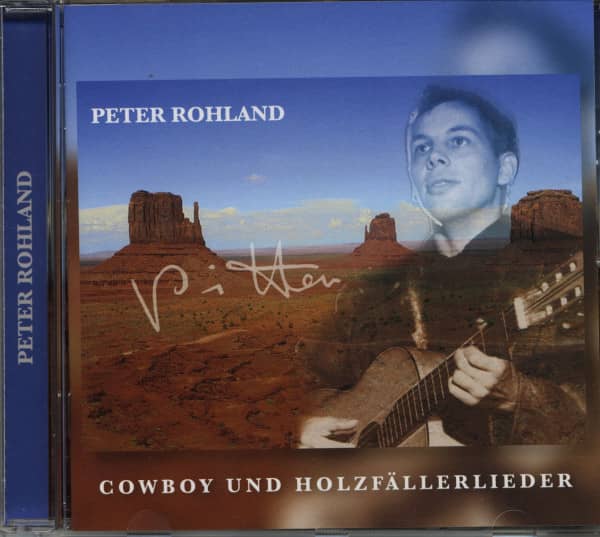
Peter Rohland
"A step towards a new, intelligent popular music" (Eckard Holler)
One of the first singers to perform folk songs of widely differing social and historical origins in the early sixties was Peter Rohland. His repertoire included Yiddish songs and vagabond ballads as well as songs set to texts by François Villon and the songs of German democrats from the Vormärz period and from 1848. With the latter in particular he did pioneering work for numerous artists who went on to add these pieces to their own programmes – among them singers such as Dieter Süverkrüp and Hannes Wader and groups such as Liederjan, Zupfgeigenhansel and Ougenweide.
Peter Rohland wanted to sing the German folk song 'dusted off' and 'unvarnished'. In a 1966 interview with the magazine 'Song' he said: "It is time to associate the term 'German folk song' not only with the songs of the Schwartenhals, the poor Jewish girl and the deserter, but also with the songs of the 1848 revolution, of the workers' struggles and the songs from the concentration camps. We must finally put this term right. German folk songs have nothing to do with the 'soul of the people' or with 'eternal values'. They are simply songs that encompass the whole spectrum of human life, from the most extreme sentimentality to harsh or coarse depiction. But if the message is conveyed in the clichés of the time, if the melody too is superficial and sentimental, then we are dealing with hit songs or tearjerkers, whether they are called 'Durch's Wiesental gang i jetzt na' or 'Küsse unterm Regenbogen'. Other songs are more precise. They describe a clearly recognisable situation or the course of an event. And it is these songs that interest me."
Born in Berlin in 1933, the year Adolf Hitler seized power, and raised in Stuttgart and Göppingen, he received his first musical impulses – like many other 'Waldeckers' – in the Bündische Jugend youth movement. He belonged to the Schwäbische Jungenschaft, a boys' league that the Nazis had banned as 'cultural Bolshevist'. There, and on journeys that took him in the mid-fifties through Greece as far as Baghdad, he got to know the songs of other peoples. He soon abandoned the law studies he had begun after his return and moved to Berlin, where he initially enrolled in musicology but before long devoted himself entirely to singing. Peter Rohland made his debut with his first appearances in small artists' bars. His first programme, in 1962, was called 'Vertäut am Abendstern – Chansons zur Nacht'. In the insert to the EP released under this title two years later, Rohland wrote: "Let us not forget that here in Germany, too, there are starting points for an independent art of the chanson. They lie somewhere between the folk song, the song of the bündisch youth and the wandering minstrels, and our native chanson art, which has meanwhile become somewhat narrow-chested. You bards, create texts that will have a wide impact! Seek them! Sing them!" The song Ich schaukle meine Müdigkeit from this EP, which he knew from the bündisch song poet Werner Helwig, is performed here, however, solo as a German chanson and not as a bündisch group song.
In Paris, where he lived for a few months in 1962, he came up with the idea of developing a programme of Yiddish songs. With this programme, which premiered in Berlin in March 1963 – with Hanno Botsch on violin and Gesine Köhler on vocals – he went on a successful tour of West Germany; even so, at first only the small Thorofon label could be found to release five songs from the programme 'Der Rebbe singt' on an EP. The title featured here, Frateg far nacht, only appeared two years after Rohland's death on the LP 'Lieder der Ostjuden I'. Although other performers – such as Belinda and Behrend in 1962 – had released records with a Jewish programme before Rohland, many music historians regard his work as a musician's decisive contribution in West Germany to breaking the silence about the persecution of the Jews.
Together with Schobert Schulz, later Lothar Lechleiter's partner in the duo Schobert & Black, Peter Rohland recorded the LP 'Landstreicherballaden' at the end of 1964. For this programme he drew, among other sources, on songs he had already sung in the Bündische Jugend. Others he found in old craftsmen's songbooks or had learned from journeyman carpenters whom he had met while 'on the tramp' himself in southern Germany. From this programme comes the song Wir drei, wir geh'n jetzt auf die Walze, which Rohland had already sung back in 1958. For Karl Mohri's film 'Und sie hatten sich geschminkt', Rohland himself slipped into the role of the 'vagabond' at that time.
A good ten years before former Federal President Gustav Heinemann called for Germany's freedom movements to be dealt with in schools, Peter Rohland presented his programme '48er Lieder – Lieder Deutscher Demokraten' at the second Waldeck Festival in 1965. This programme too, with which he introduced himself as a political singer, was only released on record after his death. It is the source of the Bürgerlied and the Lied eines kosmopolitischen Nachtwächters; Peter Rohland wrote the music to this text by Franz Dingelstedt.
His last programme – 'Lieder des François Villon' – did not even live to see its premiere, planned for May 1966 in Cologne. Peter Rohland died on 5 April following a brain haemorrhage. The music for the Villon texts, in Paul Zech's translation, was written by Schobert Schulz and Hanno Botsch as well as by Peter Rohland himself. Die Räuberballade von Pierre, dem roten Coquillard also comes from the LP of Villon songs released in 1968.
On the 40th anniversary of his death, Eckard Holler paid tribute to Peter Rohland at the Wilhelm Zimmermann memorial in Dettingen as an artist who had fundamentally changed the musical scene in Germany "by inserting between U-Musik (= popular hits) and E-Musik (= classical music) a new musical genre that is neither the one nor the other, but takes a step towards a new, intelligent popular music."
The following albums by Peter Rohland have been released on CD: 'Landstreicherballaden & Lieder des François Villon', 'Jiddische Lieder – Un as der Rebbe singt', '48er Lieder – Lieder deutscher Demokraten'.
Excerpt from: Various - Liedermacher in Deutschland Vol. 1, Für wen wir singen (3-CD)
Copyright © Bear Family Records
Copyright © Bear Family Records®. Copying, also of extracts, or any other form of reproduction, including the adaptation into electronic data bases and copying onto any data mediums, in English or in any other language is permissible only and exclusively with the written consent of Bear Family Records® GmbH.
only 2x still available
Ready to ship today, delivery time** appr. 1-3 workdays

only 2x still available
Ready to ship today, delivery time** appr. 1-3 workdays

only 2x still available
Ready to ship today, delivery time** appr. 1-3 workdays

only 1x still available
Ready to ship today, delivery time** appr. 1-3 workdays