Who was/is Carson Robison ? - CDs, Vinyl LPs, DVD and more
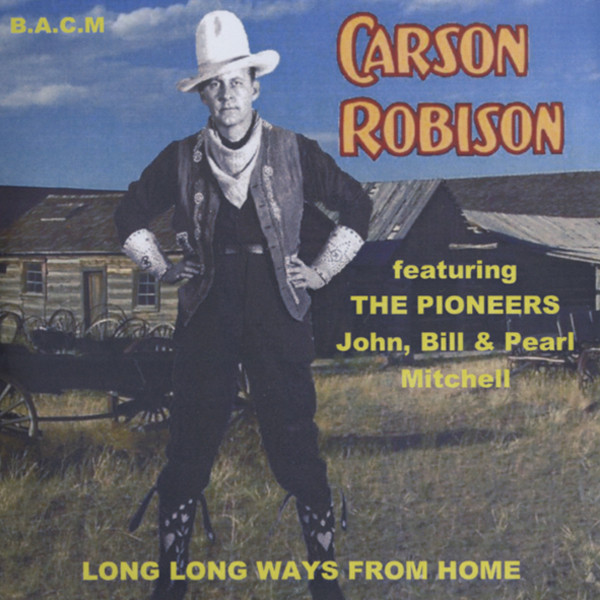
Carson Robison
He was one of the greatest names in country music. Almost anyone versed in the old stuff knows something about him. There's his trip to England in 1932, the backwoods humour of Life Gits Tee-Jus, Don't It?, even the politically incorrect songs about darkies and coons which can still be found amongst piles of 78s in shops full of old furniture.
Carson J. Robison, born on August 4, 1890 in Oswego, Kansas, rode the trails with his father, an Arkansas fiddle champion. By 1906 he was carving his own trail as a professional guitarist and whistler – whistling two tones in harmony was a trick which endured throughout a career devoted mainly to novelty sounds in pop and country. By 1922 radio networks had reached K.C. and Robison crackled over the airwaves on KDAF. In 1924 he moved to New York where he made his first recordings as guitarist with Wendell Hall, populariser of the novelty hit It Ain't Gonna Rain No More.
The mid-'20s saw the beginning of a hugely successful partnership with the sweet voiced Vernon Dalhart. Major hits from that era included My Blue Ridge Mountain Home and Little Green Valley (revived by Jerry Lee Lewis). Among the 300 or so songs recorded for VICTOR, CONQUEROR and SUPERTONE et al were those tragic event numbers like Wreck Of The Number Nine, composed within minutes of reading a newspaper headline about the disaster. Following the split with Dalhart, Robison joined fellow Kansan Frank Luther Crow on a string of skittish best-sellers including Barnacle Bill The Sailor.
In 1931 Robison formed his own group, the Buckaroos, renamed the Pioneers for a trip to England (where the term 'Buckaroo' had yet to reach common parlance) and then the Oxydol Pioneers, so called because they advertised that particular washing powder on Radio Luxembourg in the late '30s when they toured England on two further occasions. During World War II, Robison composed songs that took potshots at Hitler and Mussolini. Hits like Turkey In The Straw kept his name in the public eye.
In 1946 Robison moved to Pleasant Valley, New York and signed with the newly formed MGM label, for which he recorded Life Gits Tee-Jus, Don't It (number 3 in Country and Top 20 Pop in 1948). He and the Pleasant Valley Boys cut numerous such philosophical monologues as well as square dance tunes.
A man who always kept a foot in pop and country, Robison inevitably turned to rock 'n' roll in April 1956. Rockin' And Rollin' With Grandmaw is a tongue-in-cheek item which aficionados of Granny Rock can add to Skeets McDonald's You Oughta See Grandma Rock, Bob Grady's Granny Tops 'em At The Hop, and Solomon Burke's Be-Bop Grandma... and so on. Despite Robison's prosaic singing (a dead ringer for Merrill Moore), there's nothing arthritic about the performance.
Robison was 66 when he recorded this one. He died on March 24, 1957 and, apart from the flipside, a funny version of Hand Me Down My Walking Cane, he left no more geriatric rock 'n' roll in the vaults.
Copyright © Bear Family Records
Copyright © Bear Family Records®. Copying, also of extracts, or any other form of reproduction, including the adaptation into electronic data bases and copying onto any data mediums, in English or in any other language is permissible only and exclusively with the written consent of Bear Family Records® GmbH.