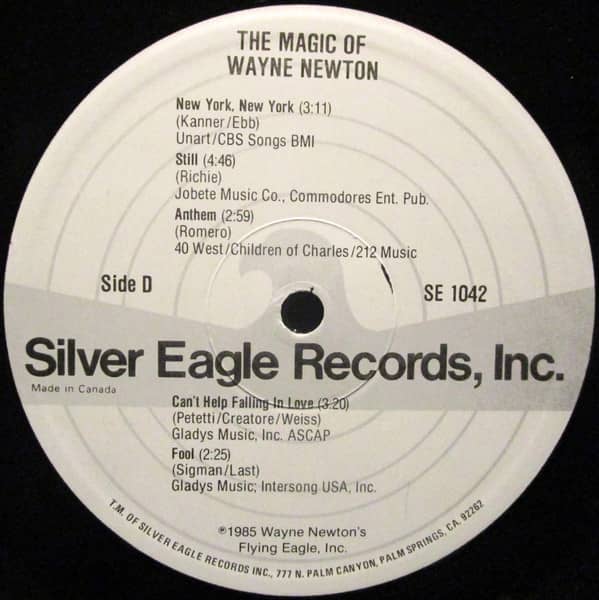
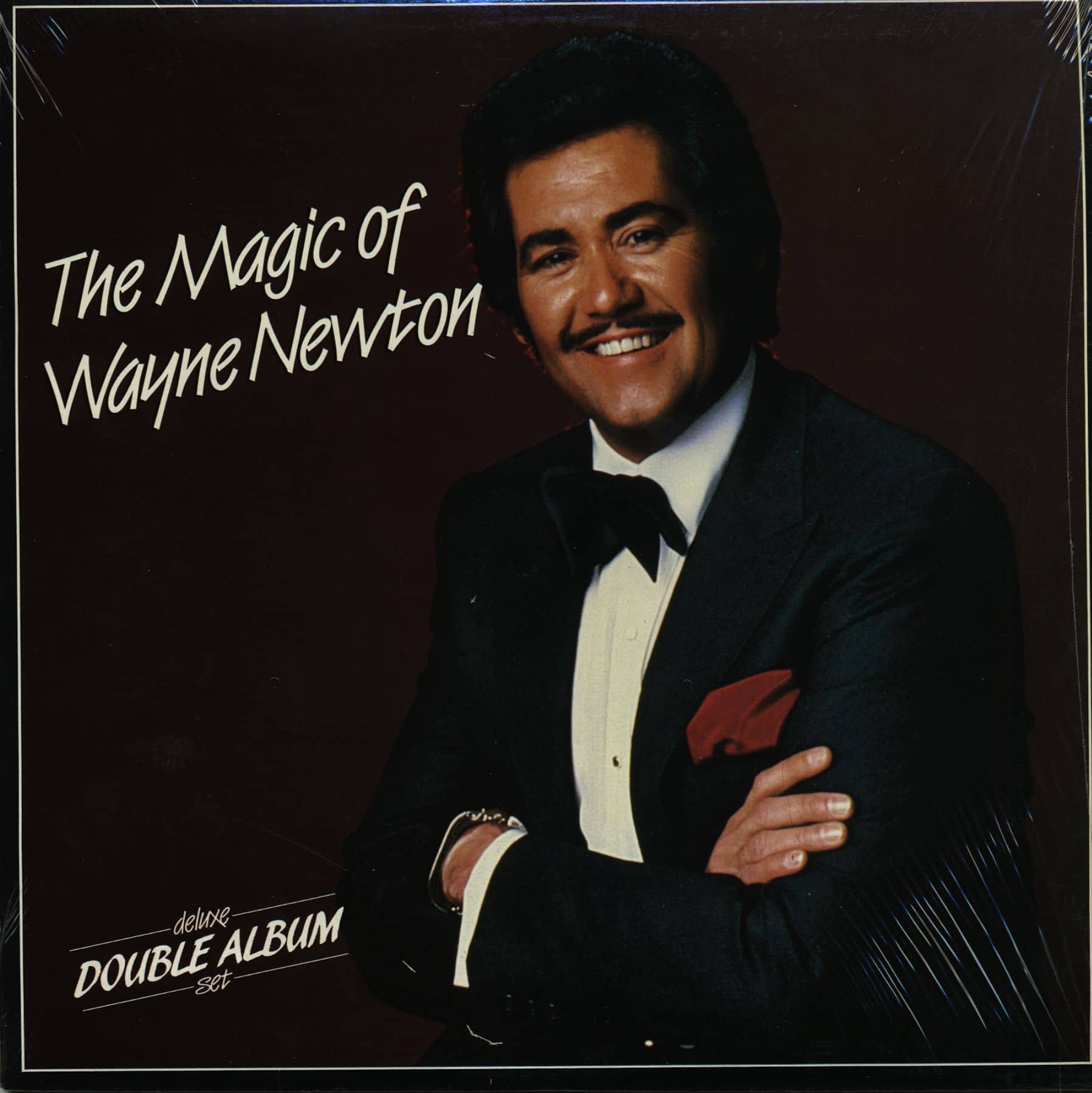
Wayne Newton The Magic Of Wayne Newton (2-LP)
* incl. VAT / plus shipping costsDepending on the country of delivery, the VAT at checkout may vary.
the very last 2 available
Ready to ship today,
delivery time** appr. 1-3 workdays
- catalog number:LPSE1042
- weight in Kg 0.35
Wayne Newton: The Magic Of Wayne Newton (2-LP)
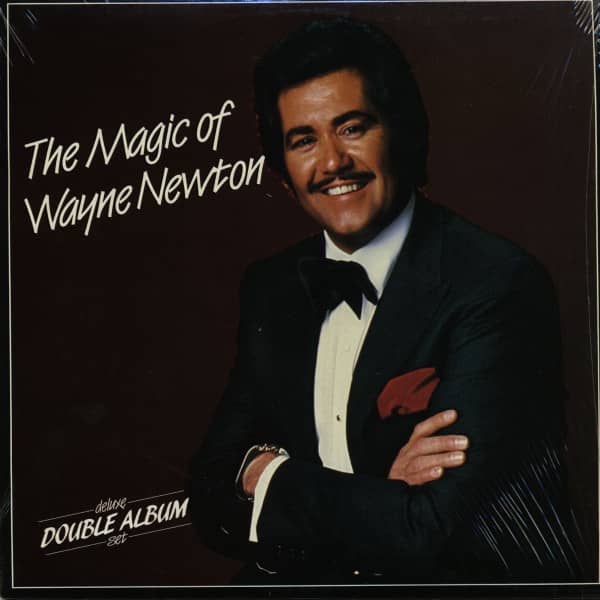
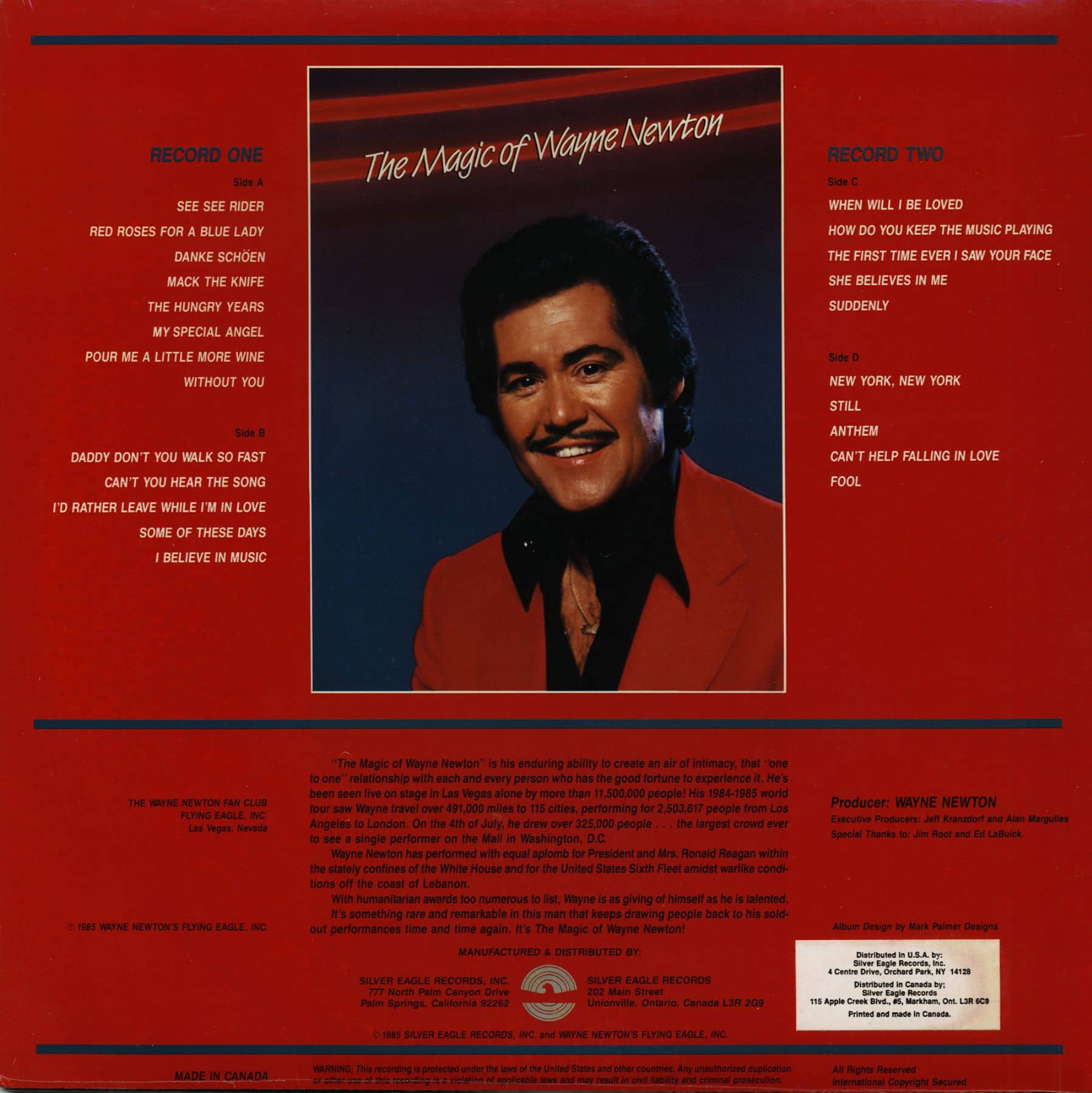
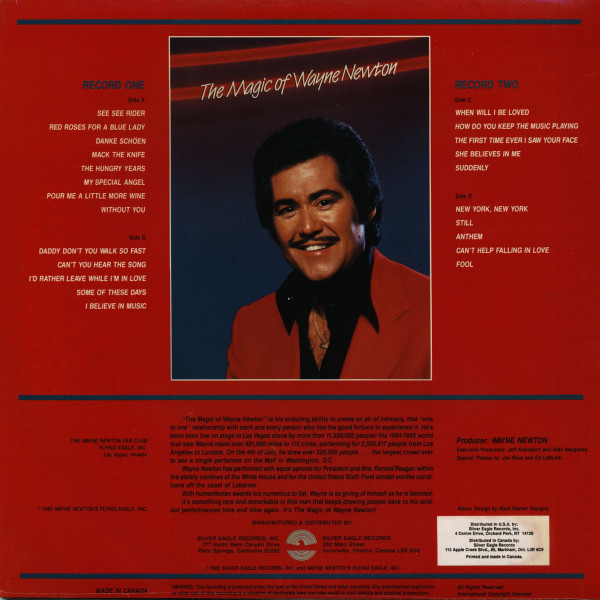
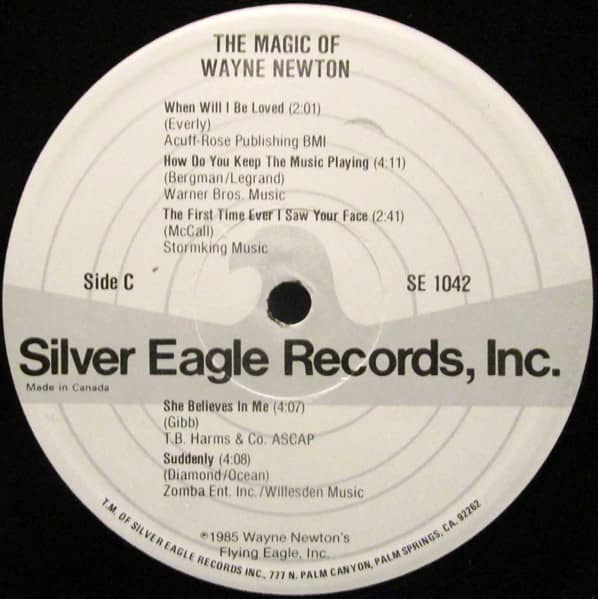
Wayne Newton – The Magic Of Wayne Newton is a 2-LP compilation released in 1985 by Silver Eagle Records as SE 1042. Across two records, the collection brings together 23 selections from Wayne Newton’s repertoire. The tracklist includes „Danke Schoen“, „Red Roses For A Blue Lady“, „Mack The Knife“, „The Hungry Years“, „Daddy Don’t You Walk So Fast“, „Can’t You Hear The Song“, „I Believe In Music“, „When Will I Be Loved“, „New York, New York“, „Still“, „Anthem“ and „Can’t Help Falling In Love“. A varied collection for Wayne Newton fans and collectors of classic vocal pop. This 2-LP set is a worthwhile addition for anyone interested in Newton’s extensive recording career.
Article properties:Wayne Newton: The Magic Of Wayne Newton (2-LP)
Artist: Wayne Newton
Album titlle: The Magic Of Wayne Newton (2-LP)
Genre Pop
- Geschwindigkeit 33 U/min
- Vinyl record size LP (12 Inch)
- Record Grading Mint (M)
- Sleeve Grading Mint (M)
Artikelart LP
Label Silver Eagle Records
EAN: 2500006119891
- weight in Kg 0.35
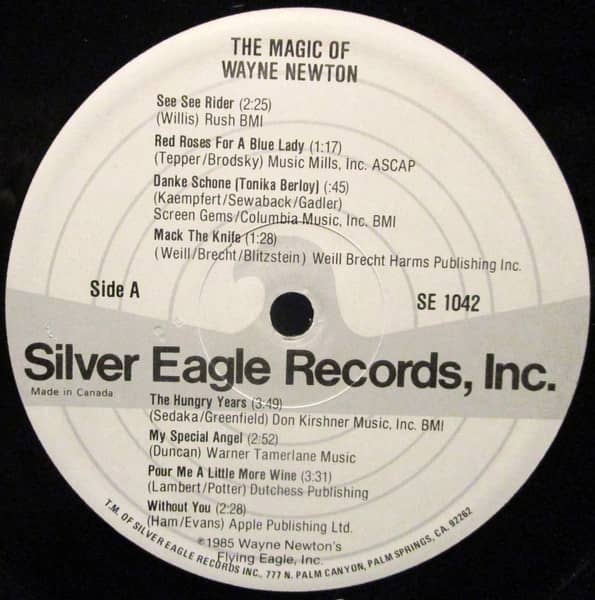
| Newton, Wayne - The Magic Of Wayne Newton (2-LP) LP 1 | ||||
|---|---|---|---|---|
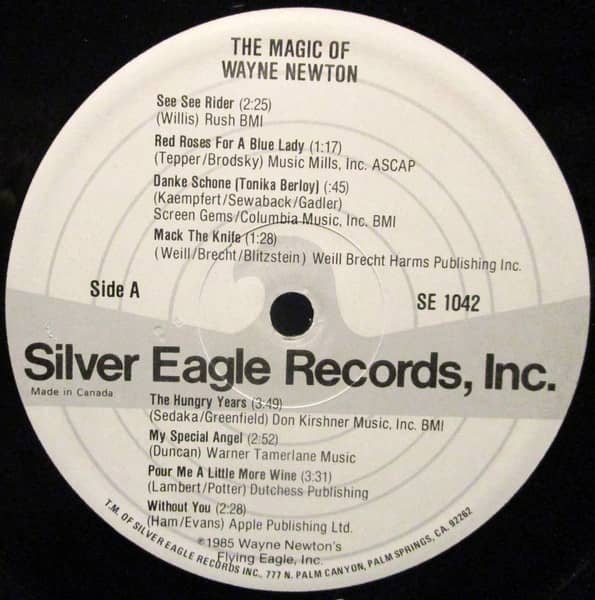
| 01 | See See Rider | Wayne Newton | ||
| 02 | Red Roses For A Blue Lady | Wayne Newton | ||
| 03 | Danke Schoen | Wayne Newton | ||
| 04 | Mack The Knife | Wayne Newton | ||
| 05 | The Hungry Years | Wayne Newton | ||
| 06 | My Special Angel | Wayne Newton | ||
| 07 | Pour Me A Little More Wine | Wayne Newton | ||
| 08 | Without You | Wayne Newton | ||
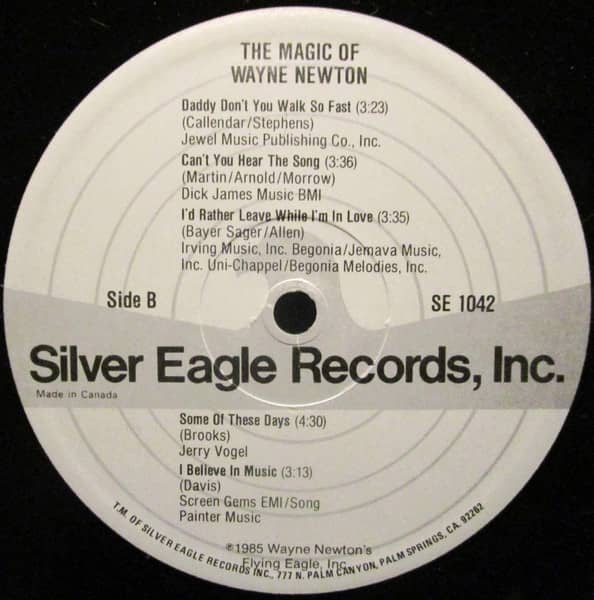
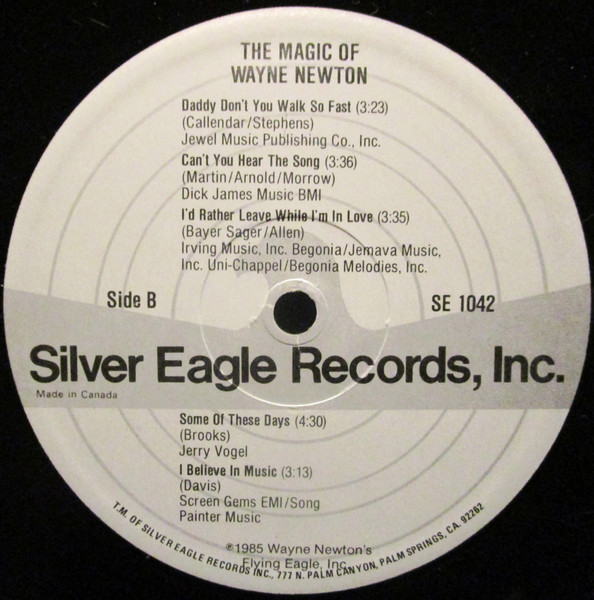
| 09 | Daddy Don't You Walk So Fast | Wayne Newton | ||
| 10 | Can't You Hear The Song | Wayne Newton | ||
| 11 | I'd Rather Leave While I'm In Love | Wayne Newton | ||
| 12 | Some Of These Days | Wayne Newton | ||
| 13 | I Believe In Music | Wayne Newton | ||
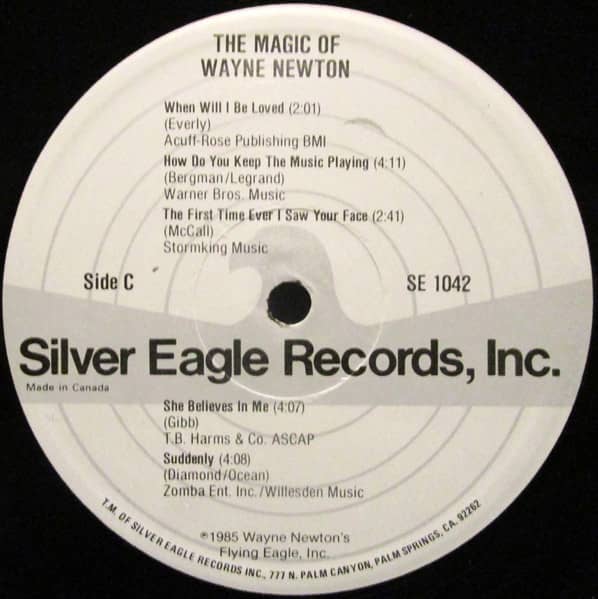
| Newton, Wayne - The Magic Of Wayne Newton (2-LP) LP 2 | ||||
|---|---|---|---|---|
| 01 | When Will I Be Loved | Wayne Newton | ||
| 02 | How Do You Keep The Music Playing | Wayne Newton | ||
| 03 | The First Time Ever I Saw Your Face | Wayne Newton | ||
| 04 | She Believes In Me | Wayne Newton | ||
| 05 | Suddenly | Wayne Newton | ||
| 06 | New York, New York | Wayne Newton | ||
| 07 | Still | Wayne Newton | ||
| 08 | Anthem | Wayne Newton | ||
| 09 | Can't Help Falling In Love | Wayne Newton | ||
| 10 | Fool | Wayne Newton | ||
Wayne Newton
The Newton Brothers featuring Wayne Newton - The Real Thing 1954-1963
It's a long, long way from the rough wooden boards of a hay wagon parked in front of a grocery store in Phoenix, Arizona, to the glittering neon lights of Las Vegas. Carson Wayne Newton made that difficult journey ... to become one of the highest-paid performers on the Strip.
This special CD contains all of his Newton Brothers records from their first three Capitol releases and marks the duo's first decade in the studio. Hear for yourself how Wayne Newton evolved from an Arizona milquetoast into 'The Midnight Idol', 'Mr. Entertainment' and 'Mr. Las Vegas'.
This is the audio history of the hillbilly brothers from the South and of those who saw Wayne's potential and wanted to record this future superstar. For even as their parents pushed brother Jerry to the microphone, everyone else seemed to know that Wayne was the one to watch, the one with the real talent.
The name on the record labels would change from 'The Newton Rascals' to 'Jerry & Wayne' to 'The Newton Brothers featuring Wayne' and finally, in 1963, to 'Wayne Newton and the Newton Brothers'. That same year, singer and producer Bobby Darin finally dropped the 'The Newton Brothers' billing from the records, freeing Wayne from his brother's musical influence, at least in the recording studio.
Wayne Newton was able to rise above the guilt of having forced his family to leave their Virginia roots and move to the Arizona desert, not once but twice, because of his health. In the early days that high voice was always an excuse for some to snicker, and yet, as you will hear, these first records prove that Wayne was a talent to be reckoned with right from the start. This album is also a tribute to those who saw that early talent and were willing and able to help the Newtons in the decade before "Danke Schoen".
Wayne Newton was born on 3 April 1942 in Roanoke, Virginia. Wayne's father, Patrick Newton (of Irish and Powhatan descent), was an auto mechanic, and his mother, Evelyn (who was German-Cherokee), raised chickens on the small family farm. Wayne was a sickly child with severe bronchial asthma and missed a lot of school.
In 1946 he saw a touring country music show, and Wayne was knocked out by the performances of Hank Williams and Kitty Wells. At the age of four he told his parents: "That's what I want to do." By 1948 the six-year-old dynamo and his older brother Jerry had their own early-morning radio show on WDBJ in Roanoke. Wayne played steel guitar and banjo, and Jerry played rhythm guitar. But Wayne's health was a chronic problem. "The minute winter set in, I got sick," Wayne recalls in his autobiography. "Maybe that's when my parents started paying more attention to my brother. They may have felt that they should show my brother more attention, since they spent so much time nursing me."
Because of Wayne's asthma, the Newtons packed up and moved to Phoenix in 1952, where Evelyn had a brother. Guilt weighed heavily on young Wayne's conscience: "Although the pain was never put into words, I felt it. It was as if I were a burden. At night I would lie in bed and think about how they gave up everything they had ever wanted because of me. For my parents, it meant tearing up their roots and leaving behind everything they knew."
In Phoenix, Patrick Newton looked for work for seven weeks and found nothing. The brother act auditioned for the Lew King Ranger Show and played their first shows in Arizona at local drugstores and supermarkets as part of King's show. Soon Wayne's health had improved, and with still no work for Patrick, the family was forced to return east. This time they went to Newark, Ohio, where Patrick's sister lived.
Everything was fine until the winter of 1953. Wayne's father had work and enough money for a down payment on a house, and the brothers were playing regularly at weekends at the Hill Billy Park. Once again, with the chill of winter in the air, Wayne became deathly ill. On the doctor's advice, the family once more sold their belongings, lost the down payment on the house, packed the basics into a small trailer and drove back to the warmth of metropolitan Phoenix, affectionately known as the Valley of the Sun.
Reunited with Lew King, the brothers appeared on the very popular Lew King Rangers Saturday night variety show on television and played in person around Phoenix. King was the most important player in Phoenix entertainment. Besides the concerts and the Rangers show on television and radio, he hosted several talk and quiz shows every day and was even a partner in an advertising agency. At that time Wayne played a double-neck steel guitar and Jerry a rhythm guitar. The duo covered the country and hillbilly hits of the day, with a few originals sprinkled into the set.
Lew King is widely regarded as the man who put Wayne on the road to success. He remembered the first time he saw the Newtons. He was doing an outdoor show in the early 1950s. "I'm on stage and we're doing the show, and in the distance I see this big old Cadillac," King said. "Vintage-wise, you wondered how they even got it onto the lot. Two kids in western outfits got out and weaved their way to the front of the stage. 'Psst!' I leaned down. 'We're Wayne and Jerry Newton. We play guitar and sing,' Wayne said."
King tried to put them off, but Wayne insisted. "The Newton Brothers were an instant success," King said. "I always had a feeling that a kid would come into my life who would make it, who had the crucial potential, who had all the ingredients to make it possible." In Wayne Newton, King found what he had been looking for. There followed a period of training, diction lessons and exposure. King put them on his show and set them up with a local TV sponsor, the Valley Furniture Company.
He got their father a job. He did everything he could to take the country out of the boy from West Virginia. "At that time they were only doing hillbilly, because their parents wouldn't let them leave hillbilly music," King said. "They were raised hillbillies, they were dyed-in-the-wool hillbillies, and they wanted to die hillbillies." Getting them to sing anything else was a struggle. Another problem, according to King, was family interference. "Jerry was the one they wanted to push, when Wayne was the obvious talent," he said.
Wayne Newton & Newton Brothers - The Real Thing (1954-1963)
Copyright © Bear Family Records

the very last 2 available
Ready to ship today, delivery time** appr. 1-3 workdays

Ready to ship today, delivery time** appr. 1-3 workdays

Ready to ship today, delivery time** appr. 1-3 workdays

Ready to ship today, delivery time** appr. 1-3 workdays

Ready to ship today, delivery time** appr. 1-3 workdays

the very last 1 available
Ready to ship today, delivery time** appr. 1-3 workdays

Ready to ship today, delivery time** appr. 1-3 workdays
Max Greger's Dance Orchester: Strict Tempo Dancing- Slow Foxtrot (7inch,... Item no.: 21621HIFIReady to ship today, delivery time** appr. 1-3 workdays