
Who was/is The Lecuona Cuban Boys ? - CDs, Vinyl LPs, DVD and more
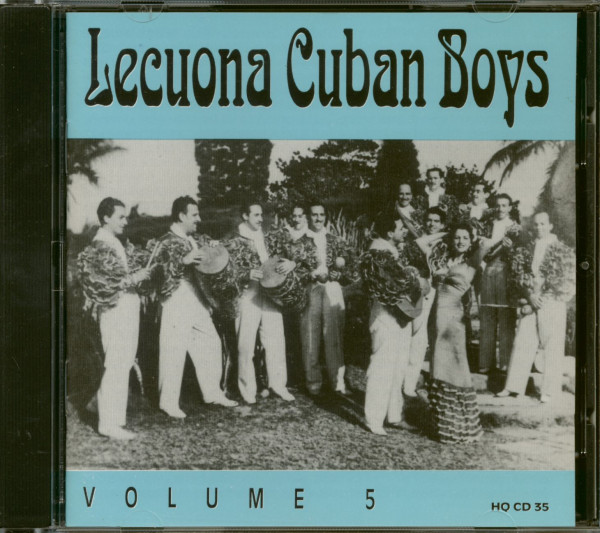
The Lecuona Cuban Boys
The Lecuona Cuban Boys commenced in 1932 and were still performing more than forty years later. During the 1930s they were the toast of Europe and left a large and valued legacy of recordings. The story of the Lecuona Cuban Boys which follows comes from interviews conducted in 1978 by Finnish collector and enthusiast Dr. Kimmo Luomanmaki with two of the founder members of the Cuban Boys, the brothers Agustín and Gerardo Bruguera. The story really begins early in 1930, when the Brugueras and pianist Armando Orefiche were members of the Orquesta Los Hermanos LeBatard-Palau. Late in 1931, together with "Jaruco" Vázquez and a few others, they formed their own band: the Orquesta Encanto. This was the group which became Ernesto Lecuona's Orquesta Cubana. Maestro Lecuona (before we met him) was in Hollywood, writing the music for the film 'Cuban Love Song' with the famous baritone Lawrence Tibbett. At that time our band had been playing at the Teatro Encanto in Havana for a year, taking its name from the theatre. Orquesta Encanto was very popular with the teenagers. Ernestina Lecuona (his sister), also a concert pianist and composer, wrote to Ernesto telling him about the success of our band. It was like love at first sight! Lecuona came from Hollywood, and that was the beginning of our friendship and of a fraternal, perfect collaboration through the years until his death (1963).
We played with Lecuona through 1931 at theatres in Havana and the provinces, mostly in the orchestra pits for Lecuona operettas like 'María La O', 'El Cafetal', 'Rumba Musulmana' and 'Rosa La China'. At that time the band was called Orquesta Lecuona. The organization was a co-operative, with income and losses equally divided. Everyone in the band had a job besides that of musician; they were in charge of travel, public relations, publicity, finance, etc.
The original band, which can be heard on the 1930s recordings, comprised: Eduardo Barrenechea (bass), Jesús Bertomeu (trombone), Agustín Bruguera (drums, timbales, conga, vocals), Gerardo Bruguera (tenor sax, clarinet), Fernando Díaz (trumpet, guitar, violin; engaged 1934), Jorge Domínguez (alto sax, clarinet, violin), Daniel González (alto sax, clarinet, violin), Guillermo Hernández (guitar, tumba, güiro, maracas), Armando "Fichín" Orefiche (piano, composer, arranger), Adalberto "Chiquito" Orefiche (tenor sax, bongo; engaged 1935), Alberto Rabagliati (vocals; engaged 1934), Enrique López Rivero (trumpet, 1932–34) and Ernesto "Jaruco" Vázquez (trumpet, guitar, composer, arranger).
Later trumpeters included Fernando Díaz (who replaced Rivero) and Luis Escalante, who joined Armando Orefiche's Havana Cuban Boys when Orefiche split from the Lecuona Cuban Boys. Later still, high-note specialist Saúl Torres from San Salvador was featured with "Jaruco"; they can be heard on Mambo De Jaruco (Harlequin HQ CD 07, Lecuona Cuban Boys Vol. 2).
Ernesto Lecuona was a technically highly talented pianist. The Bruguera brothers recalled a concert in 1932 in Matanzas province in Cuba: We arrived with Lecuona and his sister to give a concert. The first part of the programme was given by Lecuona and Ernestina – classical music and Lecuona compositions. The second part was Lecuona and the orchestra. Just before the concert, Lecuona noticed that one of the two grand pianos was tuned normally, but the other was tuned half a tone lower. We thought the concert would have to be cancelled, but Lecuona said, "Don't worry." He said to his sister, "You, Ernestina, will play the piano that is tuned normally, and I will transpose the whole concert." Isn't that unbelievable? The concert was a success, and nobody noticed the feat Lecuona had accomplished. During this tour Lecuona received a contract to give a series of piano concerts in Spain and in Paris at the Salle Pleyel. He left us at the beginning of 1932, promising that he would take the band to Spain at the first opportunity. After a few months we got a telegram and the tickets for the German ship 'Karlsruhe', which was sailing one week later from Havana to Santander. Practically without money, suitcases or passports, we arrived in Spain. Only one member of the Orquesta Encanto stayed behind in Cuba. Those were the Depression years – the Wall Street crash and misery. Lecuona fixed everything with the Cuban ambassador in Madrid, we got passports and so on, and this began the two-year tour of Spain. In 1934 Lecuona became very sick with pneumonia; it was a cold winter. The doctors said he would die before midnight. After the crisis, the doctors said, "Go to Cuba, to the tropics, or you are going to die in Madrid." The concerts given by Lecuona and "Su Orquesta Cubana" consisted of two elements: Lecuona playing his solo piano compositions and the band playing Cuban popular music. Contrary to most encyclopedias, Ernesto Lecuona never played piano in the band.
That chair was occupied by Armando Orefiche, also a productive composer. He was born in Havana in 1911 and had a formal classical piano background. Lecuona called his musicians 'boys', and the band got its name "Lecuona Cuban Boys" in 1934, with Lecuona's blessing, upon his return to Cuba. The band wanted to "conquer Europe", and so it did, with Armando Orefiche and trumpeter Ernesto "Jaruco" Vázquez as its main musical leaders. After the two years touring Spain, a former director of the Paris Moulin Rouge (Mr. Vermel) became interested in the L.C.B. in Madrid and took us to Venice, Italy, in the summer of 1934, to the Excelsior Hotel at the Lido. One day at the Lido our manager, Mr. Vermel, told us, "Amigos, your dream has come true. We will open at the A.B.C. theatre in Paris next October!" That was the biggest success the Lecuona Cuban Boys ever had. On the opening night, at the end of the show, we had to play six encores … the people in the audience were yelling, standing up, applauding like mad, asking for more, more and more. Our dressing room was full of people and impresarios. That same night our manager signed many contracts – terrific contracts that took us to the best hotels, clubs and theatres of Europe, and to Columbia Records. The golden years of the Lecuona Cuban Boys had begun after the big success at the Paris A.B.C. The irony of the situation was that our manager did not tell us the truth …
Copyright © Bear Family Records
Copyright © Bear Family Records®. Copying, also of extracts, or any other form of reproduction, including the adaptation into electronic data bases and copying onto any data mediums, in English or in any other language is permissible only and exclusively with the written consent of Bear Family Records® GmbH.
More information about The Lecuona Cuban Boys on Wikipedia.org
the very last 1 available
Ready to ship today, delivery time** appr. 1-3 workdays