
Who was/is Joy Unlimited ? - CDs, Vinyl LPs, DVD and more
Joy Unlimited
In 1965 five students in Mannheim formed the band Hit Kids - Roland Heck, Albin Metz, Hans Herkenne, Dieter Kindl and Klaus Nagel. The quintet really only wanted to top up their finances, but with the powerful-voiced Joy (Erna Raad, born November 15, 1944 in Rockenhausen!) the band became a rather more serious affair, and the sextet renamed itself Joy & The Hit Kids. The pop and beat band often appeared in front of TV cameras and received good reviews for their powerful live shows, not least because of Joy, who, "when called upon, could effortlessly outsing any female competition" (MUNZINGER). As a teenager Erna had already sung a great deal - mainly German Schlager - and at the age of 16 she was already on stage with her sister in the bars and pubs for the US soldiers stationed in Mannheim.
With their clever mix of beat, soul and blues, Joy & The Hit Kids soon made a name for themselves outside the US clubs as well. Their debut single, Sunshine / All The Days, appeared in 1967; further releases followed in 1968 and 1969, among them Feelin' (for the first time also under the name Joy Unlimited) and Take Me To The Pilot (an Elton John cover). Renamed Joy Unlimited, the group took fourth place at the band festival 'Barbarella de Conjuntos' in Palma de Mallorca in 1970 and released their debut album, 'Overground', the same year. The "quality of the music was excellent. Outstanding vocals by Joy Fleming, good, subtle and excellent playing. Stylistically ranging from soul-infected beat to psychedelic pop with tasteful orchestration" (BERLINER MORGENPOST). Shortly after its release saxophonist and flautist Gerd Köthe (ex-Moonlights) joined; alongside Roland Heck he was to become the band's second musical leader.
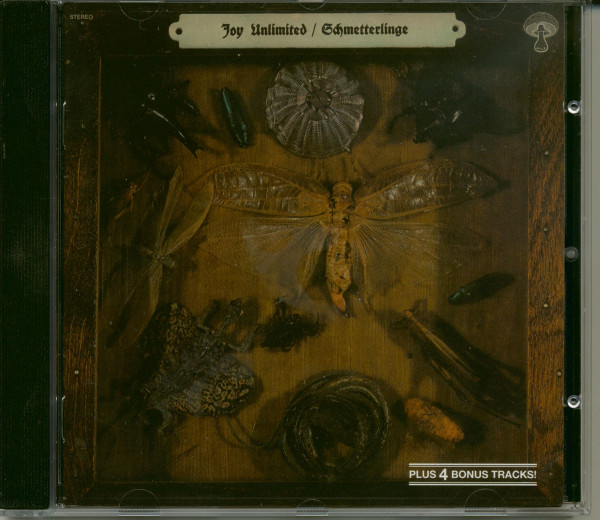
He replaced Klaus Nagel, who then took care of management, production and concert planning. As a new step in the band's artistic development, the ballet score 'Schmetterlinge' was premiered at the municipal theatre in Bonn in 1971. Parts of it were used, among other things, in a TV programme filmed around Joy Unlimited and the singer and choreographer Lester Wilson (of the original Hair cast). When the record contract with POLYDOR expired, Joy Unlimited signed with the newly founded BASF label. The second album, 'Schmetterlinge' (1971), did not come out on BASF itself, however, but on Rolf-Ulrich Kaiser's newly founded sub-label PILZ. The music was a bold mixture of ballet music, progressive sounds, blues and jazz. Its subject was the transformation from caterpillar to butterfly in three sections ("Contacts", "Manifestations", "Emotions"), which also stood as a symbol of human development. On the strength of Joy Unlimited's growing popularity, Joy Fleming ventured into a solo career.
"However, neither she nor the record company's advisers seemed to know which way to go musically. Only her 1974 live album hinted at what might have become of her" (MUNZINGER). In summer 1971 the original version of the Neckarbrücken-Blues was recorded at Süddeutscher Rundfunk; it became her biggest single success (1972), alongside Halbblut (1974), the German Eurovision entry Ein Lied kann eine Brücke sein (1975) and Bridge Of Love (the English version).
KRAUT! is a fine cross-section of krautrock in four volumes, sorted by region - North, Centre, South and Berlin - with the biggest hits, lots of long-forgotten music and the most important songs.
Burghard Rausch, June 2020
Copyright © Bear Family Records
Copyright © Bear Family Records®. Copying, also of extracts, or any other form of reproduction, including the adaptation into electronic data bases and copying onto any data mediums, in English or in any other language is permissible only and exclusively with the written consent of Bear Family Records® GmbH.
Item has to be restocked

Item has to be restocked