
Who was/is Benny Joy ? - CDs, Vinyl LPs, DVD and more
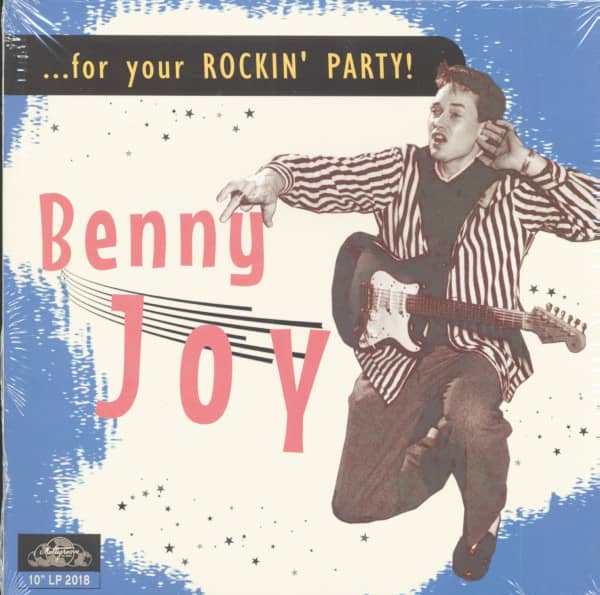
Benny Joy
Born: Benjamin Joy Eidson, November 5, 1935, Atlanta, Georgia
Died: October 28, 1988, Tampa, Florida
Benny Joy made a lot of rockabilly recordings in the 1950s (mostly self-penned), but only four singles were released at the time. Or rather three and a half, as one track appeared on two singles. Fortunately the unreleased material was eventually issued from 1978 onwards, thanks above all to the Dutchman Cees Klop.
Benny was born in Atlanta and moved to Tampa, Florida, at the age of five. At eight he was singing in the local church choir, and at 12 he got his first guitar. Although he never took music lessons, Joy was so gifted that he mastered the instrument quite well. Around 1951 he formed his first band with Big John Taylor (real name John Wilkie Taylor, born 1937), who also played guitar. They played high school gyms and drive-in theatres, mainly country music but with blues influences too, as Benny loved black music and was always around African Americans.
He had no idea that Elvis Presley and others were developing a similar combination of country, blues and rock. It was Elvis who showed what could be achieved with the new music, so Benny decided to try his luck with the label Presley was recording for, Sun Records in Memphis. His auditions for Sam Phillips and Jack Clement went well, but it seems he didn't sign with Sun because he had a job and a girlfriend in Tampa and didn't want to risk leaving either of them.
In July 1957 Benny and Big John Taylor cut their first session for the Tri-Dec label in Haines City, Florida. At least five numbers were recorded. Tri-Dec released "Hey High School Baby"/"Spin the Bottle" in September 1957, when Benny signed a publishing contract with Tri-Dec Music. Further Tri-Dec sessions produced great tracks such as "Rollin' To the Jukebox Rock" and "Ittie Bittie Everything". Then "Spin the Bottle" (the B-side of the Tri-Dec single) somehow caught the attention of Shelby Singleton, at the time a promoter for Mercury-Starday. He reissued the number on Starday's new subsidiary Dixie, with a different flip side ("Steady With Betty") and without the overdubbed drums.
With records on two small labels and a certain local following, Benny was approached by Buck Ram (who had taken The Platters to Mercury and to fame). In early 1958 Ram signed both Joy and Taylor to management and recording contracts as well as to his publishing company, Argo Music. Buck Ram also bought the Tri-Dec masters. On May 1, 1958 a single came out on Ram's Antler label (distributed by Mercury): "Crash the Party"/"Little Red Book", two great slices of Southern rockabilly. Billboard wrote: "Lad can sing, a cat to watch." Mercury failed to promote the record properly, and it sank without the proverbial trace.
Next, Ram took Joy to Nashville to record with the Nashville A-Team (Hank Garland, Bob Moore, Floyd Cramer, Boots Randolph, Buddy Harman). Benny and Big John Taylor also played guitar on the session, which yielded four high-quality tracks: "I'm Gonna Move", "Bundle Of Love", "Button Nose" and "Kiss Me". Mercury, however, rejected all of them, and the recordings remained unreleased until 1981, when the tapes were acquired by Cees Klop (see below). Ram dug out an unreleased Tri-Dec master, "Ittie Bittie Everything" (coupled with Big John Taylor's instrumental "Money Money"), and released it on his Ram label in 1959. That same year Benny Joy went on a European tour (with a package of Buck Ram's artists) that took him to France, Italy and Yugoslavia.
Benny Joy and Big John Taylor left Buck Ram in 1959 after a series of disagreements, and since they also had their own quarrels, they went their separate ways in 1960. A contract with a major label did not lead to a career upswing for Benny. Two Decca singles of slow country songs came out in 1961, light years away from his earlier high-energy recordings.
Benny also launched a career as a songwriter. He had already written "Knock Three Times" for Conway Twitty (1960, originally unreleased, though a version by Johnny Rivers came out in 1961) and "Hey Boss Man" for Ray Smith (1961, a Sun single) when he joined Cedarwood Publishing as a staff writer in June 1962. He stayed in Nashville for ten years and wrote over 200 country songs for well-known artists such as Marty Robbins, Charlie Rich, Red Sovine, Carl Smith, Webb Pierce and George Morgan (a Top 30 hit with "One Dozen Roses", 1964). His biggest success by far was "BJ the DJ", a number one country hit for Stonewall Jackson in February 1964. Benny's last releases were a Dot single in 1963 and "The Only Woman" on Mercury in 1965 (under the name Benjamin Joy). After his divorce he returned to his family in Florida in 1972.
Apart from an Italian release in 1959, none of Benny's records were issued in Europe, and he would have remained a complete unknown there had it not been for Cees Klop from Rotterdam. Klop put out two Benny Joy LPs on his White Label, first "Rock-A-Billy With Benny Joy" in 1978 (the seven previously released 1950s tracks plus five unreleased numbers), then "More Rock-A-Billy With Benny Joy" in 1981 (12 previously unreleased tracks, including those from the Nashville session). The albums did a great deal for Joy's reputation among rockabilly fans, and there was talk of appearances in Britain. Sadly, the plans were shelved when he was diagnosed with cancer. His untimely death in 1988, at the age of 52, closed one of the most colourful footnotes in the history of rock'n'roll.
Acknowledgements: Bill Millar, Cees Klop.
Copyright © Bear Family Records
Copyright © Bear Family Records®. Copying, also of extracts, or any other form of reproduction, including the adaptation into electronic data bases and copying onto any data mediums, in English or in any other language is permissible only and exclusively with the written consent of Bear Family Records® GmbH.

only 2x still available
Ready to ship today, delivery time** appr. 1-3 workdays

only 2x still available
Ready to ship today, delivery time** appr. 1-3 workdays
only 2x still available
Ready to ship today, delivery time** appr. 1-3 workdays

Item has to be restocked

Item has to be restocked