
Who was/is Louis Jordan ? - CDs, Vinyl LPs, DVD and more
Louis Jordan
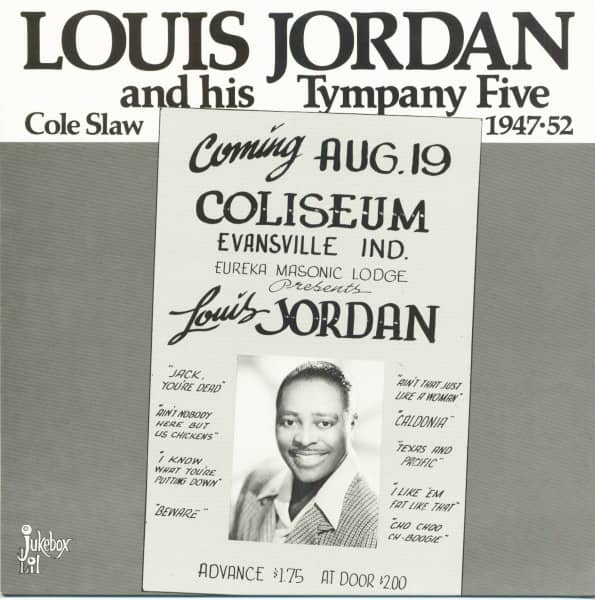
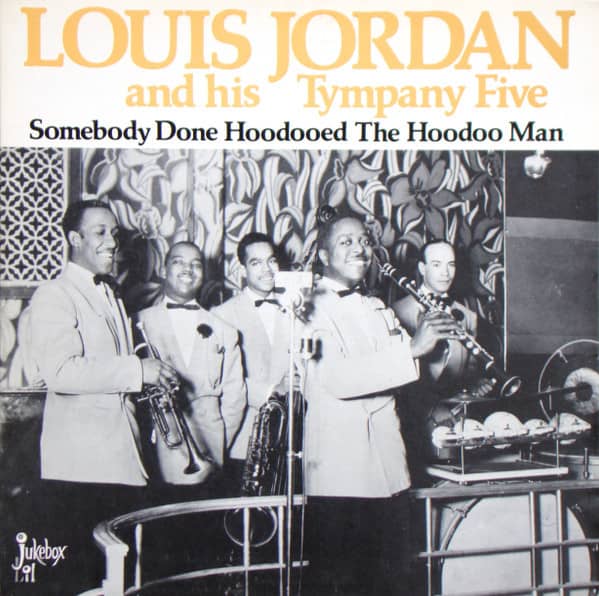
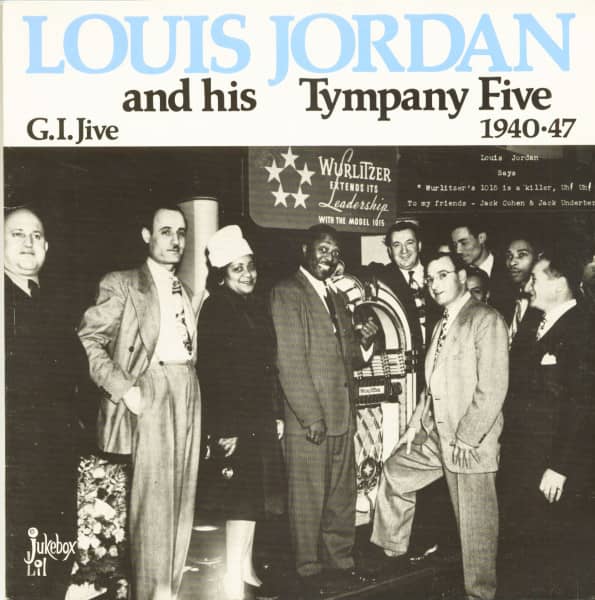
Louis Jordan and his Tympany Five
No other artist was as groundbreaking in the development of R&B, and ultimately of rock 'n' roll, as the jumping, jiving alto saxophonist Louis Jordan and his unfailingly swinging Tympany Five. They were the most popular R&B act of their era, with an unbroken run of hits for Decca from 1942 to 1951; Jordan and his compact crew even managed to cross over to the pop charts in an unprecedented way. With his natural gift for comedy and humour, Jordan appeared in several low-budget musical films for black audiences and proved a major influence on Bill Haley & His Comets, who were produced by Jordan's former A&R man at Decca, Milt Gabler.
Born on July 8, 1908, in Brinkley, Arkansas, Jordan had his musical talent nurtured as a matter of course: his father was a bandleader. By the early '30s Louis was proficient enough on his instrument to find work in New York, where he recorded as a sideman with Louis Armstrong and Clarence Williams before joining drummer Chick Webb's orchestra in 1936 (and playing on Webb's recording of Rusty Hinge). Louis left Chick's band in 1938, ready to lead the first edition of his Tympany Five. At that time he played both clarinet and alto sax.
The hits began in late 1942 with I'm Gonna Leave You On The Outskirts Of Town and didn't let up for a whole decade. Jordan spoke to the soldiers with Ration Blues and G.I. Jive and kept the jitterbugs at home happy with Caldonia and Choo Choo Ch'Boogie. Like nine of his Decca 78s before it, Ain't That Just Like A Woman stormed the 'Race' charts (the name of Billboard's charts for black music from 1945 until June 1949, when they were renamed Rhythm & Blues Records). It was written by Claude Demetrius (the supposed co-writer, Fleecie Moore, was Jordan's wife, whom he soon divorced after she attacked him with a knife - which cost him a lot of songwriting royalties, since he had registered a number of his titles in her name). For the humorous romp, recorded in New York on January 23, 1946, Louis' band was expanded to six pieces with the addition of guitarist Carl Hogan.
Pianist Wild Bill Davis drives the song, but it's Hogan's fluid boogie underpinning that makes the witty number rock. Chuck Berry long ago named Hogan as one of his chief influences and cut his own version of the song almost two decades later; other convincing renditions came from Fats Domino and Lloyd Price. Sadly, like many of his R&B colleagues, Jordan couldn't keep pace with the rock 'n' roll revolution he had helped to start. But he remained active until shortly before his death on February 4, 1975.
Bill Dahl, Chicago, Illinois
Copyright © Bear Family Records
Copyright © Bear Family Records®. Copying, also of extracts, or any other form of reproduction, including the adaptation into electronic data bases and copying onto any data mediums, in English or in any other language is permissible only and exclusively with the written consent of Bear Family Records® GmbH.

Ready to ship today, delivery time** appr. 1-3 workdays
Ready to ship today, delivery time** appr. 1-3 workdays
Ready to ship today, delivery time** appr. 1-3 workdays
Ready to ship today, delivery time** appr. 1-3 workdays

Ready to ship today, delivery time** appr. 1-3 workdays

Ready to ship today, delivery time** appr. 1-3 workdays

This article is deleted and can no longer be ordered!