
Who was/is Guru Guru ? - CDs, Vinyl LPs, DVD and more
Guru Guru
The group led by frontman Manfred ‘Mani’ Neumeier is still regarded as one of the most important exponents of 70s krautrock. The band name Guru Guru is synonymous with Neumeier, who “steered the band's fortunes and helped write several decades of German rock history” (ROCKLEXIKON DEUTSCHLAND). “The band was, if you like, also a kind of comedy troupe on the side. Almost always they laced their albums and concerts, lyrically and musically, with a certain dose of higher nonsense that was often reminiscent of Karl Valentin.” (BABYBLAUE SEITEN). He was born Manfred Neumeier on 31 December 1940 in Munich and actually wanted to become an actor. At school he tried out all sorts of instruments, but he stuck with the drums.
He practised for hours with home-carved sticks and brushes, and at seventeen he finally had his first proper drum kit. Then a concert by Max Roach inspired him, and he wanted to play like Art Blakey. He went to concerts by everyone from Thelonious Monk to John Coltrane and watched the drummers especially closely. Then Neumeier met Irène Schweizer. She formed a trio with him and Uli Trepte, and as the Irène Schweizer Trio they developed a style of their own that moved increasingly towards free jazz. From 1964 they were so successful that they were able to give up their day jobs (Neumeier, for example, was a plumber). This period also saw the invention of the “Mani-Tom”: he blew into the hole found in every tom-tom while drumming on the head with his fingers – and noticed that the pitch rose.
That suited free jazz perfectly. At the ‘Berliner Jazz-Tage’ in 1967 he performed in a duo with Philly Joe Jones (ex-Miles Davis Group, ex-Bill Evans Group) and with the Globe Unity Orchestra, in which he formed a drum duo with Jaki Liebezeit (Can). He drummed for a year with the Manfred Schoof Quartet and performed with Alexander von Schlippenbach and Peter Brötzmann, among others. Then in 1968, impressed by hearing Jimi Hendrix on the radio, he founded the band Guru Guru Groove together with Trepte and Herbert Sachs (vocals). In spring 1969 the band shortened its name to Guru Guru, parted company with singer Sachs and finally added Ax Genrich (guitar, ex-Agitation Free). “With Ax came the rock feeling, and we realised that we could now make the music we had always wanted to make” (NEUMEIER). The pressure to produce an album kept growing. Mani and his comrades had never really wanted to do anything of the sort: “If you want to hear us, come to our concerts” (NEUMEIER).
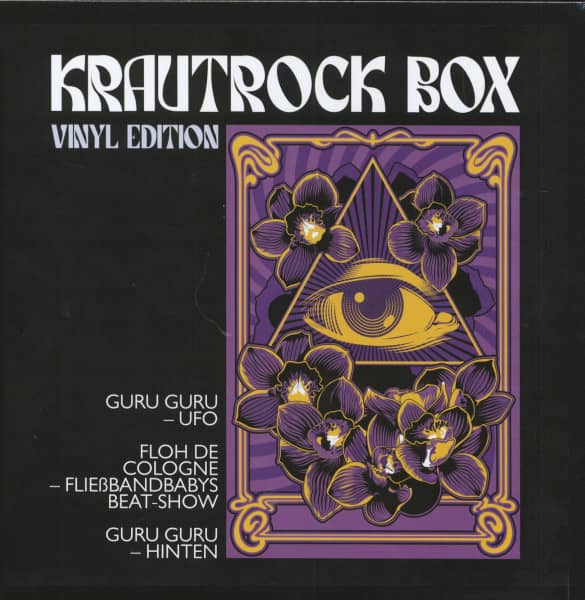
Guru Guru's debut ‘UFO’ finally appeared in autumn 1970: “This is our first record. A record is a product. Our music is a process. This is the user's manual for hearing us live” (PRESS RELEASE). In 1971 they moved to Langenthal, into the Gasthaus Zur Krone inn; there they lived together for a time in commune style and experimented extensively with hallucinogenic drugs. The second album was then produced in Hamburg under the direction of Conny Plank. ‘Hinten’ contained “acid-space music with long improvisations” (SOUNDS), but was “musically somewhat tighter, even if plenty of solos were still floating through the room” (GERMAN ROCK). In early 1972 Guru Guru went back into the studio with Plank to record their third album, ‘Känguru’, which was “filled with a certain cheerfulness. The pieces were an often very witty mix of styles, from marching music to Hendrix-style solo orgies. Guru Guru were fun and rhythm” (GERMAN ROCK). With this LP “the three free spirits of psychedelic krautrock delivered an almost perfect masterpiece” (TIP). “I don't play drums, I play and conduct an orchestra” (NEUMEIER).
Despite their growing success, bassist Trepte left the group and was replaced by Bruno Schaab (bass, vocals, ex-Night Sun). In early 1973 the three “great guys who would die for the fun of rock 'n' roll” (COVER TEXT) released the self-titled album, their last for the BRAIN label, again made under the direction of Conny Plank. Its absolute centrepiece was the track Der Elektrolurch, which from then on became the starting point of the live show. For it, the “clown” Neumeier ran around in a home-made mask, wore “wrestler-style combat trousers and hopped around his percussion instruments like a cannibal around the cooking pot” (PRESS RELEASE). The repertoire of this “incredibly rocking and densely pulsating record” (MUSIK EXPRESS) was the focus of numerous performances, such as the legendary ‘German Rock Super Concert 1973’ in Frankfurt's Festhalle in front of 6,000 people, alongside Amon Düül II, Atlantis, Birth Control, Nektar, Agitation Free, Passport and many others. In summer 1973 bassist Schaab left the band and was replaced by the Swiss Hans Hartmann (bass, piano). Also in 1973 the three “humorists and at the same time exotics of German rock” (ROCK IN DEUTSCHLAND) released their next album, ‘Don't Call Us We Call You’, their first for industry giant ATLANTIC.
The LP “isn't quite right and I don't like it any more” (NEUMEIER). A “big drawback was the strange singing and the constant continuation of the clowning around. Did the Gurus not want to be musicians, but comedians? Or comedians who make music?” (ZITTY)...
KRAUT! is a fine cross-section of krautrock in four volumes, sorted by region – North, Centre, South and Berlin – with the biggest hits, lots of long-forgotten music and the most important songs.
Burghard Rausch, June 2020
Copyright © Bear Family Records
Copyright © Bear Family Records®. Copying, also of extracts, or any other form of reproduction, including the adaptation into electronic data bases and copying onto any data mediums, in English or in any other language is permissible only and exclusively with the written consent of Bear Family Records® GmbH.
only 2x still available
Ready to ship today, delivery time** appr. 1-3 workdays

Item has to be restocked