
Who was/is Five Keys ? - CDs, Vinyl LPs, DVD and more
Five Keys
Here it is: the long-awaited unissued Five Keys session recorded in 1954 for RCA's Groove label just prior to their signing with Capitol. With four takes issued for the first time, this session represents the group at the top of their powers – just before they turned commercial. The Nitecaps may not have been as famous, but they certainly made a string of fabulous recordings for Groove. Here are eight of their best singles along with three great unissued songs.
The two groups featured here are undoubtedly gems of their kind. Originating from different regions of the USA, they both possess their own sound. While The Five Keys prepared the way to the pop charts along with their colleagues The Orioles, The Crows, The Chords, The Charms and The Penguins, The Nitecaps did not even reach the national R&B hit list – but this is certainly no measure of their talent.
Let us start in Detroit, Motor City, USA, with the almost unknown Nitecaps. In the pre-Motown years, the town's favourite R&B performer was John Lee Hooker. Jackie Wilson, as one of Billy Ward's Dominoes, was soon one of the main attractions of the city before becoming a star himself. With Chicago only two hundred miles away, heavy influences arrived via the Chess and Vee-Jay companies with groups like The Moonglows, Flamingos, El Dorados and Spaniels. The first Detroit label with an important vocal group output was Fortune Records, with The Diablos and The Don Juans in 1954. The Royal Jokers and later The Falcons were other groups emerging from Detroit.
Although scant facts are available on The Nitecaps and more than one line-up has been suggested, the most likely members were the three Hamilton brothers, Eugene 'Ronnie' (lead), Bob and Al (born 1938), along with Freddy Price. One thing The Nitecaps and The Diablos had in common was a sound that owed much to The Dominoes and the early Drifters. They tried to sound more pop-oriented and 'modern', especially with the jump tunes from their first session for Groove in November 1955. 'A Kiss And A Vow' resembles The Orioles' ballad style, most likely because Ronnie's tenor voice had the same high, soulful feeling as Clyde McPhatter's. With 'Snap, Crackle And Pop' and 'You're Gonna Be Sorry' from their second session (both issued here for the first time, together with takes different from the final masters), they gave us two distinctive jump tunes of the same musical quality. If you listen very closely to the vocal background on 'Snap, Crackle And Pop', you can hear the group singing the kind of nonsense syllables, 'doo-wop', that later gave this music its name. 'Bamboo Rock And Roll' from their third single fits exactly into the 'Ling Ting Tong' theme popular two years before, while 'You May Not Know' is a ballad par excellence.
The sound of the third and last session did not move towards songs popular in the fall of 1956, like 'See-Saw', 'Stranded In The Jungle' or 'Love, Love, Love', but went back to music popular two years earlier. 'In Each Corner Of My Heart' delights in much the same way as some Dominoes releases, with a heavy bass break and a high tenor. If you love the sound of Clyde McPhatter, you will also like 'Let Me Know Tonight', one of the two songs that recall the early Drifters' work. An almost exact replica of the Drifters' 'Honey Love' is presented here for the first time with 'Oh, You Sweet Girl', which probably stayed in the can for this very reason. (Another group to release a spin-off of 'Honey Love' were the Larks, with their late-1954 recording of 'Honey From The Bee' on Apollo.) On the fourth song from this session they backed Varetta Dillard (not included here).
Of all four fantastic releases on Groove, only two ('A Kiss And A Vow' and 'Bamboo Rock And Roll') entered a few local charts. Nevertheless, The Nitecaps must have been popular for some time, because Otis Williams (of Detroit's Temptations) remembered having seen them live: "... when I started going to the rock 'n' roll shows at the Fox Theater. For 98 cents or a dollar, you saw an amazing line-up ... There were times I got so caught up in listening to LaVern Baker, The Royal Jokers, Chuck Berry, The Nightcaps [as they were sometimes billed], Frankie Lymon and the Teenagers ... that my uncle would have to come ... looking for me." Being part of the audience at one of those fifties package tours must have been a thrilling experience. Of the Hamilton brothers, Al is well known to soul music fans as Al Kent, the name under which he entered both the R&B and pop charts with 'You Gotta Pay The Price' on Ric-Tic in 1967. When The Nitecaps broke up, he went to New York with his brother Ronnie to study music. He returned to Detroit in 1961 and started working for Golden World Records. Later he dealt with many artists on the Ric-Tic and Westbound labels and also wrote for Edwin Starr and Jackie Wilson. Ronnie, who sometimes appeared under the pseudonym Ronnie Savoy, later had success with MGM Records before producing Ben E. King.
The Five Keys' session for RCA's Groove subsidiary is quite a different story, but as so much has been written about the group, we will restrict ourselves to the main facts.
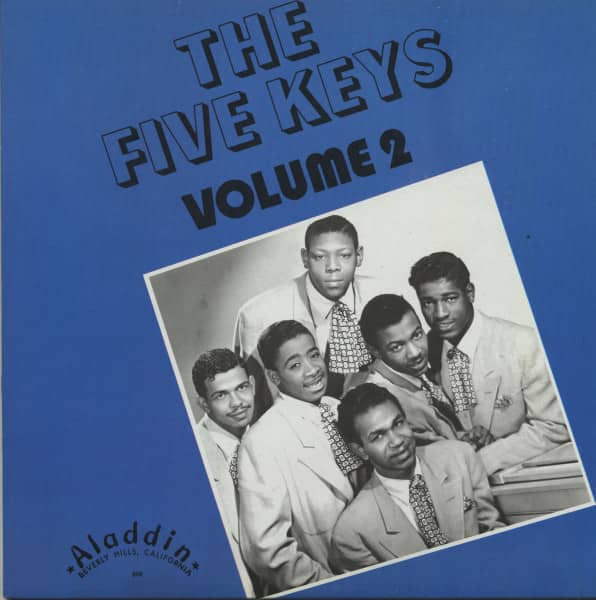
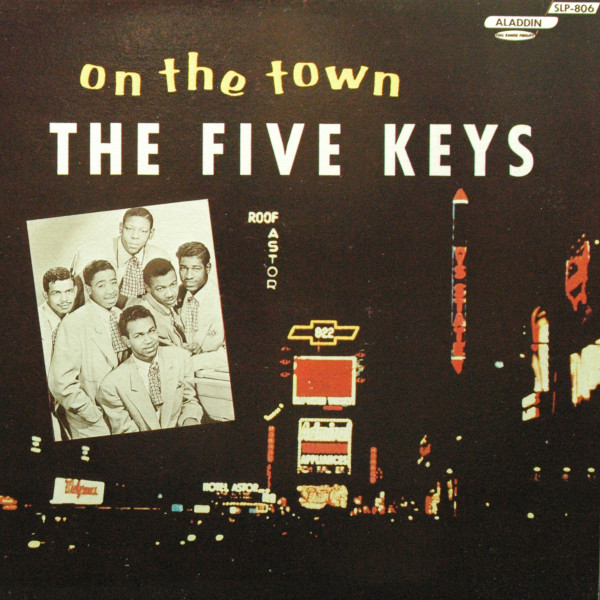
Originating in Virginia as early as 1946, The Five Keys secured their popularity with hits up until the late fifties. They recorded in New York, Los Angeles and Cincinnati, first for Aladdin, then for Capitol and King Records. Formed as the Sentimental Four, they consisted of Rudy and Bernie West and Raphael and Ripley Ingram. When Dickie Smith, a cousin of the Harptones' Willie Winfield, joined them, it led to their new name. Before their first record in early 1951, Maryland Pierce (from The Avalons) had replaced Raphael Ingram. Formed in the mould of the popular Orioles, their ballad patterns were similar until The Five Keys hit with 'Glory Of Love'. This led to more pop standards, with a few uptempo tunes thrown in. Rudy West was drafted from 1952 until 1955 and was replaced by Ulysses S. Hicks until Hicks' death in late 1954. Ramon Loper stood in for Dickie Smith from 1953 until early 1955, when Dickie returned from the service.
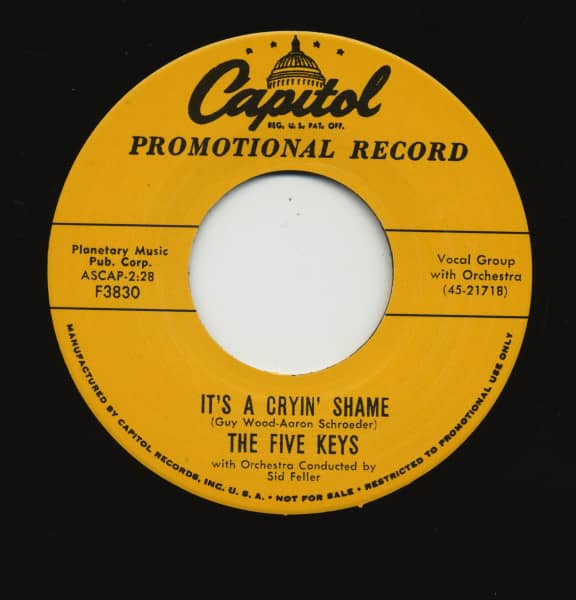
Having recorded in RCA's New York studios for years, they obtained a contract with Groove Records through the efforts of their manager, Sol Richfield. One session in July 1954 resulted, with four songs recorded. Meanwhile, it appears that their manager obtained a better deal with Capitol Records behind the scenes, as 'Ling Ting Tong' was released on that label in September. It also became the first hit for the company by The Five Keys, with many more to follow until 1959.
From: Five Keys & The Nitecaps – The Best Of Doo Wop Classics, Vol. 2
Copyright © Bear Family Records
Copyright © Bear Family Records®. Copying, also of extracts, or any other form of reproduction, including the adaptation into electronic data bases and copying onto any data mediums, in English or in any other language is permissible only and exclusively with the written consent of Bear Family Records® GmbH.

Ready to ship today, delivery time** appr. 1-3 workdays
Ready to ship today, delivery time** appr. 1-3 workdays

Ready to ship today, delivery time** appr. 1-3 workdays

Ready to ship today, delivery time** appr. 1-3 workdays
Ready to ship today, delivery time** appr. 1-3 workdays

only 2x still available
Ready to ship today, delivery time** appr. 1-3 workdays
only 1x still available
Ready to ship today, delivery time** appr. 1-3 workdays

Item has to be restocked