
Who was/is Eddie Constantine ? - CDs, Vinyl LPs, DVD and more
Eddie Constantine
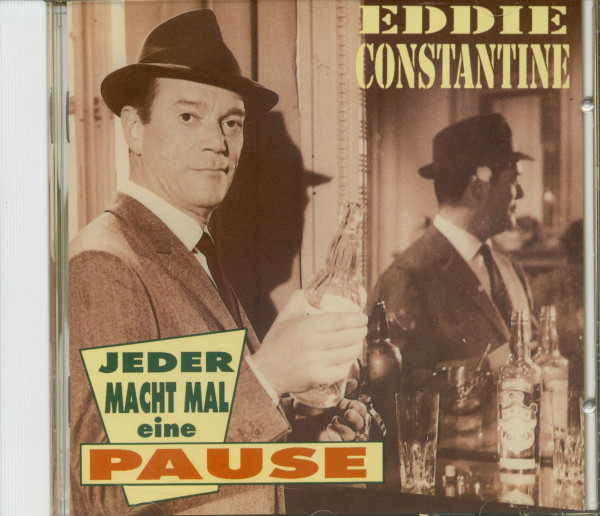
Born on 29 October 1917 in Los Angeles. Played in club combos, sang in the MGM film chorus and in New York was a member of the vocal group The Five Musketeers. In 1947 he accompanied his then wife, the Czech dancer Helinka Musilova, to Europe and stayed in France (citizenship since the 1960s). First film offers from 1952-53, among them the now cult Lemmy Caution crime films. At the same time he made records in Paris with the Belgian producer Jack Kluger. His films made Constantine very popular in Germany, which also boosted his career as a singer: no fewer than 19 German-language singles between 1953 and 1963 (Electrola, Ariola, Philips) turned him into an adopted Schlager star. In 1979 he married his third wife, the TV editor Maja Faber-Janssen. He lived in Wiesbaden, where Constantine died on 25 February 1993. Biggest hits: Ich wünsch dir einen schlaflosen Abend (12/56, No. 6), Jeder macht mal eine Pause (1/57, No. 9), Der Vagabund und das Kind (12/56, No. 10). From the Bear Family book “1000 Nadelstiche” by Bernd Matheja (BFB10025).
It takes a huge dose of irony for a man who was exempted from American military service as unfit to go on and play the hard-boiled agent and super-Rambo on the screen in post-war Europe. Eddie Constantine, born Edward Constantinowsky in Los Angeles on 29 October 1917, had actually had a career as a singer in mind. The descendant of a Moscow opera singer was sent by his father to the conservatory in Vienna as early as 1933. Two years later he was drawn to New York, where he devoted himself to popular music. As a chorus singer he accompanied stars such as Louis Armstrong and Frank Sinatra on tour, and in 1941 he was hired for the chorus of New York's Radio City Music Hall. It is hard to imagine that the guy with the knock-'em-down expression on his pockmarked face was turned down by the military on grounds of 'frailty'.
But in his French Lemmy Caution films he then did everything he could to polish up his image. He came to Europe because of an engagement of his wife Helene Mussle, a Czech dancer who was appearing with the 'Ballet Russe' in London. That was in 1947. After the London performances Helene danced as prima ballerina for the French choreographer Roland Petit, and the Constantines stayed in Paris. In German Schlager he counts among the incomers, like Kenneth Spencer or Bill Ramsey. He made his first German recordings in Cologne in 1953, where in 1955 he also sang Schenk deiner Frau (doch hin und wieder rote Rosen) at the Electrola studio. The producer was Nils Nobach, who had already discovered the Swedish export Bibi Johns and was calling the shots at Electrola at the time. On the red-roses Schlager Eddie Constantine for once didn't play the tough guy but presented himself as a man who understands women. He pulled this off particularly well because he delivered the lyrics with a slight French accent.
For that reason many people in Germany at the time took him for a French chansonnier. The gist of his little song only reinforced this impression: every woman knows perfectly well, it tells us, that only a man who likes to think of her will give her flowers. And it doesn't always have to be roses – anemones, carnations and mimosas will do just as nicely. Eddie knows that flowers bring happiness into the home. With German titles such as Ich wünsch dir einen schlaflosen Abend, Der Vagabund und das Kind and Jeder macht mal eine Pause he repeatedly made the Schlager charts over the next few years. His success was boosted by German films such as 'Hoppla, jetzt kommt Eddie' (1958) and 'Bomben auf Monte Carlo' (1959). In the latter he served up a second helping of Hamburg's own Hans Albers, whose songs, such as Das ist die Liebe der Matrosen, he also sang in the film. 'Der Spiegel' wrote of him: “His face was always years ahead of his age; even at 35 he looked like someone who had his whole life behind him.”
From 1969 onwards he was able to revive his film career when Peter Lilienthal ('Malatesta') and Rainer Werner Fassbinder ('Warnung vor einer heiligen Nutte') offered him roles. After that he kept turning up in German theatre and television, and by then he had settled in Wiesbaden with his third wife. He died there on 25 February 1993.
Copyright © Bear Family Records
Copyright © Bear Family Records®. Copying, also of extracts, or any other form of reproduction, including the adaptation into electronic data bases and copying onto any data mediums, in English or in any other language is permissible only and exclusively with the written consent of Bear Family Records® GmbH.
Ready to ship today, delivery time** appr. 1-3 workdays

This article is deleted and can no longer be ordered!