
Who was/is Butch Cage ? - CDs, Vinyl LPs, DVD and more
Butch Cage
In the rural communities of Slim Harpo's youth, many local people played an instrument in their spare time, and one of the best known was the diminutive Willie B. Thomas, born in West Baton Rouge in 1912 on the same Bellmont Plantation as Harpo. Thomas suffered a twisted back when crushed by furniture as his family moved across the river to Zachary, north of Baton Rouge. While he worked odd jobs, he learned kazoo as a teenager and guitar and banjo in his twenties, playing in the '30s and '40s at Saturday suppers and developing a repertoire of blues, spirituals, hillbilly and popular songs. Then he heard a calling to teach the gospel, and spent many years working the streets as a singing preacher.
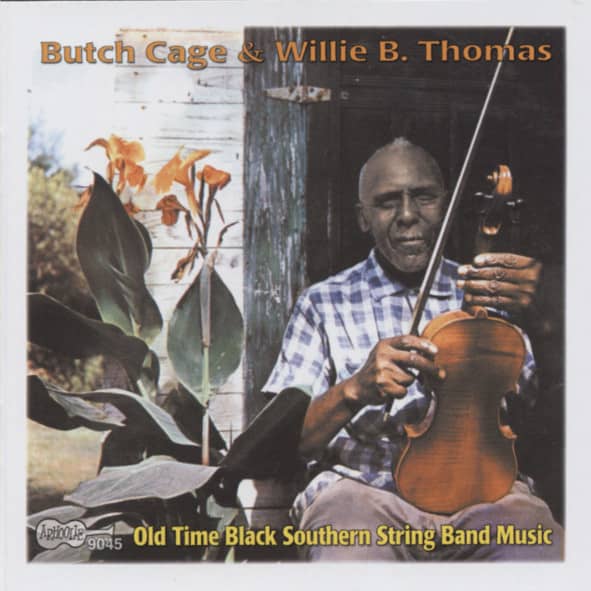
By the '30s Thomas teamed up with a fiddle player, James Cage, known as 'Butch,' born in 1894 in Franklin County, Mississippi. He said he had mastered the fiddle and the fife, both well established in the folk music of black Mississippians, by the time he was 17. 'All of my folks was some sort of musician,' he remembered. He recalled playing church songs, field songs and popular songs at dances for both black and white gatherings.
In 1927, after the great flood of that year, Cage joined his brother in Zachary to farm. He played music at local parties while by day he worked odd jobs on the farms, the railroads and in Baton Rouge. He retired in 1960 from his day jobs, around the time he and Thomas came to the attention of Harry Oster, who described Cage's syncopated fiddle music as a rare survival of a now virtually extinct nineteenth-century fiddle tradition. Cage played the fiddle down on his chest, sawing sideways, while Thomas, clad in a big black hat and a sober black suit, unlike many devout performers of his background saw no harm in singing secular songs such as the blues.
Together, Cage and Thomas made memorable music for Oster and gained limited fame in the folk world through his 1959 LP 'Country Negro Jam Session,' a disc that sought to capture older rural forms in contrast to the recordings of EXCELLO and other labels aimed at the current R&B market and the jukebox trade. On their recording of 'Who Broke The Lock,' Thomas explains how local people hid their whiskey in unusual places like the henhouse, but this was not a local song; it had been recorded far earlier.
Copyright © Bear Family Records
Copyright © Bear Family Records®. Copying, also of extracts, or any other form of reproduction, including the adaptation into electronic data bases and copying onto any data mediums, in English or in any other language is permissible only and exclusively with the written consent of Bear Family Records® GmbH.
Item has to be restocked