
Who was/is The Byrds ? - CDs, Vinyl LPs, DVD and more
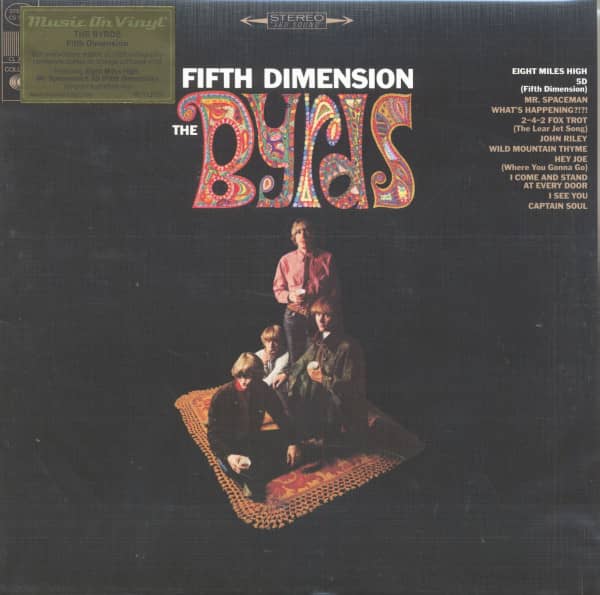
The Byrds
Among folk rock fans, the Byrds are regarded as the inventors of the genre. To groups such as the Eagles, the Doobie Brothers and Crosby, Stills, Nash & Young they remain role models to this day. The group was founded in 1964 by guitarist Roger McGuinn (born 13 July 1942 in Chicago). The other members back then were Chris Hillman, Gene Clark, Michael Clarke and David Crosby. Their first hit, 'Tambourine Man', was a Bob Dylan composition and in 1965 caused an uproar among folk devotees – the Byrds were the first group to dare play this music on electrically amplified instruments.
In 1967 the Byrds split for musical reasons, and since then they have no longer played a major role. David Crosby (born 14 August 1941 in Los Angeles) soon joined Crosby, Stills, Nash & Young. Gram Parsons and Clarence White came in as new members, and Roger McGuinn tried to stave off the group's demise, but did not succeed. The hits dried up, and other, newer folk rock groups carried on where the Byrds had left off.
When White died in July 1973 and Gram Parsons two months later, Roger McGuinn gave up. He concentrated on a solo career. Even so, the Byrds are still unforgotten today, and their records are already classics of folk rock.
Original press release: CBS Schallplatten GmbH
'Sweetheart Of The Rodeo' was neither hailed as a classic nor seen as divisive on its release on 30 August 1968. It alienated the Byrds' core audience without finding a new one. Bob Dylan's 'Nashville Skyline', released eight months later, was by contrast celebrated as boldly iconoclastic and became a bestseller. By February '68 Gene Clark, Michael Clarke and David Crosby were gone, leaving only Roger McGuinn and Chris Hillman as the Byrds. Hillman met Gram Parsons and invited him to join as a backing musician rather than as a member of the group.
McGuinn had a vision for the Byrds' new LP, but Parsons overrode it. "We hired a piano player and he turned out to be Parsons, a monster in sheep's clothing," McGuinn told Fusion magazine. "George Jones in a big sequinned suit." Both McGuinn and Hillman were well versed in folk and bluegrass, so country was not as big a leap as McGuinn suggested. Hillman's cousin, drummer Kevin Kelley, rounded out the new Byrds; they found twelve songs, got their hair cut and drove to Nashville. They recorded for a week with a few session men and guests, among them John Hartford and steel guitarist Lloyd Green. The Opry appearance at the end of the week was an omen that not everything would turn out well, but the trouble had started even before that. Lee Hazlewood had the International Submarine Band under contract and considered Parsons bound by that contract. Some of Parsons' vocals were replaced, so that he could be heard as a guest singer on only a few songs.
The album credits were cryptic, listing all the musicians in the 'Thanks to' credit line normally reserved for the dope dealer. Shortly before the release the Byrds toured Europe before setting off for South Africa. Parsons cited the South African dates as his reason for forming the Flying Burrito Brothers, although the real problem may have been that he had just heard the test pressing. "They chopped up the album however they wanted," he told Bud Scoppa. "I wasn't there when they chopped it. This cat, Gary Usher, decided it should be Hollywood crazy. It was a serious country album. A great album that might just as well never have been recorded." For his part, Usher said that the LHI contract problems were resolved during the week in Nashville and that some of the vocals were redone at McGuinn's insistence, to reduce Parsons' footprint. The LP cover, a detail from Jo Mora's poster for the 1933 Salinas Rodeo, was a stroke of genius.
'Sweetheart Of The Rodeo' included two new Dylan songs, but the high point was Parsons' achingly sweet lament for his South of dreams and memories, Hickory Wind. Chris Hillman's high harmonies were exquisite. Parsons' collaborator Bob Buchanan of the International Submarine Band said they wrote it on a train journey from Florida back to Los Angeles, shortly before Parsons joined the Byrds. "We were a bit tired of Hollywood," said Buchanan. "I had gone back to Michigan to see my parents, and Gram had gone back to see his family in Florida. I got myself a sandwich in the dining car and came back to the compartment. Gram had his guitar out and was working on the beginning of 'Hickory Wind'. We had both been back home, back in a simpler time, and suddenly we were on our way to Hollywood. We were in a bad mood." Buchanan wrote the second verse, the one about starting out younger. "Of all the people in my high-school class," he said, "how many got out and did what I did? By the time I was 19 I was on the road having adventures. Fancy sports cars and motorbikes at my house in Hollywood. I had all that and I was still broke.
What more can life bring? Big deal with all the riches and pleasures – that wasn't the answer." After Parsons' death the song was regarded as the sum of his art. But then rumours surfaced that, as a young folkie in Greenville, South Carolina, he had poached the song from a blind folk singer, Sylvia Sammons. According to researcher David W. Johnson, Sammons lived in Highlands, North Carolina. Some remember her singing Hickory Wind as early as 1963, when Parsons was in the Carolinas, and of course North Carolina is associated with the hickory tree, whereas Parsons' home state of Florida is not. She heard not the Byrds' recording but Joan Baez's 1969 cover version. According to some of those around Sammons, she has a copy of the song that she had mailed to herself in an envelope that is still sealed (an age-old way of copyrighting a song), and she received a one-off payment.
And so the story ends with a question mark. Sammons still insists that she wrote it. Parsons may have thought he was adapting a traditional song, but he never gave Hillman or McGuinn any indication that it was anything other than his and Buchanan's work. Buchanan got out of music and worked for General Motors until he retired, but still insists that he wrote the second verse – which he probably did.
Copyright © Bear Family Records
Copyright © Bear Family Records®. Copying, also of extracts, or any other form of reproduction, including the adaptation into electronic data bases and copying onto any data mediums, in English or in any other language is permissible only and exclusively with the written consent of Bear Family Records® GmbH.

Item has to be restocked

Item has to be restocked
Item has to be restocked
only 2x still available
Ready to ship today, delivery time** appr. 1-3 workdays
only 1x still available
Ready to ship today, delivery time** appr. 1-3 workdays

Item has to be restocked
Item has to be restocked

Item has to be restocked

Item has to be restocked

Item has to be restocked

Item has to be restocked
Item has to be restocked