
Who was/is Fred Bertelmann ? - CDs, Vinyl LPs, DVD and more
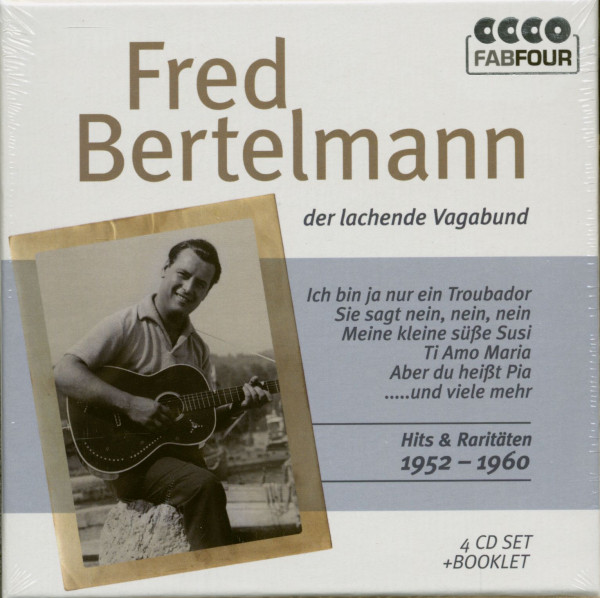
Fred Bertelmann
The future hardly looked rosy for Fred Bertelmann when, in 1952, he signed a contract with the small Tempo company, which supplied department stores with low-priced records. The label's repertoire consisted of successful Schlager songs that had already been recorded by the big stars of Polydor, Philips, Electrola or Teldec. The job of Bertelmann and his colleagues was to rush a copy onto the market for Tempo so that the label could share in the success of these songs.
Still, the singer, born in Duisburg on 7 October 1925, at least had a foot in the door of show business. And he had what it took. Against the wishes of his mother, who would have liked to see little Fred become a great doctor, he insisted on pursuing music after finishing school and enrolled at the Duisburg Conservatory to study trumpet, harmony and music history. Before he could graduate, he was called up for military service and ended up as a prisoner of the Americans.
As a 'prisoner of war' he founded an orchestra with fellow inmates in the camp in Alabama. Back in Germany, Fred Bertelmann single-mindedly pursued his career as an entertainer, which led him from a band with the Egerland musician Ernst Mosch and a detour into the Pepo de Seato show orchestra to, finally, the Charly Schiele Combo. At a concert in Travemünde he was discovered for the record business by an associate of Michael Jary. Once his Tempo recordings were being played on the radio, Fred Bertelmann was allowed to sing songs of his own instead of the usual copies. That earned him a contract with Electrola in Cologne in 1955. His first successes came with Tina Marie, a version of the American Perry Como hit which that same year also became a hit for Die drei Travellers, then as a parody (1957) and in yet another version by Fred Frohberg on the East Berlin Amiga label – and with In Hamburg sind die Nächte lang.
'In Hamburg sind die Nächte lang' was the title of a film starring Barbara Rütting that premiered in West Germany in February 1956. And the song Karl Bette wrote for it actually sounds like film music – unlike so many movie Schlager of the period. Bette, who also wrote Zum Abschied reich ich dir die Hände, worked as a composer on many screen productions, for example 'Der Schmied von St. Bartholomae', 'Zwei Herzen und ein Thron' (both 1955), 'Der Glockengießer von Tirol' and 'Wo der Wildbach rauscht' (both 1956). His Hamburg song, with lyrics by Hans Bradtke (Pack' die Badehose ein), shows the practised routine of an expert. Naturally, Fred Bertelmann sings that the girls in Hamburg are pretty and only really come alive at night.
But for once the city on the Elbe is not defined by its harbour alone: the song also tells of moonlight falling on the Alster and making you forget the whole world. The quality of In Hamburg sind die Nächte lang was recognised across the ocean as well. When the King Sisters were signed by Capitol Records in 1957, they recorded the song not only under its German title (and partly with the German lyrics) but also with exactly the same arrangement (including the whistled intro). The female chorus of the Hansen Quartet on Fred Bertelmann's recording may have given the American sisters the idea. The English lyrics, however, are considerably more flirtatious: the German line asking a girl to come along and not be afraid became, with the King Sisters, a line about taking a 'Fräulein' by the hand, and at the end the listener is asked whether he would like to get 'gemütlich' with them. After Tina Marie, Fred Bertelmann stayed loyal to the fair sex with Meine kleine süße Susi and Marie mit dem frechen Blick.
But it was only when he decided in 1957 to sing about the laughing vagabond that he really made it. With it he gave his record company Electrola its first post-war million-seller. The composition by the American Jim Lowe (Green Door) had come a long way before it reached Germany. Country singer Rusty Draper took the song into the American charts as Gambler's Guitar in 1953. That recording already featured the laugh that Fred Bertelmann later made the trademark of his interpretation. Also from 1953 is the version by the American RCA artist Jack Turner, who that same year had already recorded the Leiber-Stoller number Hound Dog, which Elvis Presley later made world-famous. Two years later RCA in Italy released an Italian version – Dillo Chitarra – by Paolo Bacilieri, whose arrangement served as the model for the Bertelmann hit. According to Electrola's company history, the German lyricist Peter Mösser heard Gambler's Guitar while on holiday and enthusiastically wrote German words for it. Whether he heard the American original or Dillo Chitarra remains unclear; he probably had both versions at hand.
Gerhard Wendland (Vagabundenlied) had already sung about the roving lover for Schlager fans. Der lachende Vagabund now became such a sensational hit that the record company came up with a publicity gag: on the millionth single, Fred Bertelmann started the song only to announce straight away that he himself could soon no longer stand hearing the laughter. He assured the buyer of that record, however, that he had good reason to laugh, because by presenting the single at a record shop he could win a trip to Electrola in Cologne and to the singer's home in Ruhpolding. The singer no longer lives there, and buyers of the Bear Family Records CD Der lachende Vagabund (BCD 15 753 AH), which includes this recording, should not call Electrola either, which is no longer based in Cologne – the prize was awarded long ago. “That song made me rich and famous,” Bertelmann still sums up today. And not only him: together with NDR orchestra leader Franz Thon, Peter Mösser also wrote the B-side of the single and so cashed in twice. It surely didn't hurt that he was married to Ilse Rehbein, the NDR editor responsible for Schlager. From there, Der lachende Vagabund was cheerfully sent out over the airwaves.
A film of the same title followed, with Cornelia Froboess, Ralf Bendix and Fred Bertelmann (in the title role), and for ten years he remained a presence in cinemas. In 1966 he married the actress and television announcer Ruth Kappelsberger and moved with her to Lake Starnberg. TV appearances and guest engagements abroad, above all in America, for instance in the musical 'Showboat', continued to shape his 'vagabond life'. In 1972, together with Gitta Lind, he founded Germany's first show school in Munich. Most recently he made more headlines with his private life, divided between his wife and his partner. He is a recipient of the Federal Cross of Merit.
Copyright © Bear Family Records
Copyright © Bear Family Records®. Copying, also of extracts, or any other form of reproduction, including the adaptation into electronic data bases and copying onto any data mediums, in English or in any other language is permissible only and exclusively with the written consent of Bear Family Records® GmbH.

Ready to ship today, delivery time** appr. 1-3 workdays

only 1x still available
Ready to ship today, delivery time** appr. 1-3 workdays

This article is deleted and can no longer be ordered!

Item has to be restocked
This article is deleted and can no longer be ordered!